
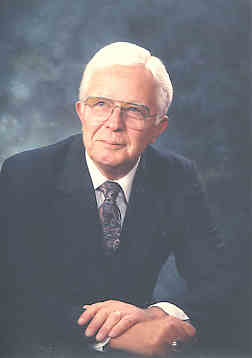
The late Homer Hoeksema was professor of Dogmatics and Old Testament in the Protestant Reformed Seminary.
Paradise the First was the earthly tabernacle of God with man. It was a real garden, the particular dwelling place of man, God’s covenant friend, in the state of righteousness. In the midst of the garden God dwelt with man. Moreover, man was at home in the garden. Twice we read that God “put” man in Paradise (Gen. 2:8, 15). This refers to an act of God whereby He so established Adam in the garden that he understood his position and calling and was able to perform it. He was not a stranger in his environment, but the proper relation was established between him and his surroundings.
In the midst of the garden was the tree of life. Thus we are informed very briefly in Genesis 2:9: “And out of the ground made the Lord God to grow every tree that is pleasant to the sight, and good for food; the tree of life also in the midst of the garden, and the tree of knowledge of good and evil.” Of this tree of life man might freely eat. For the Lord God commanded him, “Of every tree of the garden thou mayest freely eat.” The only exception to this was the other special tree, the tree of the knowledge of good and evil, of which man was specifically forbidden to eat (Gen. 2:16, 17). This is also plain from the fact that after man’s fall into sin he was barred from the tree of life (Gen. 3:22-24).
The question is: What was the significance of this special tree, the tree of life?
Various interpretations of the tree of life have been given.
According to some, the tree of life would actually have the power to give man eternal and glorious life. That is, it would not merely have the power to perpetuate Adam’s earthly existence in Paradise the First; but it would be able to give Adam eternal life in the qualitative sense of that term, heavenly life, eternal life as the Christian obtains it through our Lord Jesus Christ. However, there are some grave objections to this explanation. For one thing, this theory overlooks the fact that Adam was of the earth, earthy, and that as such he was perfectly content and happy as God’s covenant friend in the state of rectitude in the midst of the earthly creation, and that he would have had absolutely no desire for anything other than that only and perfect happiness which he knew.
Secondly, this theory presupposes that there might have been another way to the glory of eternal life than through our Lord Jesus Christ. In other words, in the divine economy of things the sending and death and exaltation of God’s Son in the flesh were actually unnecessary, except as a secondary way to eternal life. Eternal life could have been attained by Adam. If this were true, it was really a shame that Adam ever fell: the deep way of the suffering and death of our Lord Jesus Christ could have been avoided — I mean, not by man, but by the Lord our God. But let us look at this explanation of the tree of life from the point of view of that tree itself. This theory attributes spiritual power, the power to accomplish a spiritual change, to what was evidently a physical tree with physical fruit and physical energy of some kind. Besides, it is evident from Scripture that even after Adam and Eve had sinned, the tree, if they had eaten of it, would have produced its effect. This is plain from Genesis 3:22-24: “And the Lord God said, Behold, the man is become as one of us, to know good and evil: and now, lest he put forth his hand, and take also of the tree of life, and eat, and live for ever: Therefore the Lord God sent him forth from the garden of Eden, to till the ground from whence he was taken. So he drove out the man and he placed at the east of the garden of Eden Cherubims, and a flaming sword which turned every way, to keep the way of the tree of life.”
Others have explained the tree of life as a mere sacrament. This, according to them, is the whole significance of the tree of life. With respect to this view, we must remember that while there was a certain sacramental character to this special tree, it can hardly be maintained flatly that the tree of life was a sacrament. For, in the first place, a sacrament, in order to be a sacrament, must always be instituted as such. Sacraments are directly appointed by our Lord as holy, visible signs and seals. Thus it is with the sacraments of baptism and of the Lord’s Supper: they have been directly ordained by the Lord Jesus Christ to be observed by His church. But thus it was not with the tree of life. The tree of life was merely a gift.
In the second place, it is important to remember that sacraments do not have power in themselves, apart from the grace of God. The water of baptism is not itself grace, but a means of grace. The bread and wine of the Lord’s supper do not in themselves impart grace to those who eat and drink them. But it is evident that this was true of the tree of life, and that, too, even after Adam and Eve had sinned. There was a certain power and efficacy in that tree itself.
Still others explain that the tree of life was such that it would give perpetual strength to the physical nature of man. This is certainly correct, in the light of Scripture. Yet this does not explain the tree of life fully.
We would explain the significance of the tree of life as follows:
1.That tree and its fruit had the power of giving perpetual, earthly life to man in as far as he had been taken from the ground. This is very plain from Genesis 3:22-24, the passage already quoted above. That tree had this power to supply man with perpetual, earthly life even after he had sinned, so that it was necessary to bar the way to the tree of life. In this connection, it seems evident also that this eating of the tree of life was not simply a once-for-all matter, but that it would be necessary to eat of this tree continually and repeatedly. You must remember that man had not been created so that he could not die and return to the dust. To be sure, there was no death in the state of rectitude. Death is not a natural process, but it is the visitation of the wrath and curse of God. But this does not mean that the first man, Adam, was immortal. Man was created fallible and mortal. He was taken from the dust of the ground, and as such he was mortal. It was possible for him to become subject to death. He was, indeed, not subject to death; but he was, so to speak, “die-able.” For that mortal man, it was his connection with the tree which, in the positive sense of the word, invigorated his earthly life with that strength which made him victorious over all possibility of decay and death. Such was the significance, first of all, of the tree of life.
2.As such, the tree of life was a symbol to Adam of the gift of life: perpetual, earthly life. We must remember the nature of the tree in general. The tree transforms the earth into living and life-yielding fruit for the living soul. Man is of the earth, earthy. As such, he is dependent upon the ground from whence he was taken for his life. But he cannot live directly from that ground. The tree forms the connection between man and the ground, transforming, as it does, the substance of the ground into food for man. In the fruit trees, therefore, God opened His hand to give life to man and beast. Among all those trees there was one tree that was set aside: it was the tree of life, which was distinct in this, that he who ate of it would never lose his earthly life. That tree of life, therefore, was the symbolic representation of God opening His hand to give life unending, that is, perpetual earthy life, to Adam.
3.It is in this connection that we may discern something of a sacramental character in the tree of life, even though it cannot be called a sacrament in the full sense. It was an emblem, a sign, of God’s covenant. It was a kind of visible and tangible sign of God’s favor and of that higher aspect of Adam’s life which consisted in the knowledge of and fellowship of God. This is suggested by several scriptural facts. In the first place, it is suggested by the very name “tree of life.” In the second place, it is suggested by the antithesis of the tree of life in the tree of the knowledge of good and evil, which also had special significance, as we shall see. In the third place, it is suggested by the fact that Adam might eat of this tree only in the way of obedience, so that when he sinned, the way to the tree of life was closed. Finally, it is suggested by the fact that Scripture speaks in connection with the heavenly tree of life of “the right to eat of the tree of life” (Rev. 22:14).We must remember that the tree of life was more than a mere physical means for the extension of man’s physical existence. It was the tree of life. Even though Adam’s life was earthy, nevertheless life also for Adam implied the favor and fellowship of God, his Creator-Lord. Now, if in this connection we remember that the tree of life was in the midst of the garden, in the very heart of Paradise, we might say that according to the analogy of the temple, the tree of life was in the holy of holies. There, in the midst of the garden, where the tree of life was, dwelt God. There He met man in the wind of the day. To approach the tree of life, therefore, before the Fall was to approach God. As long as Adam could draw near to God, in order to enjoy His fellowship and communion, he could have life. That tree preached this to Adam: “To live apart from God is death; ’tis good His face to seek.”
Such, briefly, was the significance of the tree of life in Paradise the First.
But that tree of life is no more. We must remember that it never was destined to remain, but only to serve for a moment at the dawn of history, and that, too, in connection with the whole of God’s purpose in Christ which was to be achieved through the course of history.
First Adam, and we all in him, became separated from that tree of life. Adam was sent forth from the garden, and cherubim were stationed at the east (the entrance) of the garden, and a flaming sword turning every way, so that the way to the tree of life was closed, barred, absolutely.
The question is: why? And the answer is that if Adam had remained in connection with the tree of life, he would have perpetuated his earthly existence, but his earthly existence in sin, without God. Then there would be no redemption possible for him. Adam must lose that life. He must lose that earthly life, and he must lose that earthly life especially as it became subject to sin and as it was without God. As it was with Adam, so it is with all God’s people. They must lose this present, earthly existence, this life without God in the world. They must not cling to this life, an existence apart from the favor and fellowship of God. Indeed, “to live apart from God is death; ’tis good His face to seek.”
But in that case would it not exactly be a good thing for Adam to approach the tree of life? If he again approached the tree of life after he sinned, would he not be approaching into God’s communion? And was not that what he needed? The answer is, in the first place, that Adam through his sin, and we in him, had lost the right to eat of the tree of life as the symbol of God’s communion. In the second place, God was gone! After the Fall, the tabernacle of God was no longer with men in Paradise. That Paradise would never again be God’s tabernacle. As a house of God with man, it was empty. Nor was it God’s purpose to return to that earthly tabernacle and to restore it. He purposed to build His tabernacle, His covenant dwelling with man, in Christ Jesus. In Christ Jesus, the Son of God incarnate, He would establish His tabernacle in the fullness of time, in order to realize it fully in the new heavens and the new earth in the day to which we now look forward, when finally His Word shall be fulfilled: “Behold, the tabernacle of God is with men, and he will dwell with them, and they shall be his people, and God himself shall be with them, and be their God” (Rev. 21:3).
For a time that first Paradise and its tree of life remained on the scene of history. But it remained only as a silent, yet highly vocal testimony. It remained as gospel-preaching. God did not remove it immediately. We must remember that at that early stage in history God’s people were without the full and clear light of the gospel. God spoke to His people in sundry ways. One of those ways was through Paradise and its tree of life, the way to which was closed. That tree of life preached: “You must die. And yet there is hope. For in connection with the promise, I, the earthly tree of life, to which you can never return and to which you must not desire to return, point forward to a better tree of life which is to come.”
For we must not forget: God had better things in store for us. It was His purpose to unite all things in heaven and on earth in Christ, in the glorious and heavenly new creation. With a view to that purpose all things were adapted from the beginning with a view to the end. Thus the earthly creation is an image of the heavenly. In the things earthly are so many parables, so to speak, of heavenly things.
Thus Paradise the First was an earthly picture of the heavenly Paradise, the new and eternal kingdom of God in Christ. Adam was a picture of the second Adam, Christ, the Head of the new, united creation. The midst of the garden is an image of God’s communion with man. The river is an image of the flow of life from God in Christ eternally to His people. The tree of life is a picture of the heavenly tree of life. The vision of that heavenly tree of life is recorded for us in Revelation 22. There you find the picture of the river of water of life, clear as crystal, proceeding out of the throne of God and of the Lamb. The tree of life is pictured as bordering that river on either side, bearing twelve manner of fruits, and yielding her fruit every month. The leaves of the tree are for the healing of the nations. What the reality of this vision shall be concretely, we cannot say. We must wait until that time arrives. But certainly, it is evident that the heavenly tree of life represents the means of eternal life from God in Christ. In Christ God’s Word is: “Behold, I make all things new!”

