
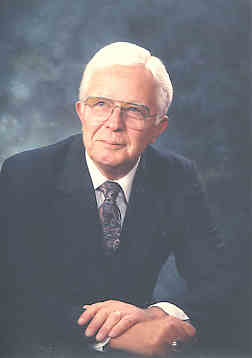
The late Homer Hoeksema was professor of Dogmatics and Old Testament in the Protestant Reformed Seminary.
But to return to the immediate subject of discussion, it is in the light of this principle (namely, that man lives, not by bread but by the Word of God — Ed.) that we can properly understand the name of this tree, which, in turn, stands very closely related to the purpose of the tree in Adam’s life and in the history of the covenant of God. Scripture calls the forbidden tree “the tree of knowledge of good and evil.”
We note at once that this is a very peculiar name. The tree is not named according to its fruit, whatever the nature and appearance of that fruit may have been. Thus we identify trees: we speak of a peach tree, or a pear tree, or an apple tree. Of such kinds of trees there must have been many in Paradise the First, offering to Adam the fruit of the ground for the sustenance of his earthly existence as a creature who was taken from the dust of the ground. Undoubtedly also the tree of which Adam was forbidden to eat bore its own fruit, a fruit which in itself and apart from God’s prohibition was good. It is striking, however, that Scripture does not even trouble to satisfy our curiosity as to how the tree looked and what kind of fruit it produced and how that fruit tasted to Adam and Eve when they ate of it. In fact, Scripture does not call the tree by its fruit at all. The tree is named in Scripture from the point of view of its meaning and significance for man, and that, too, in connection with the commandment of God which was attached to it. It was “the tree of knowledge of good and evil.”
What does this mean?
The evolutionistic conception of this tree is that it serves to bring man to moral consciousness and self-consciousness, or pictures man as having evolved to that state. According to this theory, the story of the tree is not literally true. Yet there is a deep spiritual meaning in it all. The meaning is that man was a sort of animal, or as yet a half-animal. He was without moral conception and moral consciousness. Good and evil did not mean anything to him as yet. But somehow he developed moral consciousness and a conception of good and evil. This is then the meaning of the narrative of the tree of knowledge of good and evil.
Here you have an illustration of the fact that the issue in evolutionism and the question of the literal or non-literal character of the Genesis account is certainly not a merely academic question concerning some insignificant facts. Nor is it merely a question concerning origins. But the truth about man, about the fall, about sin, and therefore about grace, about Christ, about redemption, about salvation, about the consummation of all things, about heaven, about hell — all these truths are inevitably at stake in this controversy about the philosophy of evolutionism and in those theories which deny the reality and historicity of the matters concerning which the book of Genesis informs us. Take note of the fact that a theory like this is destructive of the entire scriptural doctrine of man. Man, then, was not created a rational, moral being: he developed into one. He was not made morally good: he is as yet evolving into such a good being, he is on the way. Thus it is also with respect to the doctrine of sin. Morality and immorality, goodness and sin, religion and impiety — all these have no objective standard, and are not a matter of the will of the sovereign Lord of heaven and earth; no, they are strictly relative, the product of a long process of evolution, and determined by the evolving man in society. The fall has no reality, then, for man never fell, but he is always on the way upward, from good to better to best. As surely as sin and the fall have no reality, so surely a different content must be poured into such scriptural concepts as Christ and grace and redemption and salvation.
Over against all such philosophy stands the plain Word of God that man was created good and after God’s image, that he stood originally, as he came from the hand of His Creator, in righteousness and true holiness, possessed of the true knowledge of God, of God’s will, and of his own relation to God and to all things, and that he certainly knew the good by experience from the moment that he first gazed upon God’s creation, and was able to recognize and did recognize the evil when he met with it.
Another presentation would find the meaning of the name “tree of knowledge of good and evil” in the fact that this tree served to make man know good and evil by experience through eating of it. This idea is based on what we read in connection with this tree after man’s fall into sin, as recorded in Genesis 3:22: “And the Lord God said, Behold, the man is become as one of us, to know good and evil.” But the meaning there is not that heretofore Adam and Eve were in a condition of childish innocence, that they were naive with respect to good and evil, and that through eating of the tree they learned to know good and evil by experience. For again, as we said before, man was created in true knowledge of God, righteousness, and holiness, having been created in the image of God. As such, he certainly knew the good by experience; and he positively delighted in it, performed it, and tasted life in the fellowship of God. Moreover, he was created with the ability to recognize the evil when he met with it; and when he was confronted by the divine prohibition to eat of the tree, he actually did recognize the violation of that command as evil.
Besides, in the second place, this explanation of the tree is directly contrary to Scripture. Man was emphatically commanded not to eat of the tree. In this light the name “tree of knowledge of good and evil” could hardly denote that this tree was to make man know good and evil by eating of the forbidden fruit.
Nor, in the third place, is that the meaning of the text in Genesis 3:22. That text rather points to man’s sin and fallen estate. The words “man is become as one of us, to know good and evil” point to the fact that man, heeding the lie of the devil, has sinfully assumed such a likeness with God as to determine and to know for himself what is good and evil.
What, then, positively speaking, is the meaning of this name of the tree?
That name implies, in the first place, in connection with the command of God attached to it, that it is not man’s lot, but God’s prerogative to determine what is good and what is evil. It is man’s calling simply to listen and obey. God, the Creator, is sovereign; and man, the creature, is servant. God’s alone is the sovereign prerogative to determine what His servant shall do and what he shall not do, what is good and what is evil.
Thus, in the second place, the name of this tree denotes that by not eating, that is, by the way of obedience, man would truly know, know by experience, know as taught by God, know in the sense that he would actively assume the right attitude over against good and evil. In this sense the tree was the means whereby man would have an experiential knowledge of good and evil. If he obeyed God’s commandment, he would so know good and evil that he loved the good and hated the evil, and thus experience the favor and fellowship of God that constitute the true knowledge of God. If he disobeyed that command, he would so know good and evil that he would love the evil and hate the good, and thus experience the very opposite of the blessedness of the true knowledge of God, namely, the abject misery and desolation of spiritual ignorance and darkness, the wretchedness of that experience that is denoted in the words, “to live apart from God is death.”
In this light we can understand the purpose of this tree from a moral, spiritual point of view.
1)That purpose stands connected with the fact that Adam was created the covenant friend of God. He stood in covenant relation to the living God, his Creator. That covenant did not consist in the commandment attached to the tree of knowledge of good and evil. Nor was that covenant any kind of agreement or contract, a covenant of works. Thus it is often presented. The elements of such a covenant are supposed to have been a condition (obedience), a promise (eternal life), and a penalty (the threatened death). In that case, the commandment not to eat of the tree was to test Adam — as if God had to test His own work in order to discover what was in it! Of such a covenant and its elements you find not a word in Scripture; it can only be discovered by reading something into the text which is not really there. No, the covenant consisted in the bond, the relation, of friendship, in the living fellowship between God and the man who was created after His own image. That covenant came into existence by virtue of man’s very creation. In that covenant man is the friend of God, but always as friend-servant, while God is the friend of man, but always as Friend-Sovereign.
2)God willed to reveal that covenant relation and willed that Adam should enjoy it by way of antithesis. Hence, God’s friend-servant must show himself an enemy of God’s enemy, an enemy of that which is not of God, an enemy of that which is contrary to the will of God. As God’s friend-servant, he must show himself to be opposed to all that is not of the service of God. He is to be the friend of God, therefore, antithetically.
3)Without the tree of knowledge of good and evil there was no such antithesis expressed in Adam’s life. He could serve God positively, with his whole heart. But in the concrete sense of the word he could not serve God antithetically. This antithesis is given in the tree. In connection with that tree a prohibition is created in the life of Adam. In fact, that tree, which was in itself perfectly good, served eminently to emphasize the nature of that antithesis. For the eating of that in-itself-perfectly-good-tree was evil purely because of the prohibitive command of God that was attached to it. That command was purely and simply a matter of obedience to the good Word of God.
Moreover, soon that tree and its antithesis were to be strengthened by the temptation of the serpent, and man, God’s covenant friend, was to be confronted concretely by the calling to say “Yes” to God and “No” to Satan and to sin.
Such was the tree of knowledge of good and evil.

