
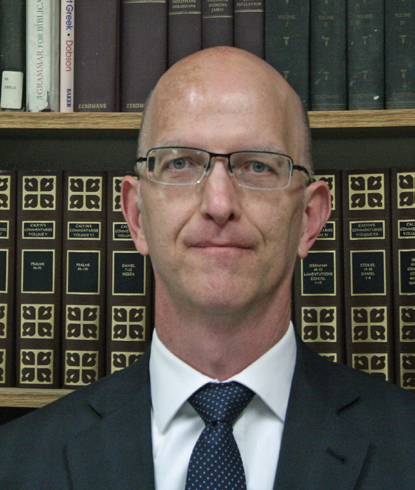
Rev. Marcus is pastor of the First Protestant Reformed Church in Edmonton, Alberta, Canada.
“Then said I, Woe is me! for I am undone; because I am a man of unclean lips, and I dwell in the midst of a people of unclean lips: for mine eyes have seen the King, the Lord of hosts. Then flew one of the seraphims unto me, having a live coal in his hand, which he had taken with the tongs from off the altar: And he laid it upon my mouth, and said, Lo, this hath touched thy lips; and thine iniquity is taken away, and thy sin purged. Also I heard the voice of the Lord, saying, Whom shall I send, and who will go for us? Then said I, Here am I; send me. And he said, Go, and tell this people, Hear ye indeed, but understand not; and see ye indeed, but perceive not.”
Isaiah had just seen a wonderful vision, the Lord sitting upon a throne in the temple. Above the throne were seraphim with six wings. With two they covered their faces. With two they covered their feet. And with two they flew. As they hovered, one of the seraphim cried to the other, “Holy, holy, holy, is the Lord of Hosts: the whole earth is full of his glory.”
To this amazing vision, Isaiah responded, “Woe is me! For I am undone.” Isaiah, a man of God, saw his uncleanness and the woe that was due to him. When he saw himself in comparison to the holiness of God, he realized how unholy he was. He understood the need for cleansing. The One who would cleanse Isaiah turned out to be the very King who was sitting on the throne. At the King’s command, the angel took a coal from the altar and touched Isaiah’s lips, proclaiming, “Lo, this hath touched thy lips; and thine iniquity is taken away, and thy sin purged.” After this good news had been proclaimed to him, Isaiah heard a voice asking, “Whom shall I send, and who will go for us?” Who will be my servant? Without hesitation, in thankfulness, Isaiah responded, “Here am I; send me.”
The account of Isaiah being called to serve provides us with a pattern, according to which we may see our own call to thankful service. When our iniquities are graciously covered by the sacrifice of the Lamb, we also become willing servants of the King. He says, “Who will represent me in this world?” And each of us says, “Here I am, send me.”
So terrified was Isaiah at the vision that he had just seen that he cried out, “Woe is me!” Isaiah had the dreadful feeling that some great evil was coming. He understood that his wicked deeds made him worthy of punishment. It is striking that Isaiah’s cry was not with regard to the woe that wicked Israel deserved. How easy it would have been to point only at others and talk about their sin. How easy it is for us to criticize others for their uncleanness and forget about our own. But Isaiah did not do that; he did not just point the finger at the nation of unclean lips. He claimed the same for himself. That is why he declared, “Woe is me!” He knew that he was worthy of being cut off from God’s holy presence and doomed to the torments of hell.
Why such gloomy thoughts from this man of God? Isaiah had heard the angels praising God with pure lips. But Isaiah was no angel. He was a “man of unclean lips.” He was a child of the stock of Adam, born with a sinful nature that manifested itself in his lips. God commands all men to praise Him with their lips. We ought to be crying out, “Holy, Holy, Holy, is the Lord of Hosts.” But, our lips are unclean, speaking unclean words that proceed from an unclean heart. Do we see ourselves as individuals with unclean lips? Do we see that we deserve God’s judgment for our sins and sinfulness?
The cause of Isaiah’s realization and subsequent confession was his vision of the Lord sitting upon His throne in the temple. Of course, Isaiah, a finite creature, did not see God’s infinite essence. But the vision did teach Isaiah something about God. The Lord sitting upon the throne is the King of kings. His throne and long robes indicate that He is exceedingly majestic, high and lifted up. His divine perfections are revealed in all the earth. Even the angels, recognizing His majesty, covered their faces and feet in the presence of the King. Also the posts and door shook as the smoke of God’s holy presence filled the temple.
Isaiah realized that this majestic King is the Judge of all the earth, who knows our sin. “The Lord is in his holy temple, the Lord’s throne is in heaven: his eyes behold, his eyelids try, the children of men” (Ps. 11:4). Isaiah had come to realize his sinfulness in the way of seeing God’s holiness.
His response was not unlike others who had seen something of God’s glory. For example, Daniel records his response to God’s holiness in Daniel 10:6-8:
His body also was like the beryl, and his face as the appearance of lightning, and his eyes as lamps of fire, and his arms and his feet like in color to polished brass, and the voice of his words like the voice of a multitude. And I Daniel alone saw the vision: for the men that were with me saw not the vision; but a great quaking fell upon them, so that they fled to hide themselves. Therefore I was left alone, and saw this great vision, and there remained no strength in me: for my comeliness was turned in me into corruption, and I retained no strength.
When Peter saw the power of God manifested at the draught of fishes, he also responded by acknowledging his sinfulness:
When Simon Peter saw it, he fell down at Jesus’ knees, saying, Depart from me; for I am a sinful man, O Lord. For he was astonished, and all that were with him, at the draught of the fishes which they had taken,
Do we respond that way when we see God’s glory and majesty displayed in Scripture and in creation? We do not deserve to stand in God’s presence, because our lips and hearts are unholy. When Isaiah saw his predicament, he understood he needed a Savior.
Perhaps it was not evident to Isaiah that the King sitting upon the throne was, in fact, Christ the Savior. At that moment of great despair, Isaiah saw Him as the holy Judge who would cast the wicked into everlasting judgment. But the King did not leave Isaiah in that miserable state. As Isaiah contemplated his woe, the King sent an angel to Isaiah to touch his lips with a live coal and proclaim that His iniquity was taken away.
The burning coal represents the cleansing power of fire, which burns away the chaff from the wheat and is used to purify gold. Here the fire is used to purify Isaiah’s lips, which represent his whole being. That’s why, after touching Isaiah’s lips, the angel said, “Lo, this hath touched thy lips; and thine iniquity is taken away, and thy sin purged.” As if to say, “Your twisted and crooked acts of rebellion, which miss the mark of God’s holiness, together with their guilt, have been washed and covered.” Through that cleansing, Isaiah had become exempt from punishment.
But how could the burning coal have such cleansing power? Only because it came from the altar, where the sacrifice of atonement had been made. This sacrifice brings reconciliation between God and man; it restores the fellowship that was once broken. Of course, the Old Testament sacrifice was only a picture of the real sacrifice of atonement that Jesus offered for us. He shed His blood to pay for our sins. Based on Jesus’ perfect sacrifice, God declares us righteous and adopts us as His children.
Notice that even though the sacrifice of atonement had been made, it was still necessary that the coal be brought to touch Isaiah’s lips. The Priestly King, as He was sitting in the temple, had already made a sacrifice of atonement. In Isaiah’s vision, the same King ordered the coal to be brought from the altar to touch Isaiah’s lips. The burning coal is a picture of the cleansing power of the Holy Ghost. The idea is that King Jesus, sitting on His throne in heaven, baptizes us with the Holy Ghost. That is why John the Baptist could say, “I indeed baptize you with water unto repentance: but he that cometh after me is mightier than I, whose shoes I am not worthy to bear: he shall baptize you with the Holy Ghost, and with fire” (Matt. 3:11). The Holy Ghost is the fire that applies to us what Christ accomplished for us on the altar of the cross.
The altar and coal of Isaiah’s vision were a kind of sacrament that pointed to the sacrifice of Jesus Christ on the cross. When the angel touched Isaiah’s lips, he proclaimed Isaiah’s cleansing, as if to say, “As surely as the coal has been brought from the altar to touch your lips, so surely are you to believe that your iniquity is taken away and your sin purged.”
After the good news had been declared to Isaiah, he heard the voice of the Lord asking, “Whom shall I send, and who will go for us?” Without hesitation, Isaiah answers, “Here am I, send me.” After experiencing justification, Isaiah was a thankful man. So when he heard the call to serve, he responded with eagerness. Of course, even the possibility of serving goes back to the King.
Previously, the angel had spoken to Isaiah and assured him that there was forgiveness for his iniquity and sin. However, after that, the Lord Himself talks to Isaiah. Isaiah refers to Him as “Lord” because he understood that the King was his master and owner; Isaiah was the King’s servant. The Lord is none other than Jehovah of hosts. He is the great I AM, who rules over all the hosts of heaven and earth. He is the thrice holy God, whose purpose is always to glorify Himself.
The King asked, “Who will go for us?” Who will go in our service? Who will go on a mission to bring glory to us? By using the plural pronoun, us, it seems the King is referring to the other persons of the Trinity. The triune covenant God sought a servant to accomplish His will in the world. Not that God needs anybody to accomplish His will; but He has chosen to accomplish His will by use of means. That’s why the King asked, “Who will go for us?” God wanted a servant to go as an instrument to serve in the cause of the covenant.
Perhaps Isaiah did not know how difficult the task ahead of him was. The mission involved preaching to the people in order that their hearts would be hardened. Who would want to be a prophet whose word hardens the hearts of a nation? Who would want to preach a message that the great majority of people would reject? No doubt Isaiah did not relish the thought of such fruit to his preaching. But he must have known it was for God’s glory.
Just as God sent Isaiah on a mission as an officebearer, He also sends us. God calls officebearers to the special offices. But He also calls each one of us to serve Him in our individual stations and callings. Husbands and wives are called to love as Christ and the church love one another. Fathers are called to serve Him as heads of homes, providing for the spiritual needs of the family. Mothers are called to serve Him in the home. Young people are called to serve their God-honoring father and mother, and to work diligently in school and on the job. Older folk are called to serve even in their pains and frailties. The truth is, our duties are not always easy. Sometimes they are downright depressing. But then we remember that God called each of us to the station and calling where we find ourselves. We are right where we are, at this time, for a reason.
What was Isaiah’s response to the Lord’s call? Did he shirk his duties? Did he say, “Why me? Why not someone else?” Does he say, “I suppose. If I absolutely have to.” Not at all. Isaiah responds, “Here am I; send me.” Literally, he says, “Behold me! Send me!” It’s not that Isaiah thought he was superior and everyone else so unfit. Rather, Isaiah was simply expressing his willingness to go anywhere God wanted him to go.
Isaiah’s response was one we would expect from someone eager to serve his holy God. Previously, he had cried out, “Woe is me! For I am undone.” He knew how far short he fell of God’s holiness. But, importantly, Isaiah had experienced the forgiveness of God. Isaiah was eager to serve because he was so thankful for God’s abundant mercy toward him. The thrice holy God had done so much for him; in response, Isaiah wanted to serve Him.
Do we give the same answer to God when He calls us to serve Him in any way? Do we say, “Here am I, Lord; send me”? Are we willing to go wherever God sends us and to do whatever He calls us to do? That applies to ministers, elders, and deacons. But that also applies to every single person in the office of all believers. God calls husbands to love their wives unconditionally. He calls wives to submit to their husbands and to work in the home to care for their children. He calls young and old alike to live a life of holiness. He calls children to honor father and mother. He even calls the sick and afflicted to serve Him in their circumstances. He calls us in every particular circumstance to seek first the kingdom of God. What is our answer? Do we say, “Here am I, Lord; I am ready to do Thy will”? That’s the response of someone thankful for God’s great mercy.
How is it possible to serve God faithfully? The possibility must rest in the King, who sits on the throne. The King, Jesus Christ, was the faithful Servant of Jehovah. He gave Himself out of love for His people. Now He rules from heaven and gives us the anointing of the Holy Spirit. From heaven, the King sends the Holy Spirit, who brings the coal from the altar and proclaims to our consciences that our iniquity has been taken away and our sin purged. The same Spirit also works in us true thankfulness for all His mercies. That is the reason we can say, “Here am I; send me.”
Not that we say it perfectly. Our old man will always make our desires and actions imperfect. There will be hesitation. Nevertheless, we will say, “Send me.” We will say, “Lord I am willing; help Thou my unwillingness.” And we will pray that God will grant the strength we need to do His will. The truth is, where God calls, He also equips.
Therefore, when the Master calls, we thankfully volunteer to go. Not for our own sakes, to make a name for ourselves, etc. But, for His sake, to glorify His holy name. For the thrice-holy God is worthy of all praise and honor. He is worthy to be served and glorified.

