
We conclude this series on a positive note.
Let us remember that the Christian—also the Christian scientist—begins and ends on the basis of the absolute authority of Holy Scripture. This is and must always be his bias, or prepossession. His approach to science is not neutral. Neutrality is, in fact, an impossibility, whether for believer or unbeliever. And with respect to the Genesis record, this bowing before the absolute authority of Scripture implies that he embraces the record of creation as literal.
One does not have to maintain that Scripture is a kind of science textbook in order to maintain this position. Everyone knows that this is not true. The Bible does not speak scientific language, and it does not present a scientific analysis of things. When it records the work of creation, it very evidently does not do so from the viewpoint of an astronomer and his telescope, for example, but from the viewpoint of the earth as the habitation of man and as the center and stage of all history. The real question is not whether the Bible is a science textbook, but whether the Bible records facts, and whether the Bible speaks accurately. The latter must certainly be maintained. When Scripture speaks with respect to the origin of things and with respect to the origin of things and with respect to the manner of their origin, it speaks inerrantly and perspicuously. Let us never forget this. And the true scientist, the Christian scientist, will bow to that speech of Scripture.
This means that the believing scientist interprets God’s book of creation, so-called revelation in nature, by faith in the light of Holy Scripture. He does not reverse this relationship. He does not come with his scientific conclusions/hypotheses to Scripture, and, discovering that the two do not agree, conclude that he will have to adjust his interpretation of Scripture to fit his science and his scientific data. But he is willing to bow before the Scriptures with his science. And where there is conflict, he will reexamine and adjust his science and scientific conclusions so that they are in harmony with Scripture.
The principle of the absolute authority of Scripture must prevail.
In this connection, there are certain Scriptural truths which are of importance and which must be taken into account by the natural scientist. No, these truths are not couched in scientific language. Nevertheless, they are truths with which the scientists must reckon. They are truths, too, which give the lie to many of the notions of unbelieving science. Let me briefly mention them:
1) In the creation narrative Scripture presents the picture of a finished creation. Sometimes this is called a creation “with the appearance of age,” an expression of which I am not especially fond. When God created, He created a complete, mature man and woman, not a couple of infants, and surely not an evolving creature. He called the sun, moon, and stars into existence; and there they were. He called the dry land and the seas into existence. He called plants and trees into existence. He called the animals, the birds, the fish out of the earth and out of the waters. All of the creation was fashioned and stood there in its completion in six days! Call it an “appearance of age,” if you will; but I do not know what age it appeared to have. Nor is that the point. The point is that on the basis of Scripture we begin with what unbelief needs billions of years to arrive at. There is a fundamental difference!
2) We must not forget that science does not and cannot study the universe as it was originally formed. The universe which we study today is a universe radically changed at the time of the fall and through the curse. There are many indications of this in Scripture; and science should pay attention to the changes which Scripture points out. There was a change in the domain of the animals. There was a change in man’s dominion over the animals. There was a change in the earth which was cursed. There was a change in the food of man. According to Romans 8:19, the whole creation came under the bondage of corruption through the fall and the curse. This certainly implies, negatively, that science cannot simply proceed on the assumption that there is an uninterrupted continuum from the beginning until today. To a large extent we cannot even imagine how things were when that first creation stood in its pristine beauty and perfection. For all that we know and can study is a creation that is under the curse and under the bondage of corruption.
3) There was a radically different world before the Flood. The Bible itself tells us this, II Peter 3:5, 6: “For this they willingly are ignorant of, that by the word of God the heavens were of old, and the earth standing out of the water and in the water: Whereby the world that then was, being overflowed with water, perished.” Notice that the Bible speaks of the pre-diluvian world as another world, the world that then was. Ours is the world that now is. That past world was destroyed by the Flood, by water. Ours will be destroyed by fire. And the destruction of that former world is comparable to and typical of the final destruction of our world in the holocaust of the final fire.
4) Closely related to the preceding is the fact of the Flood itself. Of course, you can relegate that Flood to “primeval history,” or you can deny its universality. But Biblically conceived, the Flood was in every way a tremendous catastrophe, an awful divine intervention, and at the same time a mighty wonder of grace, a miracle. Consider that the windows of heaven were opened and the fountains of the great deep were broken up, Gen. 7:11. The Flood, in the light of Scripture, must not be reduced to an ordinary event with ordinary rainfall which was exceedingly lengthy. It was the destruction of the first world. You cannot even begin to imagine the tremendous changes wrought by that Flood in comparison with the devastation that a very small local flood can wreak today.
5) Consider the fact that Scripture presents us in Genesis 5 and Genesis 11 with two very definite chronologies in the generations of Adam and the generations of Shem. Consider, too, that at the time of the Flood and again at the time of the Tower of Babel there were two divine interventions in the life-span of mankind.
All of these truths are of significance for the Christian who is engaged in the study of various natural sciences.
And they should warn us not to capitulate to worldly science and its unbelieving conclusions.
Let us hold fast to the Word of God!
—HCH
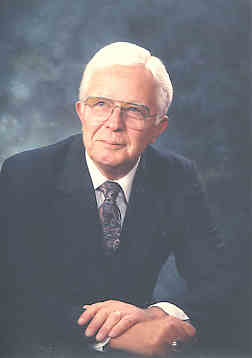
Since this is the last issue of the current volume-year, this is also my final word as Editor and Managing Editor of The Standard Bearer, in harmony with the plans approved by the Staff and announced a year ago. In harmony with those plans, Professor elect David Engelsma and Prof. R. Decker will take over as Editor-in-Chief and Managing Editor, respectively.
More than one person asked me orally whether I did not feel a certain amount of regret about my pending retirement. I told them this story. After our annual Staff meeting in June, the last over which I presided, I walked across from the seminary to my home, and said to my wife, “Just think! We made a lot of decisions at our meeting about the next volume-year, and I don’t have to do anything about them!” I felt as though a heavy burden had been lifted from my shoulders. I suppose that is a bit difficult for anyone to understand, unless he has spent as many years as I have in meeting deadlines of preparing an issue and getting material to the printer for 21 issues per year.
More important than my personal relief and the fact that now I hope to have the time to attend to other writings is my satisfaction that provision has been made for a smooth and orderly transition for our magazine and that two capable men have consented to take over the work.
To my fellow Staff members I say thanks for your help and support over the years.
To my successors I wish the Lord’s blessing and pledge my support in continuing the testimony of The Standard Bearer.
To my readers I say, “Thank you for your patient bearing with me through the years.”
For the coming volume-year I have asked for a leave of absence from the Staff, though I have promised to write some informative articles from Tasmania, Australia, for which land my wife and I will soon be departing, D.V.
May the Lord continue to bless our Standard Bearer.
—HCH

