
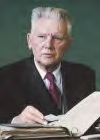
held under the Auspices of the Committee for Protestant Reformed Action, Hull, Iowa, July, 1954
(Continued)
But he also said this, and this he does not deny: “Some of you carry Protestant Reformed truth on the lapel of your coat. You are proud of being Protestant Reformed. Don’t think you go to heaven because you are Protestant Reformed.” These statements he admits to have made. I insist that in a sermon that contains these statements, the rest of a sermon cannot possibly be Protestant Reformed. I claim no Protestant Reformed man can possibly say, in the first place: “God promises everyone of you that if you believe, you shall be, saved.” That’s not Protestant Reformed. Let me analyze that a moment. God promises. Remember that that sermon was preached on the evening of April 15, 1951, that is, immediately after the Classis East adopted the Declaration of Principles, in which it was maintained, strongly maintained, that the promise of God is unconditional, and is for the elect only. That was April 15, 1951. What does it mean? Let me analyze it. Mind you, the Rev. De Wolf did not say: “I preach to you the promise that if you believe, you shall be saved.” That would have been not quite clear, but it would have passed muster. He didn’t say that. He didn’t mean to say that either. He said: “God promises.” God promises. Now the promise of God is, in the first place, an oath. What God promises He fulfills. In 1924 we opposed the doctrine of the Chr. Ref. Churches that maintained that God is gracious in the well-meaning offer of salvation to everybody. This is worse. This is not the question of a well-meaning offer of the gospel. This is the question of God’s promise. God promises. What God promises He swears by Himself to fulfill. Moreover, what God promises to anyone He surely promises in His grace. When God promises salvation, He certainly is gracious to the one to whom He promises. There’s no question of that. Even the Liberated,—the Liberated is very similar to that doctrine as far as the covenant is concerned. Prof. Veenhof in his Appel, as you probably know, insists that the promise of God is for every child that is baptized. And, moreover, he is consistent. He also writes that that promise of God to everyone that is baptized is given to every child in God’s grace. But this is stronger yet. God promises, that is, He swears with an oath to everyone of you? That was the idea. That was not the idea. That was the Statement; God promises to everyone of you, in the audience, everyone of you, that is, everyone that was in his hearing, whether members of the church or outsiders,—he didn’t know—whether carnal seed or spiritual seed, whether elect or reprobate,—he didn’t know,—everyone of you, he said, “God promises everyone of you.” Ad, he added to that the conditional clause: “if you believe.” You say, perhaps: that limits that statement? It does not. It does not limit the statement as far as God’s promise is concerned. God promises that everyone of you . . . that is the general promise . . . if you believe. I say again: if the Rev. De Wolf had said, “I proclaim that if you believe, you shall be saved,” that’s something else, something entirely different. Or even if he had said: “I proclaim that God promises to everyone that believes,” that would have been still Reformed, even according to the Canons. But he didn’t say that. He said: “God promises everyone of you that if you believe you shall be saved.” I put that in connection with the sermon, and I claim, I was not the one that protested against the sermon, let me repeat that; I didn’t; others protested; others than the consistory even. I didn’t even know what was going on in the consistory for a long, long time. But when I came in contact with it through a committee, I wrote my opinion black on white on the sermon which the Rev. De Wolf preached, and I sent it to the Consistory. It was not a protest at the time, but I wrote my opinion about the sermon. That was the first sermon preached.
The second sermon I heard. And if anything, that, to my mind, was still worse. That was preached in September, 1952, a year and a half after this sermon. I was in church then; I heard the sermon. And the essence of the whole sermon,—not only a statement or two,—but the essence of the whole sermon, except the last few sentences, maybe 2, 3 sentences, was this: our act of conversion is a prerequisite, or condition, to enter into the kingdom of God. He made that statement literally in connection with the sermon on Matthew 18:1-4. He made that statement literally. But he also emphasized it throughout his sermon. “Our act of conversion is a prerequisite to enter into the kingdom of God.” You know what that means. Prerequisite means something that is required of us beforehand. That’s a prerequisite. In other words, we must convert ourselves before we enter into the kingdom of heaven. Not only is that contrary to all that the confessions ever teach, us,—I refer you to Canons III, IV, 10-12 etc.,—it is contrary also directly to Scripture. The Word of God teaches us that we are translated from the power of darkness into the kingdom of God’s dear Son. God’s translation into the kingdom of God’s dear Son is first, it stands to reason. “Verily, verily I say unto you, Except a man be born again, he cannot see the kingdom of God.” How, then, can our conversion, our act of conversion be something that God requires of us before we enter into the kingdom of God. That was his sermon. That was the sermon throughout. Let me say too: it was a preparatory sermon, supposed to be. There was no Christ and no cross in it. I emphasized that in my protest. I protested against that sermon. I made a protest against that sermon. And I protested at the Consistory that there was no cross in that sermon. One of my elders remarked that he nevertheless had mentioned the cross once. I was present; I don’t believe it; but even that certainly cannot possibly be sufficient for a preparatory sermon on that text. The cross is the entrance into the kingdom of God, the entrance through which we enter only as we are regenerated before. Christ is the entrance into the kingdom of God. In this connection I cannot refrain from issuing to all of you a word, of warning. I’ll do it. You know, we talk about so much in our day, and in our churches,—we talk about responsibility. We talk about the activity of faith. And similar things. I’ll warn you that on that basis and in that line we’re going to lose the gospel. We’re going to lose the gospel. We’re going to lose election. We’re going to lose reprobation. We’re going to lose the gospel, the gospel of our Lord Jesus Christ. O yes, we must preach the activity of faith. But by the activity of faith I mean not something that you and I must do, except that first of all, by the activity of faith we cling to Christ, and embrace Him and all His benefits. That is the activity of faith. Responsibility? Don’t you ever forget that the accusation that Reformed people cannot maintain responsibility has always been brought against,—Reformed people have always been accused of denying responsibility by those that are Arminians and moderns. We do not deny responsibility. We do not deny the activity of faith. Of course not. But I warn you that with the emphasis that is laid upon these things, upon conditions, upon activity of faith, and upon responsibility, you’re going to lose the gospel. That’s my warning.
Well, those were the sermons preached. I protested. For a long time the Consistory treated the case. For a long time. You must not think that it was easy for our Consistory, or that they were eager to take action against one of their ministers. It was not. For over two years this case has been pending. For over two years. We asked the Rev. De Wolf to apologize. We asked him to make up his own apology, and publish it from the pulpit as he pleased, in his own words. Personally, in the meeting of the Consistory, I even suggested that he should make a sort of an apology in his sermon, in the course of his sermon. Nothing availed. I have a suspicion, that’s my suspicion, for which I have pretty good basis, that if the Rev. De Wolf had been alone, he would probably have apologized. He didn’t now. He had supporters in the congregation. Then they finally had a motion in the Consistory,—I wasn’t present at that time either,—to suspend him. That motion was carried by the majority of the Consistory, to suspend Rev. De Wolf. That suspension must, of course, be carried out with the advice of a neighboring consistory. The neighboring consistory was Fourth Church. We called in the Fourth Church. And the Fourth Church objected that our Consistory had not first decided formally to suspend the Rev. De Wolf. They had made a motion that he should be suspended, but they had not definitely and formally decided to suspend the Rev. De Wolf before they asked the Fourth Consistory. That should be done, of course. So it was decided to meet apart for a minute, or a while, and carry out that decision of Fourth Church. At that meeting we once more postponed the suspension. We were reluctant. The Consistory did not mean to suspend the Rev. De Wolf. They were reluctant. Hence, we sent the Fourth Church home, and decided that the Rev. De Wolf should put an answer black on white of the protests that had been lodged against him on both sermons. That was done. The answer was in no wise satisfactory. Then the Consistory decided,—and there I was present,—to let the Rev. De Wolf submit himself to an examination on the basis of the Formula of Subscription. That was done. And in the answers the Rev. De Wolf stated that he still maintained both the statements and the doctrine contained in them. That was the substance of the answers. There’s more. The questions and answers, of course, were all recorded. I have a copy of it. If necessary, I’ll publish the whole thing, from beginning to end. I have a copy of all my protests, of all the other protests, a copy of the questions and answers; and if necessary, I say, I’ll publish the whole thing. It should be done, probably, as an addition to the history of the Prot. Ref. Churches. In the meantime, you must not forget, the Consistory changed, that is, the personnel of the Consistory changed. It was January. New elders were installed. And the Consistory became weaker because new persons entered into the Consistory. One of the elders, moreover, that was newly installed was one of our strong Prot. Ref. elders, Mr. van Ellen. The Lord took him away soon after he became elder. So we were crippled. You must not forget that, in order to understand the rest of the action of the Consistory. I was not present very often. The Consistory changed personnel. The result was that the meeting finally decided to approve of the answers to the questions given by the Rev. De Wolf in which he plainly stated that he maintained the statements which were made in the two sermons. I say I was not present; otherwise they could not even have a majority. So slim, and so tense was the relation between the so-called minority and majority. If I had been there, and my vote had been cast, they would not even have had a majority for that motion. But they did, and I was glad they did, because I thought it would be better that the case would go in the open, and would go to the classis. And so I did. At that time, after they decided that, I sent the following document to my Consistory. This was February 2, 1953.
“Esteemed Brethren:
“I am very sorry that in his reply to the questions with which he was confronted by the Consistory thee Rev. De Wolf fully maintains the heresy implied in the statements: a. God promises everyone of you that if you believe, you shall be saved. b. Our act of conversion is a prerequisite to enter into the kingdom of God.
“I had indeed hoped that he would see and acknowledge the error of these teachings, so that we might again have fellowship with one another in the light, something which I earnestly desire, and without which I cannot live. But in this I was deeply disappointed.
(To be continued)

