
One year ago, the “News From Seminary Hill” article answered the question, “What happens on Mondays at seminary?” This article gives a glimpse into seminary life on Tuesdays and Thursdays. Good reason exists to devote an article to the Tuesday/Thursday schedule. First, most classes meet twice a week, either on Tuesday and Thursday or on Wednesday and Friday. With this focus you can learn about entire classes. Second, Tuesdays and Thursdays are the more routine days of the week; Wednesdays and Fridays often include some special events. Next year, God willing, the Wednesday/ Friday calendar will be featured.
GREEK GRAMMAR AND PROF. GRITTERS
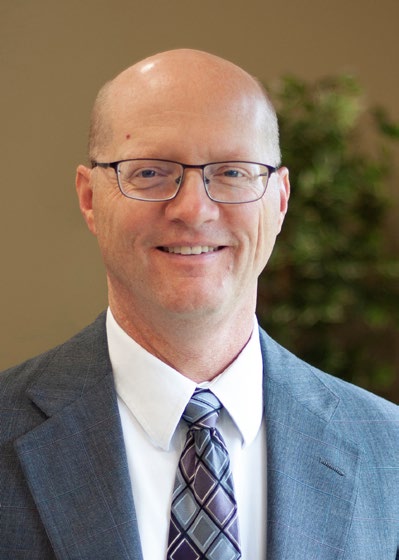
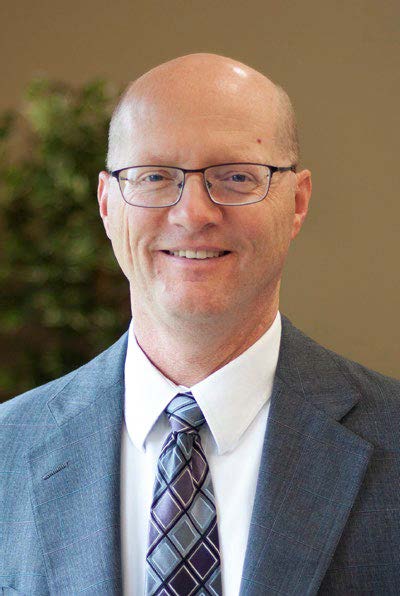
One class, Greek grammar, meets four times a week, Tuesday through Friday. This class usually consists of college juniors who have class on their college campus later in the day, so the class meets from 6:50-7:45am (“zero hour”). One of the professors in the New Testament department teaches the course; this includes Profs. Griess, Gritters, and Kuiper. Of course, in an academic year only one of them teaches the course (Prof. Gritters, this year), but all three have taught it at one point or another.
This is Prof. Gritters’ final semester as professor before Synod 2026 declares him emeritus. He has been a fixture at seminary for 23 years, and his absence will be noticed, although he still plans to keep his seminary office.
With his retirement, the faculty transition will be complete. According to the Constitution of the Theological School, a professor’s replacement must be called when the professor is 65, and the professor must be declared emeritus when he is 70. Profs. Dykstra, Cammenga, and Gritters all reached 65 within about 18 months of each other, so following the Constitution, all three replacements would be called in the space of two years. Recognizing that to turn over the entire faculty in so short a time was not wise, Synod 2015 approved a transition plan for the then-current faculty, staggering the calling of replacements.
How would the plan be implemented? Would it work well? Who would be called? Eleven years later, we have the answer. Did it work well? The new professors think it did, and we are grateful for time we were given to get our Master of Theology degree and to develop our courses.
But an era in the history of the seminary is coming to a close. The third generation of professors are almost all retired, and the fourth generation is now in full swing. Pray that we be faithful and diligent in our calling!
BIBLICAL STUDIES AND BRUCE FEENSTRA
Four classes in the category of Biblical Studies are taught on Tuesdays and Thursdays this semester. Bruce Feenstra, our senior, is the only student in two of them. In Advanced Hebrew Bruce sightreads a familiar Old Testament passage, translating it and identifying its parts of speech without using a dictionary and with only few prompts from Prof. Huizinga.
Prof. Kuiper teaches Bruce New Testament Isagogics. This course gives an overview of each New Testament book, identifying the book’s main themes and stating the book’s special place in the canon of Scripture. Rev. Daniel Kleyn’s current series of articles in the Standard Bearer is the fruit of his New Testament Isagogics course that he taught while in the Philippines, so reading those articles will give you a sense of what Bruce is learning.
On that note, this is Bruce’s final semester as student. The faculty have recommended to the TSC that Synod 2026 examine him and oversee his graduation exercises. If the schedule goes as planned, Bruce will preach his specimen sermon at Hope (Walker) PRC on Tuesday morning, June 9; will be examined in all aspects of dogmatics on Wednesday morning, June 10; and will be examined in other areas on Thursday morning, June 11. That evening, Prof. Gritters will give his last commencement address as a member of the faculty. In other words, a son of Hope (Redlands) PRC, about to be declared emeritus after 43 years of active service in the ministry, will address another son of Hope (Redlands) PRC as that son takes up his work. May God give Bruce 43 years in the active ministry!
 Bruce’s internship in Doon, IA, under the mentorship of Rev. Daniel Kleyn, went well. With thanks to God, he not only gained good practical experience in the work of the ministry, but also a fiancé; he and Leah Mowery plan to marry on July 3, the Lord willing.
The other two classes in the area of Biblical studies are both exegesis classes. In exegesis class, a student analyzes Bible passages in the Greek or Hebrew language and writes a 10-12 page paper giving his interpretation of the passage, with a view to preaching it. After critiquing the student’s work, the professor then gives his own exegesis of the text.
Prof. Huizinga is teaching Old Testament exegesis to Joe Ophoff. As of this writing, Joe is working on Psalm 103:3, “Who forgiveth all thine iniquities, who healeth all thy diseases.” All three students—Bruce, Isaac, and Joe—are also in a New Testament exegesis course, taught by Prof. Griess. Currently they are exegeting passages in James 2 and 3.
PASTORAL STUDIES AND ISAAC VAN BAREN
In addition to teaching New Testament exegesis, Prof. Griess also teaches Foreign Missions and Poimenics on Tuesdays and Thursdays.
In Foreign Missions, Isaac and Joe are currently learning what qualifications a foreign missionary should possess, how he is called to the work, where he must labor, and whether he should go alone.
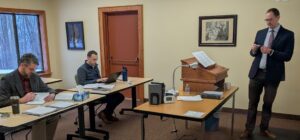 Poimenics teaches principles and applications of pastoral care, including pastoral counseling. Currently Isaac is studying what it means that Scripture is sufficient for the minister’s pastoral work.
Isaac is in his third year of seminary. By now he has preached seven sermons before the faculty, and has been speaking a word of edification regularly in the churches. The faculty have arranged for him to do an internship this fall at Unity PRC under the supervision of Rev. G. Eriks.
CHURCH HISTORY AND JOE OPHOFF
The modern church history course—church history from 1648-present—is attended by one student, Joe Ophoff, and several auditors. As of the deadline for this article, Joe has already learned about Presbyterianism in England, Scotland, and the United States; had a whirlwind tour of movements that have abandoned the biblical faith and others that wrongly reacted to this abandonment; and is now learning about the Reformed faith as it developed in the Netherlands in the nineteenth century. The rest of the year we will continue that trajectory, and then learn about the RCA, the CRC, and the PRCA.
Joe is in his second year of seminary—third, if you consider that he began seminary under the Special Seminary Entrance Program. Essentially Joe is devoting five years to preparing for the ministry, and in those five years is getting all his seminary courses and some preseminary requisites. So, after this year, he has two more to go.
CLASSES THAT ARE NOT HELD, AND OUR FRESHMEN
We can quickly dispense with speaking about our freshmen: the Lord has not given us any. Some classes that would be taught to freshmen this year—regardless of which day of the week—are not being taught this year. They include Hebrew grammar, a third and last semester of Greek reading, Hermeneutics (principles of Bible interpretation, a class that students must take before they begin exegesis), Introduction to Dogmatics, and Catechetics (principles of teaching catechism). It appears that these courses will not be taught next year either, because for a second year in a row, we know of no incoming freshmen.
Classes that are currently taught on Wednesdays and Fridays include Hebrew reading (Joe Ophoff), an Old Testament history and an Old Testament exegesis class, a class that surveys the history and contents of the Belgic Confession and Heidelberg Catechism, an Advanced Homiletics class, and Dogmatics.
OTHER EVENTS
We hope to hold two meetings of Student Club on a Thursday night this semester. Student Club consists of the students and professors getting together at a professor’s home to discuss a book or topic. Our first meeting was held at the home of Prof. Griess and we discussed Christian Nationalism.
Dr. Adriaan Neele, president of Puritan Reformed Theological Seminary and professor of homiletics and historical theology, addressed our faculty, students, and staff after lunch on Thursday, February 5. We usually have a guest speaker at least once a year, and sometimes that speaker gives a series of two or three lectures. This year Dr. Neele gave one lecture, “The Christian Reformed Church Synod of 1924’s Use of Peter van Mastricht: A Centennial Assessment.” The synod, in its defense of common grace, referred to three theologians from the “most flourishing period of Reformed orthodoxy”: John Calvin, Zacharius Ursinus, and Peter van Mastricht. Dr. Neele pointed out that, while the synod may have correctly alluded to van Mastricht in support of the second and third points of common grace, it certainly misused him as support for the first point of common grace. In addition, Dr. Neele argued that the synod made several methodological mistakes, among them the designation of a particular age of Reformed theology as “golden,” quoting only three theologians in an attempt to demonstrate that a doctrine was well-ingrained in Reformed thought, and lacking precision when defining grace.
Tuesdays and Thursdays are also the most common days for us to receive fourth or fifth graders from our area schools for a seminary visit. Usually these arrive about 9:00 am, attend a presentation about what we do at seminary, tour the building, participate in morning devotions, and have a snack with us. (Actually, they usually provide the snack, so we have a snack with them!)
THE “NEW” FACULTY AND THE STAFF
What about this fourth generation of professors in our seminary? All were born and raised to Protestant Reformed parents and schooled in Protestant Reformed elementary schools. All served previous pastorates in PRC congregations.
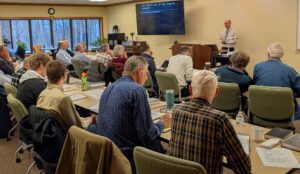 Prof. Kuiper, the oldest of the new men, has taught all his regular courses for the first time, and has taught his first January interim. This past January, he taught an interim course entitled “Protestant Reformed Churches in America: History, Doctrinal Distinctives, and Emphases”—a course that he is convinced every man entering ministry in the PRCA must take. Prof. Kuiper also serves as the seminary rector, writes for and edits the Protestant Reformed Theological Journal (it is free of charge—email our secretary!), writes for the Standard Bearer, and serves on the Contact Committee. If God wills, this summer will find him giving a speech in Greenville, SC, at the annual conference of the Reformation Bible Society, and speaking at the PR Young Peoples Convention.
With the conclusion of this academic year, Prof. Huizinga will have taught every course in his department, except for interims. He is the chief of three editors of the Standard Bearer. He will travel to Northern Ireland this summer to speak at the British Reformed Fellowship Conference.
Prof. Griess, our newest appointee, will be developing new courses for at least one more year. He is also one of the editors of the Standard Bearer. This summer, he plans to travel to Singapore to speak at the summer camp of the Covenant Evangelical Reformed Church and to visit their mission field and Rev. Singh in Kolkata, India.
The professors all preach regularly, usually at least once a Sunday, and teach catechism classes and/or lead Bible studies.
We remain grateful for the support and assistance of the seminary staff—Mr. Charles Terpstra, registrar, librarian, archivist, and building-grounds manager; Mrs. Bethany Engelsma, secretary; Kevin Rau, librarian assistant; and Matt and Kim Kuiper, janitors.
We are also thankful for the support of the denomination and the prayers of many for God’s blessing on our work.
Continue to pray for us. Include in your prayers a fervent petition that, if not again this fall, we will soon have freshmen, many of them, coming to seminary in annual waves. We need ministers!
And rest assured that we pray for you, the members of the PRCA. We are more remote from you than are your own pastors, but we are called to serve you in preparing men for the gospel ministry, and we pray God’s blessing on you, that He keep you and us faithful in doctrine and life.
