


And the Word was made flesh, and dwelt among us, (and we beheld his glory, the glory as of the only begotten of the Father,) full of grace and truth—John 1:14
An old, weathered man has just marked his ninety-fourth year. It does not feel like much of a celebration but more like solitary confinement.
He sits on the sun-bleached rocks of an island, staring out at the surf. His hands tremble—not with fear, but with the effects of old age and sheer exhaustion. He lets out a deep sigh, contemplating his seemingly dim purpose.
His name is John, but also “beloved.” He is an ordinary man who once touched the extraordinary. Having lived through the most significant century in human history, he sits now as the last living bridge between two worlds. There are no photographs to prove what he saw—only the crystal-clear gallery of his mind, vivid and sure, as if it were yesterday. But he knows that the testimony of Scripture will always be the bridge, the fullest revelation of the person and work of Jesus Christ (2 Pet. 1:18-20).
As John watches the crashing waves, his eyes sparkle as he reflects on his most memorable day of fishing. Not memorable because of the catch, but because of the call. As an ordinary man during an ordinary day of work, Jesus had suddenly “called them [James and John]. And they immediately left the ship and their father, and followed him” (Matt. 4:21, 22).
He reflects on seeing the glory of Jesus at the Transfiguration, when Jesus brought them “up into a high mountain apart, and was transfigured before them: and his face did shine as the sun, and his raiment was white as the light” (Matt. 17:1, 2). He reflects on what God has spoken of Jesus, that He was His “beloved Son,” and how Jesus had spoken that so often of him too.
He reflects on all the miracles. So many miracles. He remembers what he had written, that there were “many other things which Jesus did, the which, if they should be written every one, I suppose that even the world itself could not contain the books that should be written” (John 21:25). He shakes his head in amazement. He marvels not only at the sheer physical defiance of those wonders, but at the greater wonder that after ninety-four years, the most miraculous thing he ever witnessed was not a dead man walking (John 11:43), but the mercy that rescued a common fisherman like him.
He knows of the extent of that mercy to him as he remembers his unmerciful desire to incinerate a Samaritan village with fire from heaven (Luke 9:54). The Lord’s admonishment gripped his heart and led him to later pray for these same Samaritans, “that they might receive the Holy Ghost” (Acts 8:15).
John reflects on how Jesus, though truly the Son of God, repeatedly called himself the Son of Man. Jesus was “of the Father” and yet became a man like him. John could talk with Him, laugh with Him, and cry with Him. They could have deep, intimate discussions with each other, sometimes late into the night. Yet he also remembers Jesus’ gift to preach a beautiful sermon to a great multitude, and still speak so personally that John felt he was the only one there (Matt. 5-7).
As his mental timeline moves forward, he thinks about all the meals they had shared together. His eyes narrow as he reflects on the last supper with his Lord. While he had wrestled with confusion about the future, he now understands clearly that the “Last Supper” would not be the last, for he had written: “Blessed are they which are called unto the marriage supper of the Lamb” (Rev. 19:9). And he will be at that table—a beloved disciple, chosen and called to the eternal supper with Jesus.
But then the picture in his memory becomes very painful as he reflects on the image, seared into his mind, of his dear Lord hanging from the cross. A tear rolls down his cheek as he remembers the anguish on Jesus’ face. He had watched them nail His hands and feet, and so many had ignorantly mocked and jeered. And he, John, had put Him there. He was responsible. Overcoming the truth of that reality, he knew, with confidence, his Lord’s obedience and how that ultimate act of love had covered all his sins.
He reflects on the moment when Jesus had commanded him to “Behold” Mary, and how John had “from that hour” done exactly that (John 19:27). In compassion, in his ultimate moment of suffering, Jesus recognized Mary’s need—and John’s too—of spiritual support as they transitioned to life without Jesus in their midst. Witnessing Jesus’ final breath was more than he could bear.
But then there was the empty tomb. He remembers his first-hand account: “Then went in also that other disciple, which came first to the sepulchre, and he saw, and believed” (John 20:8). To him—a “son of thunder” (Mark 3:17)—the silence of the empty tomb spoke volumes more than anything he had ever preached as an apostle. It was the definitive proof that every word the Son of Man had spoken was true.
He reflects on anxious waiting being replaced by startled joy when, several days later, he recognized Jesus on the shore. After coming to his senses, he remembers calling out to Peter, “It is the Lord” (John 21:7). It is He! My Lord and Savior! John chuckles as he recalls Peter’s dive into the water. He sees the full circle of this day of fishing with that “first” day of fishing.
But he breathes in deeply as he recalls Jesus’ final moment and his own ignorance. After all those discussions with Jesus, he and the disciples had asked if He would “at this time restore again the kingdom to Israel?” (Acts 1:6) What folly! Jesus’ patient response was to promise “power, after that the Holy Ghost is come upon you: and ye shall be witnesses unto me both in Jerusalem, and in all Judaea, and in Samaria, and unto the uttermost part of the earth” (Acts 1:8). He remembers the very moment when a “cloud received him out of their sight” (1:9). Like a photograph, his mind recalled all the detail. Sixty years ago, but like yesterday.
And just like that, they were on their own. He remembers the anxious chatter in those early days when they had so many questions about what would happen next. Yet, the Holy Spirit came soon, not just to give power, but to assure them they were not alone (Acts 2).
He reflects on that truth being confirmed when he took part in their first miracle. He remembers that look in Peter’s eyes—oh, that look!—when he, “fastening his eyes upon him [the lame man] with John, said, Look on us” (Acts 3:4). He remembers the joy on the man’s face as he “leaping up stood, and walked…leaping, and praising God” (3:8).
But John moves from the memory of the lame man’s joy to his experience of loss, specifically when his dear brother James was executed at the hands of Herod Agrippa (Acts 12:2). The loss of James strengthened his resolve to confess, unashamedly, the name of Christ before men. He further remembers when each one of his fellow apostles, as well as many friends, now passed into glory. Only he remains. And as John looks out at the horizon, he utters, barely audible, “How long, Lord?”
No answer is given, but John remembers what work the Lord had recently given him to do, and his mind shifts to his writings. A gospel narrative, three epistles, and revelations from Christ Himself. He offers a prayer of gratitude for the strength given him to carry out that work. John reminds himself that the answer to his purpose at age 94 lies on the very pages of those writings, namely, to “love one another” (1 John 4:7).
Now, as John rests, a weary old man, he reflects again on that last day of fishing with Jesus some six decades ago (John 21). Jesus had revealed to Peter that he would die the martyr’s death (21:18), and he remembers with grief the day he heard of its fulfillment. But now he remembers the question that Peter had asked Jesus about John himself:
Peter seeing him [John—“the disciple whom Jesus loved”—v. 20] saith to Jesus, Lord, and what shall this man do? Jesus saith unto him, If I will that he tarry till I come, what is that to thee? follow thou me (John 21:21, 22).
He had wondered what those words had meant, “if I will that he tarry till I come.” But now, he wonders no more. Forming the faintest smile, he now understands that he was meant to outlive them all. But now he is ready to join them all, and to once again see his dear friend Jesus.
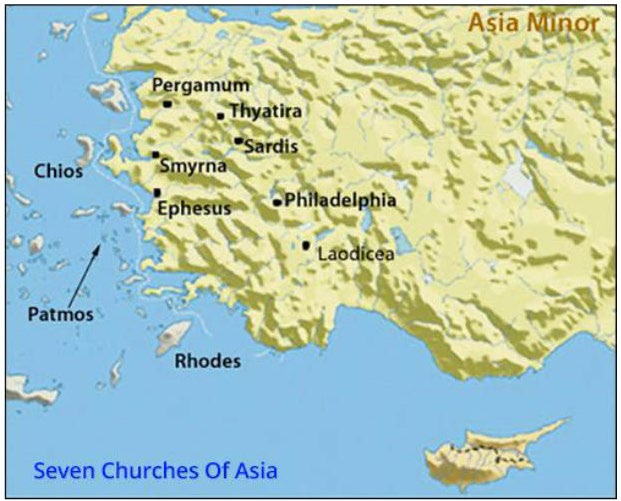
In the many years prior to that day of reflection on the sun-bleached rocks of Patmos, John had relocated to Asia before the First Jewish-Roman War of AD 66 and immediately became involved in the church at Ephesus.1 Several years after his arrival there, Emperor Domitian (AD 81-96) exiled John to Patmos, due to his worship of Jesus as Lord. However, once Domitian was assassinated, Emperor Nerva (AD 96-98) authorized John’s release and return to Ephesus.
From fishermen to disciple to apostle, John lived out his final days as a member of the church of Ephesus. Christian tradition says that in his final days, well into his 90s, John was so frail that he had to be carried into the church to worship. The church father Jerome wrote that “one phrase was constantly on his lips: ‘My little children, love one another.’ Asked why he always said this, he replied, ‘It is the Lord’s command, and if this alone be done, it is enough.’”2
 The apostle John was given a few more wearisome years after that day of reflection. His firm trust in Jesus Christ became an eternal reality when he passed into glory at an advanced age, approaching, if not reaching, 100.3 All the reflections, all the remembrances, all the pictures in his mind, now gone, for the former things have passed away, and he lives, once again, face to face with his Savior whom he loves. From sight, to faith, and at last—sight forever.
Do you, like John, have much to remember? Do the memories flood—sometimes in joy, and sometimes in sorrow? John reflected on his own regrets—do you carry yours as well? Do you, too, feel alone and confined? Are you perhaps an aged saint—a weary worshiper, or a weary pilgrim? Take comfort from the reflections of John. Know, with certainty, that you, too, are Jesus’ beloved.
Know this love despite all your regrets, all your sorrows, all your sins.
Reflect on a life filled with expressions of His love.
Jesus loves you, and through John, has told you:
“In this was manifested the love of God toward us, because that God sent his only begotten Son into the world, that we might live through him. Herein is love, not that we loved God, but that he loved us, and sent his Son to be the propitiation for our sins” (1 John 4:9, 10).
To be the “disciple whom Jesus loves” was not a title of pride for John, but a confession of his own faith in Jesus Christ. It was his ultimate identity. He knew with certainty that he was loved.
Dear Christian, you, too, are the “disciple whom Jesus loves.” Like John, you have received the revelations of Jesus Christ through His Word. As the ascended King, Jesus gives you reminders of His eternal love and promises you an eternal glory to come. And He continually shows you, as He did to John, that He will never leave you or forsake you.
In times of reflection, remember, you are His beloved.
1 R. H. Lenski, The Interpretation of the Epistles of St. Peter, St. John and St. Jude (Wartberg Press: Columbus, OH), 363. Interestingly, John’s influence in Ephesus was more impactful than Paul, who labored for 2-3 years in Ephesus on his third missionary journey (Acts 19). John’s influence in Ephesus dominated the last 30 years of the apostolic age. See F.F. Bruce, Peter, Stephen, James, and John: Studies in Non- Pauline Christianity (Wm. B. Eerdmans: Grand Rapids, MI), 120, 121.
2 St. Jerome, cited in John MacArthur, Twelve Ordinary Men (Thomas Nelson: Nashville, TN), 117.
3 Lenski, Interpretation of the Epistles of St. Peter, St. John and St. Jude. According to the church father Irenaeus of Lyons (c. A.D. 130-202), John died during the reign of Emperor Trajan, who ruled from AD 98-117. See Simon J. Kistemaker, New Testament Commentary: Exposition of the Epistle of James and the Epistles of John (Baker Book House: Grand Rapids, MI, 1986), 200. It is difficult to determine John’s exact birth year; therefore, it is most probable that John died between the ages of 95 and 100.



