

member of Southeast PRC in Grand Rapids, Michigan, and administrator at Eastside Christian School in Grand Rapids, Michigan
Submitted by Carmen Griess, member of Loveland PRC in Loveland, Colorado.
The Loveland Protestant Reformed Church’s roots are thoroughly German. The charter members were almost exclusively children and grandchildren of German- Russian immigrant Henry Schwarz from Sutton, Nebraska (NE). His ancestors can be traced back to the Protestant Reformation, including the 1525 marriage of Felix Ochsner and Fronegg Gosswiller performed by Swiss Reformer, Ulrich Zwingli! His family is thoroughly interwoven with two other German- Russian families, Griess and Ochsner. Both of Henry’s successive wives had the last name of Griess, but both their mothers were Ochsner, as was Henry’s mother. And five of Henry’s children married a Griess! So, let’s take a look at God’s guiding hand as He led the Griess and Ochsner families out of Germany, into Russia, and then into the United States, preserving the Reformed faith all the way to Loveland, CO.
MANIFESTO OF EMPRESS CATHERINE THE GREAT
Using Theodore C. Wenzlaff’s research in Pioneers on Two Continents: The Ochsner-Griess History and Genealogy as a guide, we will start our story with the Manifesto of Empress Catherine the Great in 1763.1 Having overthrown her husband Peter III from the throne, she desired to have sparse areas along the Volga River in Russia settled and developed. She coaxed foreigners with generous terms of immigration, such as freedom of religion, no military service, and self-government in their villages. Russia even provided money, land, interest-free loans, and no taxes for 30 years. Her grandson, Alexander I, obtaining the throne in 1801, followed the same plan in the newly acquired Ukraine territory, specifically the Black Sea region near Odessa. Alexander added one more stipulation: immigrants had to come in families with financial means and be talented as farmers or craftsmen. Recruiting took place particularly in Germany and Switzerland.
Back in Germany, Napoleon Bonaparte of France levied taxes on the German areas that he occupied and conscripted young men to serve in his armies. These hardships and famines presented conditions that would have made Russia’s generous terms of Alexander’s decree for inhabitants very inviting!
Johann Nicolaus Ochsner, 43, and his family left Edenkoben, Germany in 1809. Edenkoben was located west of the Rhine River, near France. At that time, he and his wife Klara, 38, had four sons ranging in age from 5-12 years old. We can imagine that conscription was on the mind of this family of boys! Nicolaus died sometime during that journey, yet Klara and their sons continued on to Russia and ultimately settled in Worms colony near Odessa.
Close to the same time, another family left that same German village and would also settle in Worms. Johann Henrich Gries (original spelling), 26, and wife Christina, 27, had two young children, ages one and two. Children of these two men ended up in Sutton, NE about 65 years later.
WORMS COLONY, RUSSIA
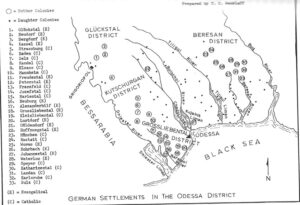
In his research, Theodore C. Wenzlaff found that the arrival of these families in Worms was not recorded. However, schoolmasters in 1848 chronicled the German colonies. Assignments were made to colonies based on religious denomination: Evangelical, Catholic, or Mennonite.
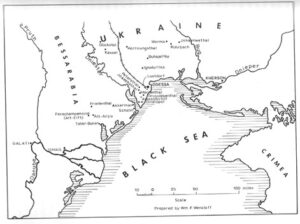
The journey to their new home would have been monotonous as this Crown steppe was a flat, seemingly endless sea of grassland. Villages were established with 50-100 families. Accessing the German Russia Heritage Society’s website (https://www.grhs.org/pages/worms), Gries, Ochsner, and Schwarz names are found among the pioneer settlers in Worms colony. All the colonists would settle in their assigned village, which would be surrounded by the allotted land, divided among the families. Each family received a total of 162 acres in smaller plots spread out over the area. This gave no one family an advantage because each family had some land that was closer, some that required travel, some that got sufficient rain, and some that was lacking. The cultivation of this land was difficult, facing hardships such as hail, grasshoppers, crop failures, and winter starvation of livestock.
Children of the colonists were raised in their own self-supported parochial schools. Children were confirmed in the church at age 13 or 14, so the main emphasis in the schools was religion. The students received only basic knowledge of traditional school subjects as we know them. Theodore C. Wenzlaff noted that the schools’ main purposes were to maintain German culture and to train students to live Christian lives. Eventually, training schools for teachers were established and education improved.
CHURCH IN THE COLONY
The religious freedom granted to the colonists resulted in them establishing churches of the same religion they had in Germany. In Worms, the Lutherans outnumbered the Reformed, but in nearby Rohrback, the Reformed were more. Visiting ministers came once or twice a year to confirm those who were of age, but neither group had their own pastor—for 15 years!
Did you stop to ponder that? Hearing the preaching once or twice a year?! Theodore C. Wenzlaff provides excerpts from Schoolmaster Fritschle of Rohrback (pp. 29-31) that are important to consider as we focus on the preservation of the Reformed faith.2 The worship and fear of God was missing. There was spiritual starvation. The Germans’ lives were worldly, with little restraint. The teachers and leaders within the villages were inept and spent most of their time in the taverns. The young people grew up the same, and most could not read. It is reminiscent of the times of the judges in Bible times: “In those days there was no king in Israel, but every man did that which was right in his own eyes” (Judges 17:6). We know God had mercy in that He repeatedly raised up deliverers for the Israelites. And that is just what happened. God provided a Reformed minister in 1824, Johannes Bonekemper. Wenzlaff quotes the schoolmaster: “The happy cooperation, the censure of sin and an appropriate discipline, soon brought blessing to our people. The fear of God has returned” (p. 20). The Griess, Ochsner, and Schwarz families certainly could not have realized that in the next 84 years, God would provide 67 years of Reformed preaching by three ordained pastors in the Bonekemper family.
Pastor Johannes Bonekemper accepted the call to serve a combined Rohrbach-Worms Evangelical parish, meaning the Reformed and Lutherans worshipped together. He strictly clung to the Reformed form of worship, with which the Lutherans had no problem. That unity lasted about ten years. Pastor Bonekemper was ordered in 1833 by the Consistorium at Odessa to start a Lutheran form of service. After discussions and letters, the order came to hold separate services for the two groups. As Theodore C. Wenzlaff puts it, “The heretofore peacefully united church was spiritually split” (p. 30). Despite great effort of Pastor Bonekemper to keep the groups together and despite most Lutherans desiring to keep their pastor, problems still arose, causing him to resign 24 years after taking the call.
Without a pastor, peace could not be restored, so the Reformed and Lutherans established separate parishes. The Reformed church was vacant for 13 years, experiencing Jesus’ words in Matthew 9:37, “The harvest truly is plenteous, but the labourers are few.” Swiss pastor Philipp Jakob Uehlinger filled their pulpit only four years. He was replaced by Pastor Karl Bonekemper, the oldest son of their previous pastor! He had attended seminary in Pennsylvania, served there as a Reformed pastor for three years, and then returned to Europe as an instructor for eight years in Basel, Switzerland. He would serve in their parish for 11 years before returning to America.
GERMAN THROUGH AND THROUGH
Anyone visiting Worms and the surrounding villages would have thought they were in Germany. These pioneers clung to their German heritage so that every aspect of life was German, except for the Russian land that they farmed. Even the villages were named after cities in Germany. The colonists were allowed self-government, which was strict and resulted in no lawlessness. Theodore C. Wenzlaff notes, “The colonists were models of hard-working, law-abiding citizens, devoted to their families, their homes, their churches and schools, and their fields” (p. 28).
The Germans continued to live gladly in isolation from the Russians, considering them an inferior people. But Russia took notice of their growth in numbers, strength, expansion, and wealth, generating an anti-German movement. The result in 1871 was the Imperial Russian Government overturning the previous manifestos. I was immediately reminded of Exodus 1:7, “And the children of Israel were fruitful, and increased abundantly, and multiplied, and waxed exceeding mighty; and the land was filled with them.” Pharoah had felt threatened and sought ways to diminish them. Similarly, the German’s social status was reduced to Russian peasants, and their culture and heritage were now threatened by Russianization. Fearing that their freedom from military service would be taken away (it was, just three years later), leaving Russia seemed to be the only solution. They decided to move to the United States having heard about religious freedom there. We will see in the next article God’s provision for these Reformed, German families.



