

Martin Luther’s The Bondage of the Will is a book that is doctrinally foundational to the great Reformation of the sixteenth century, to be outdone only by the much more extensive doctrinal treatment of John Calvin’s Institutes of the Christian Religion. Martin Luther wrote extensively during his lifetime. The published volumes of his works now number 79. Luther considered The Bondage of the Will the most important of his writings.
But there is a background to his writing and publication of this book that must be considered in order to understand the great value of the book for the church of the Reformation as well as the church today. In it Luther set forth what he considered to be the doctrine that lay at the heart of the gospel. The matter under debate was the absolute sovereignty of God in salvation.
Throughout history the great adversary, Satan, has attempted to call into question God’s sovereignty. In the early part of the fifth century, a man named Pelagius was rejecting the doctrine that Adam was the representative head of the whole human race, as is taught in Romans 5:12-18. To Pelagius there was no such thing as original guilt and original sin. Adam’s fall did not affect us except to leave us a bad example. Sin comes by imitating various bad examples that we are confronted with in the course of our lives. Pelagius’ views had two consequences when it came to the doctrine of man’s salvation. First, with his denial of Adam’s legal headship over the human race, Pelagius also denied the legal headship of Christ our Savior. Second, Pelagius rejected the biblical doctrine of total depravity and maintained that man’s will remained free after the Fall. With this free will man was able to choose the good or the evil. God’s grace was only necessary to assist man in choosing the good, by which he would be justified before God.
Augustine was the chief figure in defending the truth of the Scriptures over against the Pelagian heresy. Augustine knew his own deliverance from the bondage of sin. He knew the horrible power of sin and how it enslaves the very nature of man so that sin is not merely in the external act. Adam being the legal head of the whole human race, his sin was the sin of all, and death was the consequence of sin upon the entire human race. That death included the loss of freedom to do the good and the bondage to evil and, finally, physical and everlasting death. In this connection Augustine developed the biblical doctrine of total depravity and emphasized that salvation is entirely by the sovereign work of God and a wonder of divine grace in Christ Jesus that changes the will, enlightens the mind, and works faith. In answer to the question how some happen to be recipients of the grace of God and others are not, Augustine unfolded the doctrine of predestination.
But while the church would condemn Pelagius as a heretic, she would not have Augustine’s doctrine of man nor of God’s absolute sovereignty. At that time certain aspects of Pelagian teaching were already too deeply ingrained in the church and would become even more so in later centuries with the rise of the Renaissance. A form of semi-Pelagianism ruled the thinking in the Roman Catholic Church, even as today the descendant of that Pelagianism, Arminianism, rules the thinking in much of the evangelical church world. At the heart of that thinking is the exaltation of man. In the church prior to Luther’s day that meant that while salvation is God’s work, man also plays a cooperative role. Man is not dead in sin, but seriously ill, and in need of the great Physician. But he must summon that great Physician. God’s healing mercies will not take effect until man requests it and applies the remedy.
Couple that corruption of biblical truth with the immorality in the church, especially notable in the highest offices during the Borgia dynasty of popes and family-appointed cardinals and other prominent leaders in the church, and you have the background of the controversy that arose between Martin Luther and the Dutch humanist, Desiderius Erasmus (c. 1466- 1536).
Martin Luther (1483-1546) needs no introduction for us. I would only emphasize that Luther himself was a great scholar. Though not as widely known as Erasmus in the years prior to the Reformation, Luther had begun as a law student, receiving his master’s degree when he was 22, before changing the direction of his studies entirely to theology and becoming a monk. Even so, by the age of 29 he had received his doctorate and had succeeded Johann von Staupitz as Professor of Theology in the University of Wittenberg. At the same time he was a pastor and preached at the Castle Church at Wittenberg.1
Erasmus, blessed with a brilliant mind, was known as the most influential scholar in all of Europe. He was some seventeen years older than Luther and well established in scholastic circles throughout Europe by the time Luther rose to prominence in the Reformation of 1517. He had embraced some of the principles of the Renaissance with its emphasis on learning and scholasticism  and the elevation of the human mind. Erasmus was a humanist. The term humanism in our day has taken on a different connotation with a total rejection of God, and is usually associated with atheists and “freethinkers.” But at its root, humanism emphasizes human ability and potential, the natural goodness of the human being, and the solution to all problems coming from man’s knowledge. You can sense, therefore, that humanism is fundamentally another development of the Pelagian heresy. But humanism also sought a return to learning from original sources. And when the ancient city of Constantinople fell to the Muslims in 1453, many Byzantine Greek scholars fled to Europe, renewing an interest in Greek studies, the language of the New Testament Scriptures. In 1516 Erasmus would publish his Novum Instrumentum, the first printed New Testament in Greek, which also included his own Latin translation and scholarly annotations alongside the Greek text. This would later be used by Luther in translating the New Testament into the German language. But it also set him on the pathway of being led by the Spirit to an understanding of the biblical doctrine of justification by faith alone through his study of the epistle to the Romans.
Both Luther and Erasmus were deeply disturbed by the corruption and immorality that plagued the church even to its highest offices. Erasmus wrote In Praise of Folly, published in 1511, in which the ignorance of the church and its leaders were the object of his sharpest wit. It was a satirical examination of the supposedly pious but superstitious practices of the church as well as the immorality of its members and clergy. Erasmus longed for a return to the Scriptures. But he did not see the corruption in the church as something rooted in a profoundly erroneous theology. Luther, on the other hand, did.
Luther came to his theological position in his study of the Scriptures. He had been deeply troubled, not only by the notorious corruption of the clergy, but by his own lack of assurance. Already as a young man, Luther had been terrified of dying. It was not unusual in those days to be confronted by death frequently. Luther had lost several friends and acquaintances to the plague. He himself had just about lost his life when the sword that he was carrying as a student accidentally cut his leg and severed an artery. His traveling companion ran to a nearby town to summon a doctor who 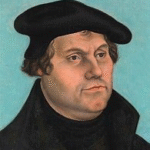 could treat the wound.2 Later Luther found himself outside in a severe storm and in his perceived threat of being killed, the terrors of damnation swept before his mind and he vowed to Saint Anne that he would become a monk. But life in the monastery did not deliver him from the terrors of hell. His devotion to a life of good works could not relieve him from the perception that he was a guilty sinner who could not escape the just judgment of the holy God.
A chief consideration in his struggle was the truth— and an inescapable biblical truth—that sin is not simply in the actions, but permeates the nature. That truth had been lost in the semi-Pelagian teachings of the Roman Catholic Church. Nothing Luther could do in the way of good works according to the church could open the way to salvation. Christ alone is the way, the truth, and the life. No man comes to the Father but by Him (John 14:6). Luther had to come to the realization that justification is not by works, but by Christ’s imputed righteousness. God imputes the righteousness of Christ to His people by grace alone through faith alone.
As God brought Martin Luther to this knowledge through the study of Paul’s epistle to the Romans, God prepared Luther for the work that lay before him. He gave Luther the understanding that the sins plaguing the church of his day were not just moral improprieties or a lack of knowledge to be solved by humanistic education. The sins plaguing the church were rooted deeply in doctrinal errors, and especially the denial of the absolute sovereignty of God in salvation.
When Erasmus, therefore, in 1524 published a treatise On the Freedom of the Will in which he criticized Luther’s doctrine of divine sovereignty and predestination and defended the traditional Roman Catholic teaching of man’s free will in the matter of salvation, Luther was fully prepared to respond. The result would be his book The Bondage of the Will, in which the teaching of divine truth is clearly set forth from Holy Scripture.
1 Martin Luther, The Bondage of the Will (Old Tappan, NJ: Fleming H. Revell, 1957), 19-22.
2 Eric Metaxas, Martin Luther: The Man Who Rediscovered God and Changed the World (Penguin Publishing Group. Kindle Edition), 29.

