
Results 1 to 10 of 12
The text here is taken from the 1831 edition of The Works of the English Reformers, vol. I, Ed. Thomas Russell (published in London). Minor edits were made. Let it not make you despair, nor yet discourage you, O reader, that it is forbidden you, upon pain of life and goods, or that it is breaking the king’s peace, or treason to his highness, to read the word of your soul’s health. But much rather, be bold in the Lord, and comfort your soul: forasmuch as you are sure, and have an evident token through such persecution, that it...
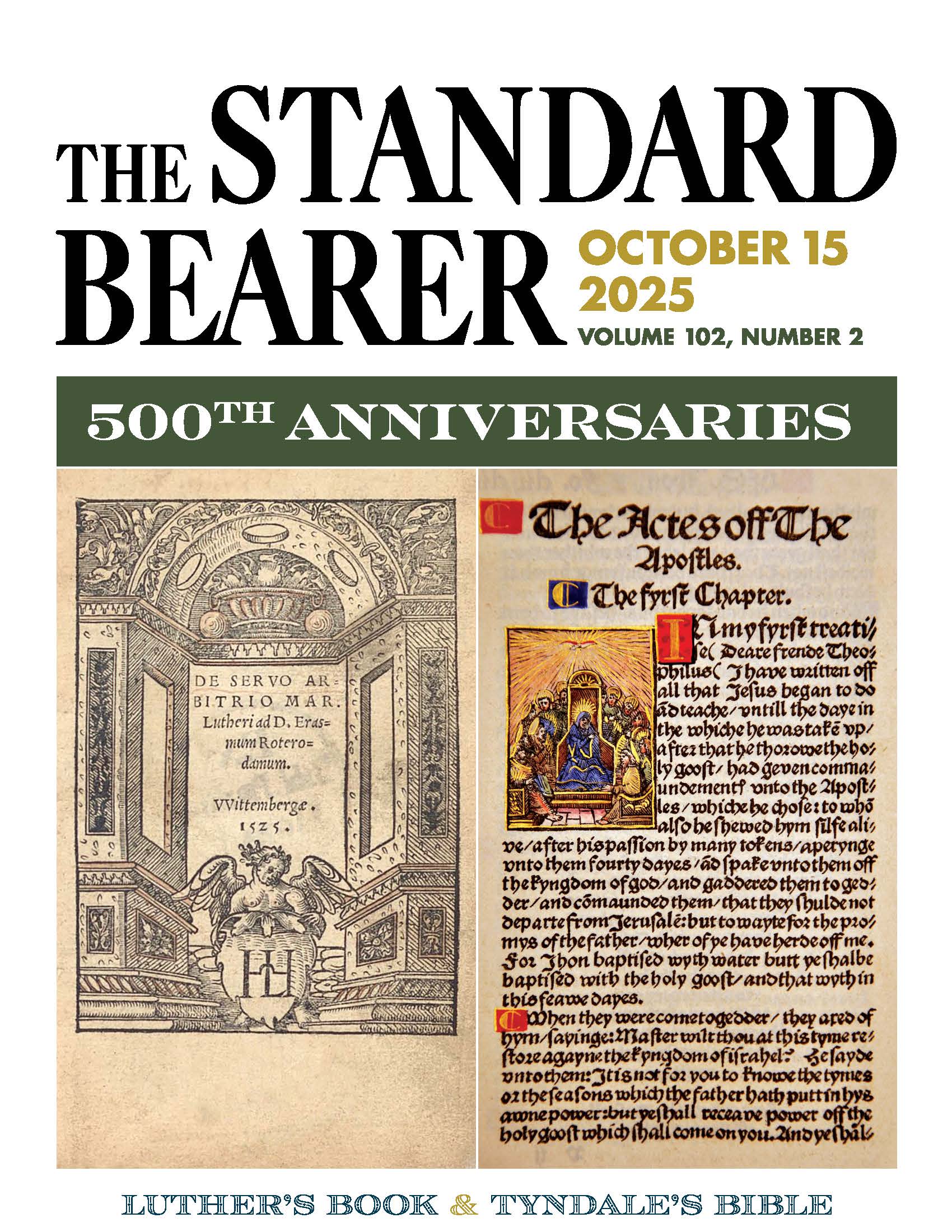
With excitement we present to you this year’s Fall Reformation special issue commemorating the 500th anniversary of two very significant works produced in 1525 (see cover): The Bondage of the Will by Martin Luther and an English translation of the New Testament by William Tyndale. Tyndale’s Bible, which consists of the New Testament and some Old Testament books, was published in 1526 with a revision in 1534. However, he completed his masterful translation in 1525 and was planning to print several thousand copies in Cologne, Germany and convey them secretly back into his homeland of England from which he had...
It is always fascinating to study great figures of church history whom God raised up for extraordinary service on behalf of His covenant. It is also fascinating to try to determine what kind of personal relationship or communication giants of the faith who were contemporaries may have shared if they did not work side by side. For example, did Martin Luther and John Calvin know each other? How? To what extent? Or think about biblical figures like the Old Testament prophets Jeremiah and Habakkuk, did they have any direct communication? How about Adam and Enoch or Methusaleh, for Adam was...
Martin Luther’s The Bondage of the Will is a book that is doctrinally foundational to the great Reformation of the sixteenth century, to be outdone only by the much more extensive doctrinal treatment of John Calvin’s Institutes of the Christian Religion. Martin Luther wrote extensively during his lifetime. The published volumes of his works now number 79. Luther considered The Bondage of the Will the most important of his writings. But there is a background to his writing and publication of this book that must be considered in order to understand the great value of the book for the church...
The Bondage of the Will is famous reformer Martin Luther’s most significant writing for God’s church. Why? It is such a strong defense of salvation by grace alone. The Lord used this work to expose Rome’s error of salvation by merit and keep the Reformation going. Filled with biblical arguments, this treatise still helps us today battle those who teach that man contributes to his own salvation. This writing, and its fame, clearly came about by the providential hand of God. Luther wrote The Bondage of the Will as a response to Desiderius Erasmus, a world-renowned Dutch scholar. The Lord...
Regarding [the plan] to collect my writings in volumes, I am quite cool and not at all eager about it because…I would rather see them all devoured. For I acknowledge none of them to be really a book of mine, except the one On the Bound Will and the Catechism.1 With these typically pointed words Martin Luther classified his many works in a letter from 1535. Of all his numerous writings (which, when combined, amount to over 80,000 pages!), he was only truly convinced of the quality of two. Interestingly, one of these two works is On the Bondage of...
Among the benefits God graciously bestowed upon His church through the Reformation, one of the greatest was (and still is) a return to the Bible. The Roman Catholic Church had strayed in many respects over the centuries, and at the heart of all of her other issues was this: she had left God’s Word behind. Church tradition and the decrees of popes had become the ultimate authority for faith and living. So severe was the neglect of God’s Word that few people had any idea what the Bible said. But the Reformation championed the principle of sola Scriptura, Scripture alone,...
INTRODUCTION The Reformation did not come quickly to England. Separated from continental Europe by water, and held tightly by Rome under a united monarchy and clergy, England sat in medieval darkness longer than Germany and the Lowlands. To be sure, there had long been discontent with clerical corruption, the wealth of the monasteries, and, since Wycliffe, the church’s resistance to Scripture in the English tongue. Yet, it was not until the 1530s that the Reformation formally began to take shape in England. One man God used to ensure the English Reformation’s shape was the shape of Scripture was William Tyndale....
professor of Church History and New Testament in the Protestant Reformed Theological Seminary, and member of Trinity PRC in Hudsonville, Michigan In the begynnyng was that worde and that worde was with god: and god was that worde. John 1:11 For we knowe wele that all thynges worke for the best unto them that love god, which also are called of purpose. Romans 8:28. Nowe abideth fayth, hope, and love, even these thre: but the chefe of these is love. 1 Corinthians 13:13. For I knowe whom I have beleved, and am sure that he is able to...
In the honorable history of the translation of the Bible into English, there is one heroic man and there is one magnificent version that stand out. The former is William Tyndale of Gloucestershire (c.1494-1536) and the latter is the Authorised Version (AV) or the King James Version (KJV) of 1611, named after King James VI of Scotland (1567-1625), who became King James I of England and Ireland (1603-1625). A helpful way to understand both better is to compare them, considering both their striking differences and their highly significant similarities. DIFFERENCES It could be said that, in the minds of both...
Download in pdf, mobi or epub formats

