
Results 1 to 10 of 13
Does God show a saving grace to His elect, based on Christ’s atoning death, and a non-saving grace to every human? Do some who receive grace in this life go to hell after this life? And is the preaching of the gospel an instance of non-saving grace, as God expresses a favor to those who hear but refuse to believe? Many theologians in the Christian Reformed Church in North America (CRC) in the early 1920s answered affirmatively. They asserted that Scripture and the Reformed confessions provided the basis for this positive answer, and that Reformed theologians from the time of...
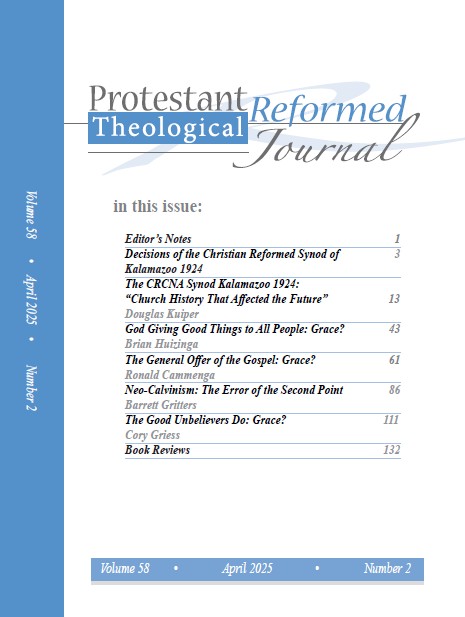
Each of the following articles in this issue references the decisions regarding common grace made by the Christian Reformed Church in North America’s Synod of Kalamazoo 1924. In order that the reader have a fuller understanding of the decisions themselves, of the scriptural and confessional support for them, and of other related decisions that synod made, they are reproduced in full below. Omitted in what follows are quotations from writings of Reformed theologians in the sixteenth and seventeenth centuries to which the synod referred. -Ed. MOTION TO APPOINT A STUDY COMMITTEE Article 124, as taken from the CRCNA English translation...
Anticipation filled the air, and the editor of the Kalamazoo Gazette caught the scent. Welcoming delegates to the 1924 Synod of the Christian Reformed Church in North America (CRC), he wrote, Many questions of importance, not only to the Christian Reformed church but also in a measure, to all Christian denominations in the United States, will come before the synod this year for its prayerful consideration. Church history that will affect the future of all the Reformed denominations will be made in Kalamazoo during the next two weeks.1 In the coming days the synod would remind its member churches of...
The doctrinal issue that I address in this article and that we address throughout this volume of the Protestant Reformed Theological Journal (PRTJ) on common grace, is first, a positive issue. It is true that the Protestant Reformed Churches in America (PRCA) reject the three points of common grace as adopted by Synod 1924 of the Christian Reformed Church (CRC). Furthermore, we reject that doctrine as it has developed in the last one hundred years. Rejecting common grace, we do not stand alone. We stand united with other churches with whom we have an official relationship of one kind or...
The preaching of the gospel is grace, a means of grace, as Scripture teaches and the Reformed confessions affirm. The preaching is God’s means of grace. It is God’s means of grace to all who hear the preaching, that is, to all who hear the preaching who are elect children of God. To them and only to them is the preaching grace. They alone are blessed under the preaching of the gospel. Through the preaching of the Word, the grace of God works sorrow over sin, faith in Jesus Christ, and a life of gratitude in obedience to God’s commandments....
Introduction I was not always onboard with those opponents of common grace in the Protestant Reformed Churches in America (PRCA) who, it seemed to me, were concerned about very little else. That is not to say that I ever embraced the doctrine of common grace, for I was well taught in catechism and seminary what it was all about. I understood and agreed with the PRCA’s opposition. But it is to say that I did not think incessant pounding of that drum was necessary. I imagined that there were bigger fish to fry, and that in our opposition to the...
Introduction Jon A. Roebling, a genius of a man, engineered and built the Brooklyn Bridge. Having already built complex bridges in Pittsburgh, in Cincinnati, and over the Niagara Falls, Roebling was convinced such a bridge could and should be flung over the East River connecting Manhattan and Brooklyn. Though he was an unbeliever, Roebling was so convinced that such a bridge would benefit the common good that he gave much of his own time and money to get the project started. Once it was in motion, he willingly allowed himself to be cheated out of much financial gain to keep...
by Douglas J. Douma. Eugene, OR: Wipf & Stock, 2017. Pp. 292. $37 softcover. ISBN 9781532607240. Reviewed by David J. Engelsma. A correction of the title of this book that might increase its appeal to the average Presbyterian and Reformed reader (who ought to read the book) is The Presbyterian Theologian, or, The Presbyterian Philosopher/Theologian. “Clark came to believe that all knowledge possible to man is limited to the propositions of the Bible and that which can be logically deduced from the Bible” (68). “Clark…claimed that the Bible is the sole source of all human knowledge.” Therefore, Clark’s philosophy later...
by Cornelius Jansen, transl. by Guido Stucco. Washington, D. C.: Catholic University of America Press, 2022 (vii+322). $65.00 hardcover. ISBN 9780813235424. Reviewed by Douglas J. Kuiper. This book review was first published in the April 2025 issue of the Calvin Theological Journal, and is reprinted here with the kind permission of the Calvin Theological Journal. Today the Roman Catholic bishop Cornelius Jansen (1585–1638) is mostly forgotten except by a few scholars, and his masterpiece Augustinus (defending Augustine’s teachings on human depravity, irresistible grace, and divine predestination to a Roman Catholic audience) is not well known. Yet the Jansen controversy was...
by Gerald R. McDermott. Grand Rapids, MI: Baker Academic, 2024. Pp. 448. $44.99. Hardcover. ISBN: 9780801098543. Reviewed by Marco Barone. A History of the Work of Redemption is a series of sermons by Jonathan Edwards (1703–1758). He preached these sermons in 1739, and they were published posthumously in 1773. Edwards planned to revise and expand these sermons into a body of divinity, in a new method, and in the form of a history; in which he was first to show, how the most remarkable events, in all ages from the fall to the present times, recorded in sacred and profane...
Download in pdf, mobi or epub formats

