
Results 1 to 10 of 14
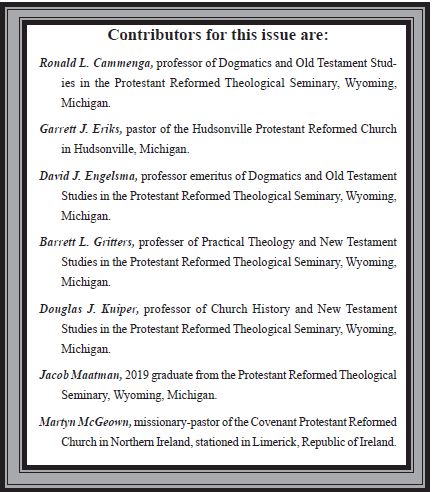
This issue of the Protestant Reformed Theological Journal is late—very late. For that we apologize to our readers. The main explanation for its lateness is the fact that the Protestant Reformed Theological Seminary sponsored a special conference commemorating the 400th anniversary of the Synod of Dordt, 1618-19. It was a three-day conference that demanded the involvement of all our faculty members. Each of us gave a major speech or presentation, along with a number of foreign representatives of churches with whom the Protestant Reformed Churches in America have an official relationship. In addition, we were able to host a goodly...
Defining Salvation In the minds of many, salvation is assumed to be equivalent to justification. Salvation, however, is broader than justification. Salvation is the entire work of God by which He delivers us from sin and brings us into the enjoyment of blessedness in body and soul forever. Salvation includes our future bodily resurrection and our everlasting enjoyment of heaven in the new creation. Finally, salvation includes our conscious enjoyment of the benefits purchased by Christ. With that in mind, consider the following statement: “Salvation is by faith alone.” Is that true? Yes—justification is by faith alone. No—regeneration is not...
Background to Jephthah’s Judgeship The history of the judge Jephthah is probably not as well-known as some of the other judges. Mention of Jephthah in the Old Testament is limited to Judges 11 and 12. Usually what is known of Jephthah is the vow that he made, which is recorded in Judges 11:29-40. Even then, there is often misunderstanding about the nature of that vow. Frequently, Jephthah’s vow is regarded as a rash and sinful vow. Jephthah is criticized for making an unrighteous vow, a vow that he should not have made. The text is cited as an example of...
Although God’s people are called to live for His glory, because of indwelling sin and many temptations, God’s people sometimes fall into great and heinous sins. By these sins they offend God, experience guilt, grieve the Holy Spirit, and may even lose the sense of God’s favor (Canons of Dordt, 5.3). The church sees this reality in marriages, which are under the constant assault of Satan and this world. Within churches today, many members are enslaved to sins of pornography, drunkenness, drug use, self-harm, and many others. Such sins arise out of a heart that is not seeking the one,...
This installment concludes the bibliography of George M. Ophoff (1891-1962), one of the three founding pastors of the Protestant Reformed Churches in America. The first installment (November, 2017) was devoted to writings about Ophoff, as well as works by Ophoff that are not found in the Standard Bearer (SB). The next installment (April, 2018) included Ophoff’s Standard Bearer writings in the areas of New Testament Studies, Church History, and Church Polity, while the third installment (November, 2018) covered his Old Testament writings. This final installment is devoted to Ophoff’s Standard Bearer articles that fall in the category of doctrinal and...
#17: Calvin’s Doctrine of the Last Things Related Topics: Calvin’s amillennial viewpoint and the errors he rejects Calvin’s view of the death of believers and the intermediate state Calvin’s teaching of the second coming of Christ Calvin’s teaching concerning the final resurrection Calvin’s teaching of heaven and hell Adams, Jay E. “A Certain Inheritance.” In John Calvin: A Heart for Devotion, Doctrine, and Doxology, ed. Burk Parsons. Lake Mary, FL: Reformation Trust Publishing, 2008, 179-90. Balke, Willem. “Some Characteristics of Calvin’s Eschatology.” In Christian Hope in Context, vol. 1, ed. A. van Egmond and D. van Keulen. Leiden: Brill...
Honey From the Rock: Daily Devotions from Young Kuyper, tr. James A. De Jong. Bellingham, WA: Lexham Press and Grand Rapids, MI: Dutch Reformed Translation Society, 2018. Pp. xvii + 741. $39.99 (hardcover). [Reviewed by David J. Engelsma.] The aptly titled Honey from the Rock is a collection of devotional meditations by Abraham Kuyper, translated from the Dutch by James A. De Jong. The meditations are Reformed spirituality at its best. The title is fitting in that the honey of the devotionals flows from the rock of Reformed doctrine by way of sometimes ingenious but invariably sound interpretation of...
The Benedict Option: A Strategy for Christians in a Post-Christian Nation, by Rod Dreher. New York: Sentinel, 2017. Pp. xix + 262. $25.00 (hardcover). [Reviewed by David J. Engelsma.] There are any number of reasons why a review of this book in a Reformed journal would be unexpected. The author, himself a devout Roman Catholic, holds up Roman Catholic monasticism as the paradigm for the Christian church’s mode of survival in the present evil days. The Benedict mentioned in the title of the book was the founder of monasticism. In keeping with his fervent Catholicism (although he is as...
Saving the Reformation: The Pastoral Theology of the Canons of Dordt, by W. Robert Godfrey. Sanford, FL: Reformation Trust, 2019. Pp. xiv + 265. $19.00 (hardcover). [Reviewed by David J. Engelsma.] W. Robert Godfrey of the United Reformed Churches (URC) and their seminary, Westminster Seminary California, adds his voice to the chorus of Reformed celebration of the 400th anniversary of the Synod of Dordt, 1618/1619. For the most part, his voice is on pitch and pleasing. Godfrey soundly explains and vigorously defends Dordt’s Canons, the Reformed creed that confesses the gospel of salvation by sovereign, particular grace, while exposing...
The Reformation and the Irrepressible Word of God: Interpretation, Theology, and Practice, ed. Scott M. Manetsch. Downers Grove, Illinois: InterVarsity Press, 2019. Pp. viii + 244. $30.00 (softcover). [Reviewed by David J. Engelsma.] Volumes consisting of individual essays by a number of authors seldom make a good book, even though the essays, or most of them, may be good. The reason is that the volumes are individual essays by a number of authors. This is such a volume. The best, if not the only, way to review such a volume is to comment on each essay, or on those...
Download in pdf, mobi or epub formats


