
Results 1 to 10 of 13
Sermon at the occasion of the decease of The Reverend Hendrik DeCock In life, preacher in the Christian Secession (Faithfully Reformed) Church in Groningen, etc. by S. VanVelzen Preacher in the Christian Secession (Faithfully Reformed) Church in Amsterdam Translated by Marvin Kamps Published at ’s Granvenhage By J. Van Golverdinge 1842 Ecclesiastically Approved The immediately following sermon, as far as concerns specifically its major elements, was preached by the undersigned on the day of the Lord, after the report was sent to me that the venerable and learned Rev. Hendrik DeCock, Christian Secession Reformed pastor and preacher at Groningen, had...
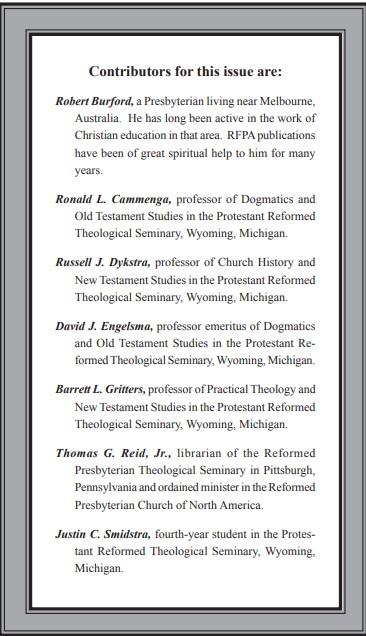
by John Bolt. Wheaton, Illinois: Crossway, 2015. Pp. 266. $19.99 (soft). [Reviewed by David Engelsma.] Bavinck on the Christian Life is the latest in a series of works on their doctrine concerning the Christian life by notable theologians. The series includes Augustine, Bonhoeffer, Calvin, Edwards, Luther, Packer, Warfield, and others. Herman Bavinck certainly belongs in the list. The Dutch Reformed theologian was an outstanding theologian, for whom the life in the world of both Christian and church, that is, the ethical aspect of Christianity, was not merely a matter of implication but a matter of emphasis. The chief benefit of...
by David J. Engelsma. Jenison, MI: Reformed Free Publishing Association, 2016. Pp. 192. $19.95 (hard). [Reviewed by Robert Burford.] In the light of the RFPA’s publication of Prof. David Engelsma’s new book, Christianizing the World: Reformed Calling or Ecclesiastical Suicide?, it would be easy to imagine the modern proponents of the theory of common grace exclaiming, “Another book opposing common grace? Here go the PRCA again!” Such a response would be tacit acknowledgment of Engelsma’s repeated claim in this book that the Protestant Reformed Churches are the denomination best equipped by God to oppose this theory. Perhaps there may even...
by T. David Gordon. Phillipsburg, PA: P&R Publishing, 2009. Pp. 108. $9.99 (paper). [Reviewed by Barrett L. Gritters.] One might expect that Why Johnny Can’t Preach would be most useful for, if not exclusively written for, preachers and seminary professors. In fact, it is a book as much for school teachers, parents, and elders as for preachers and professors. Titled after the Why Johnny Can’t Read (1966) and Why Johnny Can’t Write (1990) books written for a secular audience, Why Johnny Can’t Preach is written for a Christian and specifically a Reformed Christian audience. And, although it blames some preachers...
by John Owen. Ed. Kelley M. Kapic and Justin Taylor. Wheaton, IL: Crossway, 2007. Pp. 445. $28.00 (soft). [Reviewed by David J. Engelsma.] The English Puritan John Owen (1616-1683) is not as well known by us as he ought to be. Perhaps, by the efforts of J. I. Packer we are acquainted with Owen’s The Death of Death in the Death of Christ. But we have read little more. Owen himself may be partly responsible for his not being better read. His style was prolix. His exposition of his theme was detailed and complex, if not complicated. Like many other...
Dewey Roberts. East Peoria, IL: Versa Press, 2016. Pp. 410. $24.99 (hard). [Reviewed by David Engelsma.] The strength of the book is its width. It critiques the Federal Vision broadly, from its doctrine of baptismal regeneration, which can be lost, to its doctrine of the final judgment, which will be based on man’s works. With appropriate appeal to Scripture and the Reformed creeds, as well as to the Christian tradition, the book demonstrates, beyond the shadow of a doubt, the egregious heresy of the theology of the Federal Vision. The Federal Vision is un-Reformed and un-Christian. The author charges semi-Pelagianism,...
(Edited and annotated by Janet Sjaarda Sheeres, transcribed by Hendrick K. Harms, translated by Richard H. Harms, for the Historical Committee of the Christian Reformed Church in North America.) Grand Rapids, MI: Wm. B. Eerdmans, 2013. Pp. i-xxxiv + 1-634. $69.95 (paper). [Reviewed by Barrett L. Gritters.] Reading minutes of the broader assemblies (classis and synod) of the Christian Reformed Church in its beginnings (1857-1880) may sound about as interesting as reading an encyclopedia. But in truth, anyone interested in the church of Jesus Christ, especially its history, will be fascinated by these old records now put into good form...
This issue of the Protestant Reformed Theological Journal is the first issue of volume fifty. That, certainly, is a milestone! For fifty years, without interruption, the Lord has made it possible for the Protestant Reformed Seminary to publish two issues per year of its theological journal. Founded in 1966, at a time when the seminary was housed in the basement of the First Protestant Reformed Church, located on the corner of Fuller Avenue and Franklin Street, the first issues were a “testing of the waters” to determine whether there was sufficient interest to warrant continued publication. From the enthusiastic reception...
This year marks the 499th anniversary of the great Reformation of the sixteenth century, or, rather, God’s great work in the Reformation of the sixteenth century. Next year the church will celebrate the 500th anniversary of the Reformation. Already plans are being made to commemorate this milestone with conferences and special events. The Protestant Reformed Seminary is laying plans for a two-day conference in the Grand Rapids, Michigan area, a conference that will call attention to a number of different, enduring contributions of the Reformation. We intend to include in our celebration speakers from abroad, particularly speakers from our sister...
by B. Wielenga. Tr. Annemie Godbehere. Ed. David J. Engelsma. Jenison, MI: Reformed Free Publishing Association, 2016. Pp. xx + 425. $39.95 (hard). [Reviewed by David J. Engelsma.] The liturgical form most often read in a Reformed church is, undoubtedly, the Form for the Administration of Baptism. This judgment excludes the Heidelberg Catechism, a major Reformed confession that is never read in a worship service of the congregation in its entirety. No Reformed man or woman tires of the Form, at least not when he or she is living in the consciousness of faith and certainly not when the Form...
Download in pdf, mobi or epub formats

