
Results 1 to 10 of 15
The 400th anniversary of the venerable Synod of Dordt is fast approaching. That august assembly, meeting from the winter of 1618 through the spring of 1619, settled a raging conflict in the Reformed churches in the Netherlands over the doctrines of sovereign grace and produced a rich, beautiful statement of faith for the benefit of many generations. It was, without question, one of the greatest victories given by God to the New Testament church of Christ. With good reason one of the delegates could, whenever mention was made of the Synod afterwards, raise his hat and cry, “Sacrosancta Synodus! Most...
Compiled by Ronald Cammenga #4: Calvin’s Doctrine of the One, True, and Triune God Related Topics: The evil of idolatry The one true God as revealed: a. In creation b. In sacred Scripture Calvin’s doctrine of the Trinity as: a. Embracing the language and distinctions of the early church fathers b. Embracing the language and distinctions of the early church creeds Calvin’s orthodox confession of the truth of the Trinity a. God as singular in essence b. God’s one divine being subsisting in three distinct persons Two important emphases in Calvin’s doctrine of God a. God’s Fatherhood b. God’s absolute...
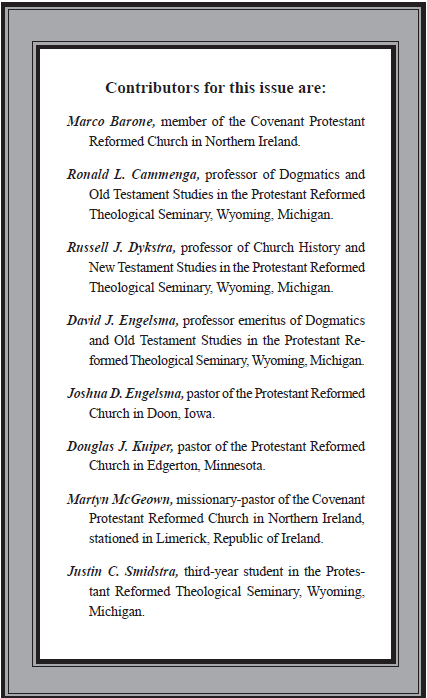
You hold in your hand the April 2016 issue of the Protestant Reformed Theological Journal. Included in this issue are three articles and a number of book reviews, some of them rather extensive. We are confident that you will find the contents of this issue worth the time you spend in reading—well worth the time. Few doctrines of the faith are more precious to the Reformed believer than the doctrine of God’s everlasting covenant of grace. Few books of the Bible are dearer to the saints than the book of Psalms. Prof. Dykstra puts those two together in the first...
A Relationship of Friendship Psalm 25:14 The secret of the Lord is with them that fear him; and he will shew them his covenant. Psalm 55:14 We took sweet counsel together, and walked unto the house of God in company. The Reformed church can be characterized in many ways. A Reformed church is confessional, that is, she holds to the Reformed confessions as her standard. A Reformed church maintains the doctrines of sovereign, particular grace. She also stands consciously on the foundation of Scripture, defending it as the infallible and inerrant Word of God, authoritative for doctrine and life....
Joel R. Beeke and Paul M. Smalley, Grand Rapids, Michigan: Reformation Heritage Books, 2013. Pp. xiii + 287. $19.00 (paper). [Reviewed by Martyn McGeown.] It is no secret that Joel Beeke loves the Puritans. In this book, Beeke and Smalley examine one of Puritanism’s most controversial doctrines, preparatory grace or “preparation.” The Puritans were faced with a situation in which almost everyone was a member of the church. Clearly, a great number of churchgoers were unbelievers. How, then, could the preacher awaken the carnal, self-righteous hypocrites sitting in the pews to their need of salvation? The Puritans developed a theology...
by Kevin DeYoung. Wheaton: Crossway, 2012. Pp. 159. $17.99 (hardcover). [Reviewed by Ronald Cammenga.] This is a popularly written book about the doctrine of sanctification. The book’s author is Kevin DeYoung, the pastor of University Reformed Church (URC) in East Lansing, Michigan, and recently appointed Chancellor’s Professor of Systematic and Historical Theology at Reformed Theological Seminary (RTS). University Reformed Church was affiliated with the Reformed Church in America (RCA), but under DeYoung’s leadership recently withdrew from that denomination and has joined the Presbyterian Church in America (PCA). While teaching for RTS, DeYoung intends to continue to pastor URC. Kevin DeYoung...
by Sinclair B. Ferguson. Wheaton, Illinois: Crossway, 2016. Pp. 256. $24.99 (hardcover). [Reviewed by David Engelsma.] Much of this book is sound Reformed doctrine concerning Jesus Christ as the complete (“whole”) Savior; justification; sanctification; and assurance of salvation. There are provocative insights, particularly, that legalism and antinomianism are not, in fact, heretical opposites, but closely related errors—“ non-identical twins,” as Ferguson describes them. Also, there is helpful pastoral wisdom concerning the struggles of some believers to possess and enjoy assurance of salvation. Lending worth to the work for Presbyterians and Reformed is the author’s relating all these fundamental doctrinal and...
by Eugene P. Heideman. Grand Rapids: William B. Eerdmans Publishing Company, 2015. Pp. xxxv + 278. $30.00 (paper). [Reviewed by Ronald Cammenga.] Hendrik P. Scholte: His Legacy in the Netherlands and in America is a fascinating treatment of the life and legacy of one of the earliest leaders of the Secession of 1834 in the Netherlands known as the Afscheiding. Dr. Eugene Heideman’s account of Scholte’s ministry, interaction with other Afscheiding notables, contributions to the development and solidification of the reform movement that separated from the state church of the Netherlands, his founding and editorship of the Dutch church paper...
by L. Charles Jackson. Grand Rapids, MI: Reformation Heritage Books, 2015. Pp. 312 (hardcover). $30.00. [Reviewed by Douglas Kuiper.] As king of England, Scotland, and Ireland from 1625 to 1649, Charles I believed that all answered to him, and he to none. He considered the English Parliament unnecessary, dismissing it more than once. He viewed himself ruler not only of the state but also of the church, and worked to impose the Episcopalian form of worship and church government on all churches. Understandably this troubled many, particularly in Scotland, whose conscience directed them to favor the Presbyterian (Reformed) religion, form...
by Matthew Levering. Grand Rapids, MI: Baker Academic, 2013. Pp. xviii + 224 $26 (paper). [Reviewed by Marco Barone.] The aim of this book is to present the theology of Augustine of Hippo (AD 354–430) through the exposition of “seven pivotal works” (xii). This is an ambitious task for two reasons. First, Augustine of Hippo is one of the greatest theologians in the entire history of the church, and arguably the greatest theologian of the ancient and medieval church. To summarize the teaching of such a great mind is never easy, and such a summary will necessarily leave something out....
Download in pdf, mobi or epub formats

