
Results 1 to 10 of 12
Two words in our title require some explanation. The English words, irenic and polemical, are both derived from Greek, with both appearing (in various forms) in the New Testament. Polemics is concerned with war and irenics with peace. This accounts for the article’s subtitle: “War and Peace in the Heidelberg Catechism.” Unlike Leo Tolstoy’s famous, epic novel War and Peace (1867), we are dealing here not with a physical war (such as, the invasion of Russia by the French under Napoleon) but with a holy war and peace, the spiritual war and peace of the biblical and Reformed gospel of...
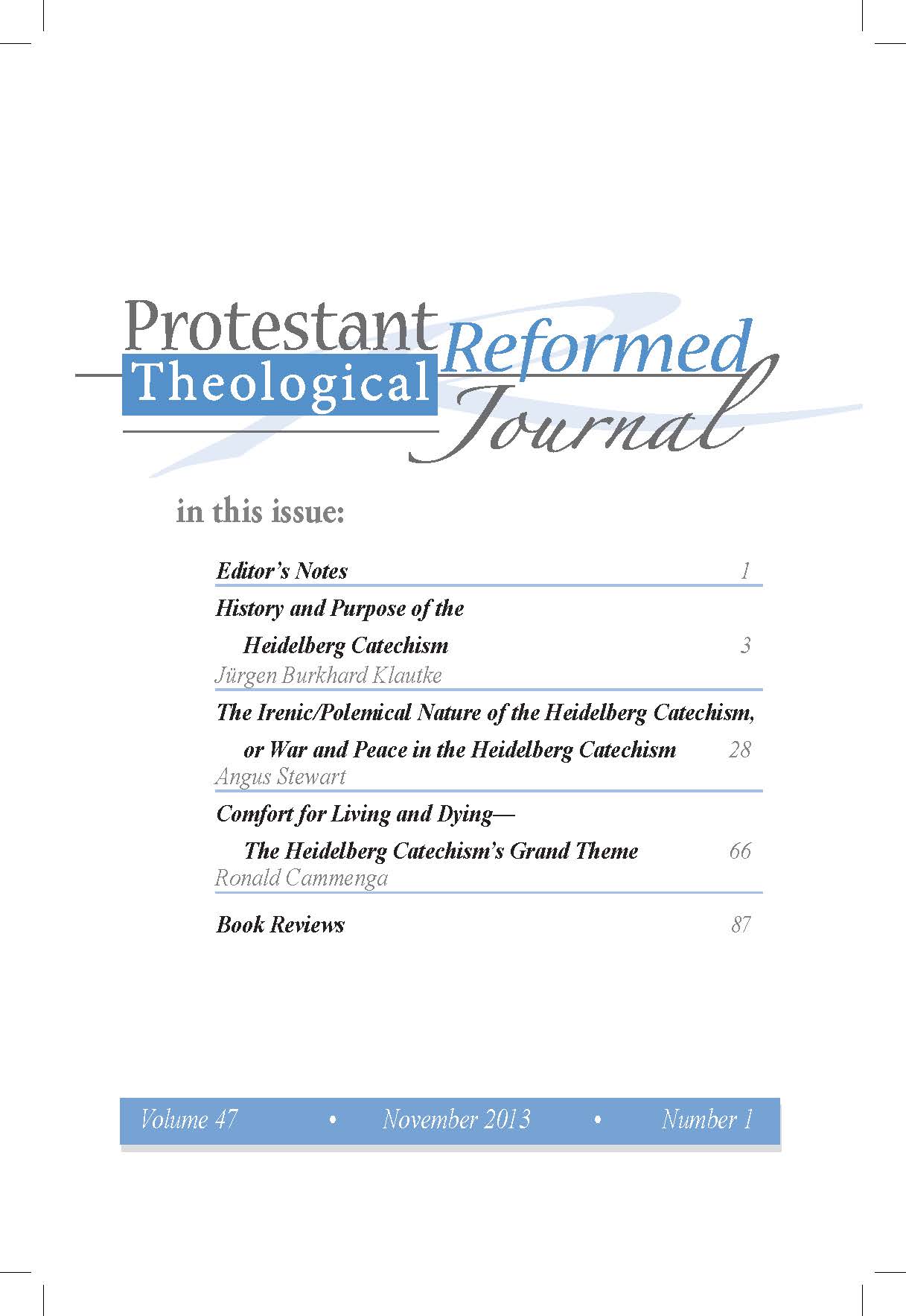
This issue of the Protestant Reformed Theological Journal is the first of two special issues. Both issues feature the speeches—three in this issue and three in the April 2014 issue—that were delivered at the conference sponsored by the Protestant Reformed Theological Seminary commemorating the 450th anniversary of the publication of the Heidelberg Catechism. The conference was held in the Hudsonville Protestant Reformed Church, Thursday through Saturday, October 17-19, 2013. We had an excellent turnout for the entire conference. What’s more, the speeches were “live-streamed,” and the indications were that over two-hundred people joined the conference at each session by this...
Introduction “What is thy only comfort in life and death?” For 450 years, in many different languages, nearly all the languages of the countries in which the Reformed faith found a home, that question has been asked. Ministers and elders have asked the question. Christian school teachers have asked the question. Parents have asked the question. And believers have put the question to their fellow believers and to themselves. And for 450 years the answer has been given: “That I with body and soul, both in life and death, am not my own, but belong unto my faithful Savior Jesus...
William Ames, trans. Todd M. Rester. Grand Rapids: Reformation Heritage Books, 2008, hardback, xxxii + 253 pp. ISBN 978-1-60178-045-4. [Reviewed by Angus Stewart.] Not Really a Heidelberg Catechism Commentary If you are looking for a commentary on the Heidelberg Catechism, this book will disappoint you, for it is not really an exposition of the Heidelberger. William Ames did not believe in preaching the Heidelberg Catechism. Instead, he picked a verse or verses from the Bible on the subject of the Lord’s Day and expounded his scriptural text. The fifty-two Lord’s Days are treated in forty-eight chapters, with Ames taking...
The Catechism, whose 450th anniversary we celebrate this year, is named after the German city of Heidelberg, because it was written and published there. In order to understand its development, we should keep in mind the political context of that time. 1. History of the Heidelberg Catechism 1.1. The Political Context In 1563 Heidelberg was the capital of the Palatinate. The Palatinate was a territory within the German Empire, or as it was known back then, the Holy Roman Empire. The Heidelberg Catechism was not only created in Heidelberg, it was intended to be the official doctrinal basis of this...
by Anthony N. S. Lane. Grand Rapids, MI: Baker Academic, 2009. 174 pages. Paperback $15.00. [Reviewed by Douglas J. Kuiper.] This is a “reader’s guide” to aid in reading the 1960 McNeill-Battles translation of Calvin’s Institutes. Anthony Lane informs the reader at the outset: “This volume…is not a book to be read in its own right but functions purely as a reading guide.” And a paragraph later, “This volume could be used in conjunction with a different translation of the Institutes, but a significant amount of material would then no longer be relevant” (9). To guide one in studying...
Starr Meade, P&R Books, Phillipsburg, NJ, 2013. Paperback, 255 pp. [Reviewed by Martyn McGeown.] Starr Meade has written a beautiful and worthwhile book. It is commendable to see a book on family devotions which does not dumb down doctrine for children or ignore doctrine altogether in favour of silly stories; and it is heartwarming to see our beloved Heidelberg Catechism itself used as the basis of family devotions. The same author has written a devotional based on the Westminster Shorter Catechism so this is her second “creedal devotional” work. The aim of the book is to have families memorize...
A Westminster Divine and Extra Ecclesiam Nulla Salus by John Philips (1585-1663), edited by C. Matthew McMahon & Therese McMahon. Puritan Publications, USA, 2013. 120 pages. Paperback $14.99, eBook $7.99. ISBN: 978-1-938721-95-3, eISBN: 978-1-938721-94-6. [Reviewed by Angus Stewart.] Introduction Some in our day claim that it is Roman Catholic or “extremist” to teach that outside the church there is no salvation (Latin: extra ecclesiam nulla salus), even though this is the teaching of the historic Christian church, from the church fathers onwards, including the Reformers, their successors and the Reformation creeds: Luther’s Larger Catechism, the Catechism of the Church...
by Petrus Van Mastricht, translated and introduced by Todd M. Rester. Grand Rapids, MI: Reformation Heritage Books, 2013. 82 pages. Paperback $10.00. [Reviewed by Douglas J. Kuiper.] “This little book on preaching, translated from Latin and Dutch, is intended to whet your appetite for what is to come in the projected publication of Petrus van Mastricht’s massive dogmatics, Theoretico-practica Theologia, which is presently being translated and published by the conjoined efforts of the Dutch Reformed Translation Society and Reformation Heritage Books” (21). Why a book on preaching to whet our appetite for a book on theology? Todd Rester indicates...
edited by Willem van ’t Spijker, translated by Gerrit Bilkes. Grand Rapids: Reformation Heritage Books, 2009, hardback, x + 291 pp. ISBN 978-1-60178-056-0 [Reviewed by Angus Stewart.] The title of this fine work on the Heidelberg Catechism, The Church’s Book of Comfort, alludes to the famous first question: “What is thy only comfort in life and death?” It consists of nine articles in seven chapters by six Dutch theological doctors, dealing with church history, biography, theology and catechetics, and complete with helpful pictures, boxed inserts and bibliographical details. Summary of Contents The opening chapter, “The Reformation in Germany,” sets...
Download in pdf, mobi or epub formats

