
Results 1 to 10 of 10
Introduction The great sixteenth-century Reformation was a powerful work of God restoring His church back to the Bible in every area—doctrine, worship, church government, and life. Headed especially by Luther, this reformation was carried on by a host of dedicated and capable men, including Zwingli and Calvin, whom God raised up for the work. Since the Reformation was a return to the Bible, it should surprise no one that the Reformers were men who were—in their lives and work—closely tied to the Bible. In fact, if we were to pick out one personal conviction, one characteristic passion, found in every...
Introduction The story of the King James Bible is the story of a king, a conference, and a committee. The king was James I, who had just ascended the throne of England. James had been the king of Scotland as James VI. But when Queen Elizabeth died after reigning for nearly half a century, James was next in line to the throne of England. (For the smug satisfaction of those who like to keep track of such things, James was Elizabeth’s first cousin, twice removed.) James VI of Scotland became James I, king of England, in 1603. Elizabeth was the...
Introductory Comments To assess critically the English translations of the Bible other than the King James Version (KJV or AV) is a dizzying task. It is not unlike attempting to explain to a driver of Mercedes S Class cars the strengths and weaknesses of every other make and model of cars, in 45 minutes; or trying to tell a young man who has just become engaged to be married the strengths and weaknesses of 100 other young ladies in the world. Is he interested? Should he be? According to my estimates, there are approximately 150 modern (from 1800 to today)...
Leland Ryken. Wheaton: Crossway, 2011. Pp. 265. $15.00 (paper). [Reviewed by Charles Terpstra.] “Of making many books” on the King James Version of the Bible during this year of commemorating her 400th anniversary there seems to be “no end” (Eccl.12:12). And truth be told, the study of some of these books is indeed “a weariness of the flesh.” But not so is it with this wonderfully informative and engaging book written by Leland Ryken, professor of English at Wheaton College, master of the English language and its history, and expert witness to the power and influence of the KJV!...
David Teems. Thomas Nelson, 2010. Pp. 301 (paper). [Reviewed by Herman Hanko.] I have seldom read such a well-written and interesting book on the behind-the-scenes happenings and the actual translation of the King James Version of the Bible. The blurb on the back cover is not exaggerating when it says, “David Teems’ narrative crackles with wit, using a thoroughly modern tongue to reanimate the life of this seventeenth century king—a man at the intersection of political, literary, and religious thought, yet a man of contrasts, dubbed by one French king as ‘the wisest fool in Christendom.’” Its theme is...
Laurence M. Vance. Pensacola: Vance Publications, 2006. Pp. 167 (paper). [Reviewed by Herman Hanko.] Dr. Vance has brought together fourteen essays he has written over the years in defense of the King James Version of the Bible. The essays are roughly divided into four groups. The first group, composed of four essays, deals with the history that resulted in the KJV and the translators who did the work. The second group of three essays discusses the translators’ finished product. The third group of two essays examines the KJV in the context of the history of the English Bible. And the...
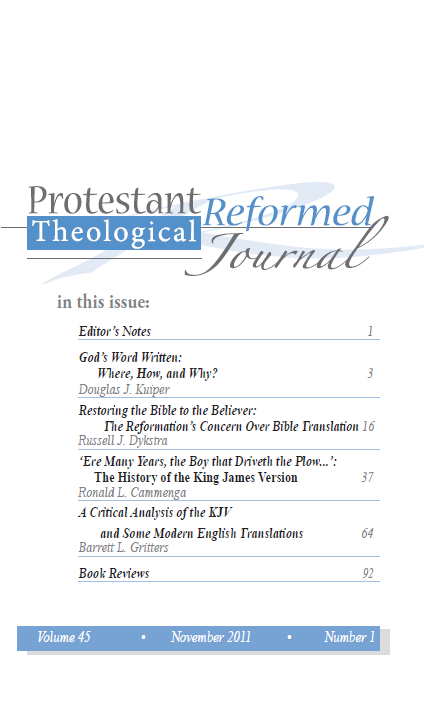
The November 2011 issue of the Protestant Reformed Theological Journal is devoted to articles and book reviews that commemorate the 400th anniversary of the King James Version of the Bible. Included in this issue are the speeches that the faculty gave at the Seminary-sponsored celebration that was held the second week of October in the First Christian Reformed Church of Byron Center, Michigan. Prior to the Seminary’s celebration of this noteworthy anniversary, the faculty gave their speeches at the Officebearers’ Conference of Classis West of the Protestant Reformed Churches. The conference was held at the Peace Protestant Reformed Church in...
For whatsoever things were written aforetime were written for our learning, that we through patience and comfort of the scriptures might have hope. Romans 15:4 God communicates to His people by His word, His revelation of Himself. Our words take different forms—spoken, written, signed. So does God’s word. God gives His word to the church in spoken form (the prophets and apostles), written form (the Scriptures), and incarnate form (Christ in the flesh). Apart from the form of the incarnate Word, the other forms are without substance. Christ’s work of coming in our flesh was God speaking His Word to us:...
Introduction The great sixteenth-century Reformation was a powerful work of God restoring His church back to the Bible in every area—doctrine, worship, church government, and life. Headed especially by Luther, this reformation was carried on by a host of dedicated and capable men, including Zwingli and Calvin, whom God raised up for the work. Since the Reformation was a return to the Bible, it should surprise no one that the Reformers were men who were—in their lives and work—closely tied to the Bible. In fact, if we were to pick out one personal conviction, one characteristic passion, found in every...
Download in pdf, mobi or epub formats

