
Results 1 to 10 of 10
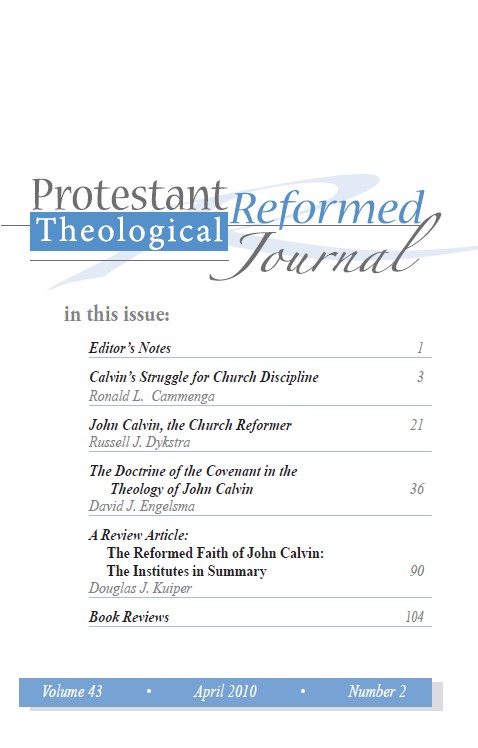
This issue of the Protestant Reformed Theological Journal contains the last three speeches that were presented at the Calvin Conference sponsored last fall by the Protestant Reformed Seminary. The undersigned examines Calvin’s crucially important work on behalf of the restoration of biblical church discipline. As I indicate in the article, Calvin’s enduring contribution in this whole area was the result of several great struggles in which he was personally involved, struggles that entailed sacrifice and loss for Calvin. He did not draw back. He maintained strong, biblically-informed convictions, for which he was willing to suffer persecution. May God stir up...
Introduction By a conference such as this the Protestant Reformed Seminary acknowledges its debt to the great sixteenth-century Reformer John Calvin. Without hesitation, without any embarrassment, we embrace the heritage that God has given to us through the great Reformer John Calvin. We are Calvinists. Gratefully we are Calvinists. We are convicted of the truths of Calvinism. We train men in the precious truths of Calvinism. We send them forth to proclaim the truths of Calvinism throughout the world. In the “Catalog of the Theological School of the Protestant Reformed Churches,” in the opening paragraph that introduces everything else in...
John Calvin was a church reformer par excellence. He was a church reformer only because God made him a church reformer, for the church is God’s and reformation is God’s work. When the church of God apostatizes from His truth and the biblical pattern for the church, then reform is required. The church must be re-formed, that is, formed back to the Bible. Church reformation is a spiritual work, and therefore reformation begins with the Spirit changing the hearts of the members. God Himself determines the man who will work mightily to lead the church back to the Bible. God...
Introduction The doctrine of the covenant of grace is thrust to the foreground in Reformed and Presbyterian churches by the contemporary heresy of the federal vision. The name of the heresy, by which its proponents themselves call their teaching, clearly indicates that this teaching puts the doctrine of the covenant on the front burner of the Reformed churches, for “federal” means “covenant.” Although the heresy corrupts every aspect of the confessional Reformed doctrine of salvation, from justification to perseverance, as well as the doctrine of the atonement of the cross, it is fundamentally a vision of the covenant. Closely related...
by David J. Engelsma (Jenison, MI: Reformed Free Publishing Association, 2009). Pp xiii + 455. $34.95. Hardcover. [Reviewed by Douglas J. Kuiper.] Within a few decades of the publishing of the 1559 edition of Calvin’s Institutes, summaries of Calvin’s work began to appear. If not the first summary, Caspar Olevianus’ Institutionis Christianae Religionis Epitome (Epitome of the Institutes of the Christian Religion) was one of the first, published in 1586. In commemoration of the 500th anniversary of Calvin’s birth in 2009, more summaries have recently appeared. In 2008, Presbyterian and Reformed Publishing Company (P&R) published the book Theological Guide...
D. A. Carson (Grand Rapids: William B. Eerdmans Publishing Company, 2008). Pp. 243 (hard cover), $24.00. [Reviewed by Herman Hanko.] The question of the relation between the Christian believer and the culture of the world in which he lives is an important one. It has been a topic high on the agenda of the church ever since the days of Augustine, bishop of Hippo. Indeed it can be argued that with the founding of the New Testament church, it has been a crucial question, which believers have been forced to face since Pentecost. Although Scripture itself does not use...
by Robert Godfrey (Wheaton, Illinois: Crossway Books, 2009). Pp. 207 (soft cover). [Reviewed by Herman Hanko.] Godfrey has written an excellent biography of John Calvin that should have an important place among the many other biographies that have appeared over the years. I would recommend it for reading in our high schools in any church history classes that include the history of the Reformation. It is a book that in my judgment is what a biography of a church father ought to be. It does not give mere data on Calvin’s life. It makes no effort to explain his...
by Bruce Gordon (New Haven: Yale University Press, 2009). Pp. 398 (hard cover), $35.00. [Reviewed by Herman Hanko.] This book, written by a professor of reformation studies at Yale Divinity School, has been said to be the definitive biography of the great Genevan reformer. I am very much inclined to agree. I have read many biographies of Calvin, but I cannot remember reading one that was as interesting, comprehensive, informative, and accurate as Gordon’s work. It was written in commemoration of Calvin’s 500th birthday, which took place last year. It is a worthy addition to the countless books on...
by Herman J. Selderhuis, tr. by Albert Gootjes (Nottingham, England: InterVarsity Press). Pp. 287 (soft cover). [Reviewed by Herman Hanko.] With the 500th anniversary of the birth of John Calvin, a spate of books have come out on Calvin’s life and doctrine. The book under review is, as the title suggests, a biography. I have mixed feelings about it. The author is professor of Church History and Church Polity at the Theological School in Appeldoorn, Netherlands. He is also director of the University’s Institute of Reformation Research. He, as professor in a Reformed Seminary, stands in the line of Calvin,...
by Randall C. Zachman, ed. (Grand Rapids: Baker Academic, 2008). Pp. 224 (soft cover). [Reviewed by Herman Hanko.] We are given, between soft covers, the papers presented at the Calvin Studies Colloquium held in 2007 at the University of Notre Dame. Claiming in a rather boastful way that “a good deal of the best scholarship on Calvin has been done by Roman Catholics,” the book is quite convincing proof of the error of that claim. Its avowed goal is ecumenical; that is, the book is an effort to bring Protestantism and Roman Catholicism closer in the hopes of ultimate union....
Download in pdf, mobi or epub formats

