
Results 1 to 10 of 11
by Edward J. Young. Willow Grove, PA: The Committee for the Historian of the Orthodox Presbyterian Church, 2007. 112 pages. $5.00. Softcover. [Reviewed by Douglas J. Kuiper.] The four chapters that comprise this book are the written version of four lectures that Edward J. Young (1907-1968) gave in 1966 at Grace Theological Seminary and College, and which were published in the Fall 1966 volume of the Grace Journal. Spoken some nine years after the publication of Young’s well known book Thy Word is Truth, these lectures “clearly reflect the basic contents of that book” (7), according to Richard...
by N. T. Wright. Downers Grove, IL: InterVarsity Press, 2009. 279 pages. Cloth ($25.00). [Reviewed by David J. Engelsma.] The main value of this latest book by the prolific N. T. Wright is its demonstration of the radical rejection of the sixteenth century Reformation of the church, particularly orthodox, creedally Reformed Christianity, by the New Perspective on Paul (hereafter, NPP). Indeed, despite Wright’s disarmingly deceptive, gentlemanly manner, the book is another salvo in the NPP’s attack on the gospel, recovered by the Reformation. Wright is forthright: “The stray lambs [Wright and his NPP cohorts—DJE] are not returning to...
by Carl R. Trueman. Burlington, VT: Ashgate Publishing Co, 2007. 132 pages. $29.99. Softcover. [Reviewed by Douglas J. Kuiper.] This book is part of a series entitled “Great Theologians,” which Ashgate is publishing. Other theologians treated in this series include Athanasius, Aquinas, Barth, and Anselm of Canterbury. The subject of this present work is John Owen, who “was without doubt the most significant theological intellect in England in the third quarter of the seventeenth century” (1). Carl Trueman, author, is professor of historical theology and church history at Westminster Seminary in Philadelphia. The main theme of the book is...
ed. Douglas A. Sweeney and Allen C. Guelzo. Grand Rapids: Baker Academic, 2006. 320 pages. $29.99. Softcover. [Reviewed by Douglas J. Kuiper.] This book is a “collection of the New England Theology’s primary texts” (24)—selections from the writings of the two Jonathan Edwards (the well known preacher, and his son by the same name), Joseph Bellamy, Samuel Hopkins, Sarah Osborn, Nathan Strong, Nathanael Emmons, Stephen West, John Smalley, Asa Burton, Timothy Dwight, Nathaniel W. Taylor, James Harris Fairchilds, Charles G. Finney, Edwards Amasa Park, and Harriet Beecher Stowe. The thesis that the book demonstrates is that these writers were...
by Robert A. Peterson. Presbyterian & Reformed Publishing, 2007. 208 pages. Paper. (Part of the Series, “Explanations in Biblical Theology.”) [Reviewed by Herman Hanko.] One whose love is Reformed theology picks up a book with this or a similar title with a certain eagerness. The book is on a doctrine that is close to his heart and one of such interest to the church and to believers that it has been a subject of discussion, debate, and disagreement for over 1,500 years—that is, since the time of the great bishop of Hippo, Augustine. The author, professor of systematic theology...
by A. T. B. McGowan. Downers Grove, IL: InterVarsity Press, 2008. 240 pages. Paper. [Reviewed by Herman Hanko.] This is a very puzzling book. The author professes to hold to the errorless character of Scripture, and yet he argues vehemently against the doctrine of inerrancy. He sets inerrancy, which the book sharply condemns, over against infallibility, when both words mean the same thing according to my unabridged dictionary. He argues strongly against the position of Warfield and Hodge, who held to inerrancy, but recommends the position of James Orr. I find the book strange and unclear. But let me...
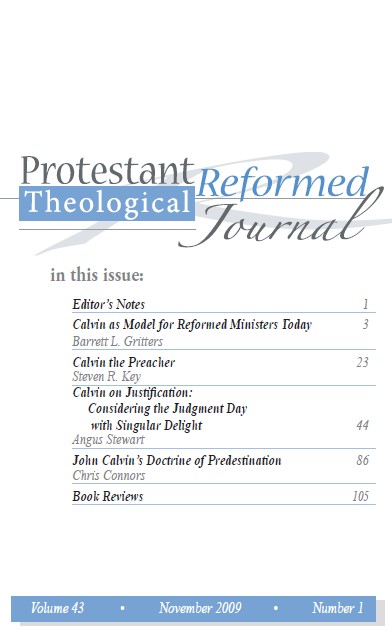
Introduction “If I wished to write a confession of my faith; I could do so with all fullness and satisfaction to myself out of his writings.” That is what Calvin said of Augustine; and I say it of Calvin. I suppose that means this paper has a huge bias. I am a Calvinist by conviction—for I believe the doctrines of grace are the gospel. That may not be the most scholarly approach—but I am unrepentant! Indeed, my hope is that this speech might in some small way spur us all to kneel alongside the apostle Paul, Augustine, Luther, and Calvin...
Approach and Orientation Right from the very first time that I read John Calvin’s Institutes of the Christian Religion, I was deeply struck by especially one thing in his treatment of justification: his repeated and forceful call to consider ourselves before the heavenly judgment seat of Almighty God. All are, or should be, aware of the theological issues. Does justification mean “make righteous” or “reckon righteous”? Is justification the infusion of righteousness or the imputation of righteousness? Is justification by faith and works or by faith alone? As Calvin puts it, these things are not “frivolous word battles,” but this...
Considering that the inspired apostle Paul was compelled to speak of “the foolishness of preaching,” men of the world would certainly find it astounding that so many should be gathered together to consider John Calvin as a preacher. Calvin’s contributions were many. Even the world recognizes the impression he left upon many aspects of life not only in Geneva, but in Europe and from there spreading to North America. But the one thing that Calvin himself would be remembered for—I have no doubt—is that he stood before God a faithful preacher of the gospel. While the focus of this conference...
Reading the life and work of John Calvin is intimidating. It can also be invigorating and motivating for a Reformed pastor. Few will ever attain the stature of such a giant servant of Jesus Christ, but all can pray that Christ will use them as He used Calvin. If Reformed ministers today in their 50-year pastorates did half of what Calvin did in his 27, preached a quarter as often per week as Calvin preached, worked with a tenth as much energy as did this man of God, reached even to Calvin’s knees in theological stature, were devoted to the...
Download in pdf, mobi or epub formats

