
Results 1 to 10 of 16
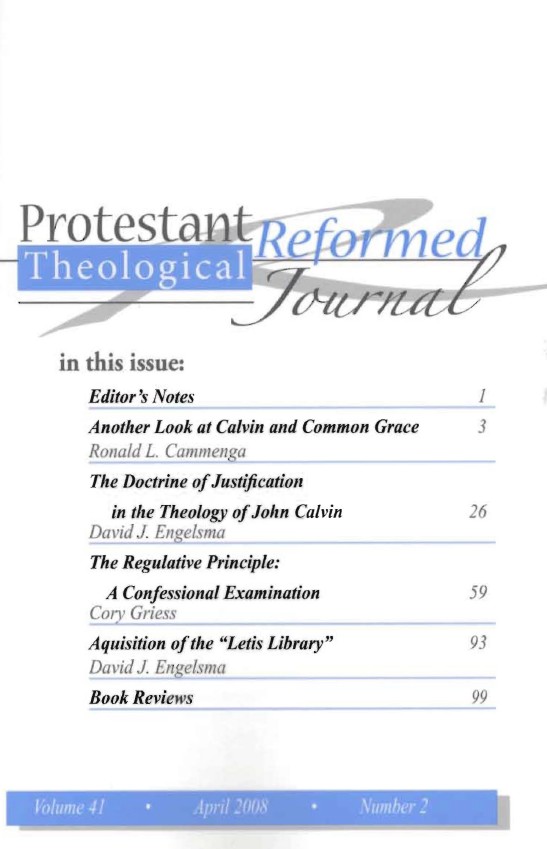
This issue of the Protestant Reformed Theological Journal contains articles by two faculty members of the Protestant Reformed Theological Seminary (PRTS). Each contributes an article dealing with an aspect of the theology of the sixteenth-century reformer John Calvin. Prof. David Engelsma writes concerning John Calvin’s doctrine of justification in “The Doctrine of Justification in the Theology of John Calvin.” The men promoting the heresy of the Federal Vision attempt to drive a wedge between the teaching of Calvin on justification and the teaching of Martin Luther. They contend that whereas Luther taught justification by faith alone, Calvin taught justification by...
Introduction Proponents of common grace have long appealed to John Calvin in support of the teaching of common grace. This appeal to Calvin has been made by individuals as well as by church bodies. The argument is advanced that, although admittedly Calvin did not fully develop the teaching that later became known as common grace, the seeds of common grace can be found in his writings. Already at the time of the Reformation, it is argued, Calvin articulated the basic principle of common grace, the notion of a general favor of God towards all men, and in a beginning sort...
Introduction Calvin’s doctrine of justification has become a controversial subject in the Reformed and Presbyterian churches. Advocates of the theology of the “Federal [Covenant] Vision” contend that Calvin, unlike Martin Luther, taught justification by faith and works.1 Whereas Luther rigorously excluded all human works from the righteousness with which the elect sinner is justified before God, Calvin included some works of the sinner himself, specifically the good works he himself does by the sanctifying Spirit of Jesus Christ within him. Justification by faith alone is a typically Lutheran doctrine. It is distinctively Reformed to preach and practice justification by faith...
Introduction Worship has always been a major issue in the church. The question of proper worship has divided churches in the past and continues to be a divisive issue today. At the time of the Reformation, the right worship of God was one of the greatest issues that faced the church. Calvin believed that the question of worship was the greatest question in the Reformation. Indeed, for Calvin, a proper understanding of worship was the central piece to the Christian religion. If it be inquired, then, by what things chiefly the Christian religion has a standing existence amongst us, and...
The library is an important part of a Reformed theological seminary. In the library, ready at hand, is the knowledge that professors and students need for their work. The library contains the helps—dictionaries; lexicons; biblical, theological, and ecclesiastical encyclopedias; and other works—necessary for lectures, making sermons, writing papers and articles, and the general study of the word of God. Once upon a Time—No Library at All It was a serious weakness of the Protestant Reformed Theological Seminary in years gone by that it had virtually no library at all. In part because of the cramped space in the basement of...
by Richard P. Belcher, Jr. Scotland: Christian Focus Publications, Ltd., 2006. 288 pp. £11.99; US $19.99 (paper). [Reviewed by Douglas J. Kuiper.] Every truly Reformed preacher will appreciate the thesis of this book and Belcher’s effort at demonstrating it. Every true Christian who understands that the Scriptures reveal Christ, and who studies the Scriptures to see what they reveal of Christ, will also benefit from reading this book. In Belcher’s own words, the “basic thesis of this book is that all the psalms, either directly or indirectly, relate to the person and/or work of Christ” (p. 195). In chapter...
by John F. Brug. Milwaukee, WI: Northwestern Publishing House, 2005. Pp. 520. $41.50 (hardcover). ISBN-13: 978-0-8100-1711-3. [Reviewed by Ronald L. Cammenga.] The author of this two-volume set of commentaries on the book of Psalms is Dr. John Brug, Professor of Systematic Theology and Old Testament at Wisconsin Lutheran Seminary. Dr. Brug’s commentary on Psalms stands in the tradition of conservative Lutheran scholarship. That is certainly a praiseworthy feature of the commentary. One will not find in it higher-critical views of Scripture, but instead a commitment to Scripture’s divine, infallible, verbal inspiration. Neither will one find in the commentary a...
by Robert Duncan Culver. Great Britain: Christian Focus Publications (Mentor), 2005. Pp. xviii + 1258. $49.99 (hardcover). [Reviewed by Ronald L. Cammenga.] Published when its author was 88 years old, this new systematic theology is the fruit of a lifelong teaching and preaching career. It is clearly Dr. Robert Culver’s magnum opus. The volume is billed as a systematic theology “in the classic evangelical and Reformed stream of Christian understanding…. Within the group of recent conservative systematic theologies this one stands high as a demonstration of the biblical rationality of the Reformed faith” (J. I. Packer, slip jacket). In...
by Nicolaas H. Gootjes. Grand Rapids, MI: Baker Academic, 2007. Pp. 229. $29.99 (paper). ISBN: 978-0-8010-3235-6. [Reviewed by Ronald L. Cammenga.] The Belgic Confession is one of three gem stones in the confessional crown of Reformed churches around the world. Published in 1561, it is the oldest and arguably the most comprehensive of the Three Forms of Unity. Unique features set it apart from the Heidelberg Catechism, published in 1563, and the Canons of Dordrecht, published in 1618-1619: its breadth, covering all the main doctrines of the Reformed faith; its polemic not only against Roman Catholicism, but also against...
by Homer C. Hoeksema. Jenison, Michigan: Reformed Free Publishing Association. Pp xviii-446. $32.00 (hardcover). ISBN: 978-0-916206-97-0. [Reviewed by William A. Langerak.] Few sermons should be published. Not even great sermons should readily find their way into book form. It is not an issue of quality. Even poor sermons have been used by the Lord to sustain His church in this dry and thirsty land. The problem is that they are…sermons. And, like a sermon that is read when it is delivered, there simply is something about putting it into print afterwards that seems to transform that lively, life-giving feast...
Download in pdf, mobi or epub formats

