
Results 1 to 10 of 16
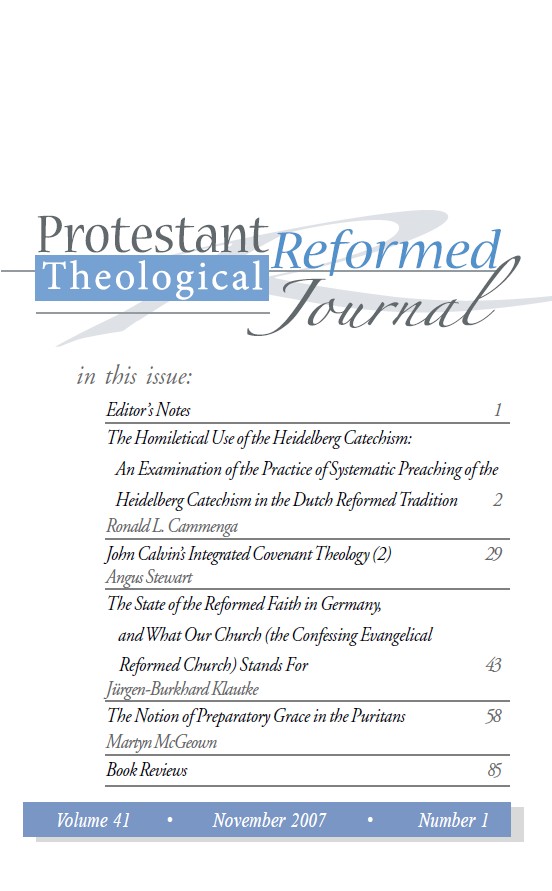
You have in hand the November 2007 issue of the Protestant Reformed Theological Journal. We hope and expect that you will profit from its contents, both the feature articles and the book reviews. In this issue, the Rev. Angus Stewart continues his treatment of “John Calvin’s Integrated Covenant Theology.” Rev. Stewart indicates the contours of Calvin’s covenant theology and his impact on the future development of the doctrine of the covenant in the Reformed churches. We look forward to additional articles in this series in the future. We welcome to the pages of PRTJ, Prof. Jürgen-Burkhard Klautke. Prof. Klautke teaches...
The Origins of the Practice of Heidelberg Catechism Preaching The Heidelberg Catechism has not only been subscribed to but also preached in Reformed churches the world over almost from the time of its first publication in 1563. Besides serving as a confession and as an instructional tool for the youth—one of its main purposes, as stated by Frederick III in his preface to the Catechism— it also very soon became the text of sermons. That practice has continued down to the present. Sermons on the Heidelberg Catechism have been a regular part of the spiritual diet of Reformed Christians for...
While Calvin is both clear and biblical in his treatment of covenant unity, covenant diversity, covenant hermeneutics, and covenant progression, we shall see, with the benefit of over four centuries since his death, that there is room for some correction and development as to his conception of the nature of the covenant.1 Calvin on the Nature of the Covenant It is undeniable that Calvin spoke of the covenant as a pact, compact, contract, or agreement. There may be various reasons or sources for this, including political, ecclesiastical, and lexicographical. First, medieval and sixteenth century political theory (of which Calvin was...
I think it would be good to tell you a bit about my background first, so that you can better assess what I say.* I grew up in a Christian home in the north of Germany, but my parents did not belong to a Reformed church. When I was a teenager, the literature I read was generally pietistic, and somewhat dispensationally orientated. In 1974 I began to study theology at a seminary that had been founded a few years earlier in Switzerland. (Dominant at that time in Germany and German-speaking countries was the theology of Karl Barth and Rudolf Bultmann....
I. Introduction Preparatory grace is a notion that crept into the theology of many of the Puritans. Although the Puritans insisted that man is totally depraved and unable to contribute anything to his salvation, “as early as 1570” some English theologians began to teach that the sinner “might somehow dispose himself for saving grace.”1 By this they meant, generally (with some variation), that an unregenerate sinner could prepare himself for the grace of regeneration by a serious consideration of his sins in the light of God’s law. By careful self-examination the sinner could and ought to stir himself up to...
by Peter Barnes, Webster, New York: Evangelical Press. 364 pages (hardcover). [Reviewed by Herman Hanko.] Evangelical Press, with plants in Darlington, England and Webster, New York, is publishing a set of New Testament commentaries. The commentary on Galatians is the fifth book of Scripture on which commentaries have been written. The author of this commentary is pastor at Revesby Presbyterian Church in Sydney, Australia. He also is lecturer in Church History at the Presbyterian Theological Centre in Sydney. He has written other books as well as this commentary. The book has several important strengths. It includes a rather thorough...
Karel Blei. Translated by Allen J. Janssen. Grand Rapids, MI. Wm. B. Eerdmans Publishing Co., 2006. Pp. xiv-164. $25.00 (paper). ISBN# 978-0-8028-3286-3 [Reviewed by Prof. Russell Dykstra.] This book is part of “The Historical Series of the Reformed Church in America” (No. 51), which has been a rich source of material on Reformed doctrine and history, both in the Netherlands and in America. As the title of the book indicates, this is a history of the Netherlands Reformed Church from the sixteenth century, when the Reformed faith became a significant part of the Protestant Reformation in the Netherlands, to...
by John D. Currid. Rossshire, Scotland: Christian Focus Publications, 2006. Pp. 106. $16.00 (paper). ISBN-10: 184 55021245. ISBN-13: 978-184 5502126. [Reviewed by Ronald L. Cammenga.] Dr. John Currid is Professor of Old Testament at Reformed Theological Seminary in Jackson, Mississippi. In this work he not only demonstrates the important use that John Calvin made of the original languages of the Old and New Testaments, but also issues a clarion call to Reformed seminaries to remain steadfast in their insistence on the importance of a mastery of Hebrew and Greek by those who are being trained for the ministry, as...
by James A. De Jong. Grand Rapids: Eerdmans, 2007. Pp. xviii-270. $34.00 (paper). [Reviewed by David J. Engelsma.] President-emeritus of Calvin Theological Seminary James A. De Jong has written an interesting account of the life and work of influential Christian Reformed minister Henry J. Kuiper. Because of the prominence of “HJK,” the book affords as well a fascinating look at the Christian Reformed Church during the years of Kuiper’s ministry, from 1904, when Kuiper entered what would now be considered seminary, until his death in 1962. For most of his ministerial career, Kuiper was a leading, powerful churchman. He...
by Arie de Reuver, translated by James A. De Jong. Grand Rapids, MI: Baker Academic, 2007. 303 pp. $29.99. Softcover. [Reviewed by Douglas J. Kuiper.] It is good to read the original writings of men of centuries past who, in God’s providence and grace, had a great impact on His church. But the task is often made difficult for the English- speaking reader by the great number of such writings, and by the fact that they are not always available in English. Books in which the writings of such men are studied and evaluated make the task easier. However,...
Download in pdf, mobi or epub formats

