
Results 1 to 9 of 9
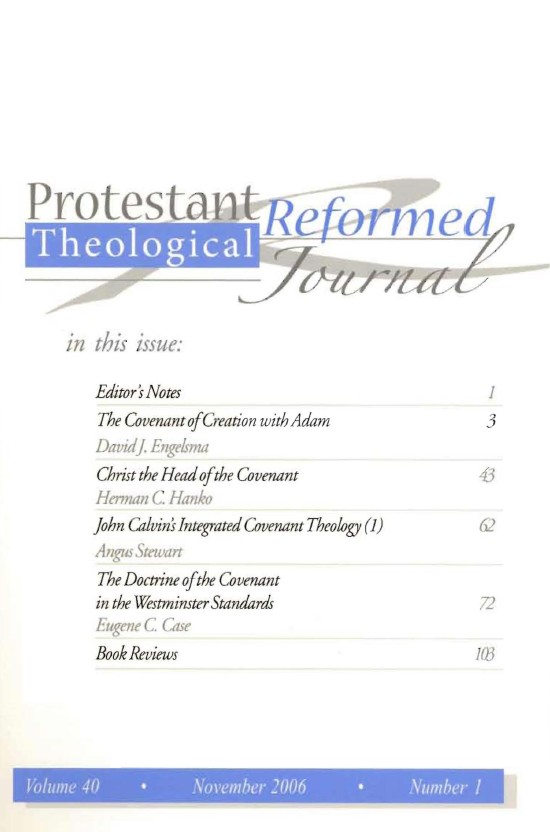
Thirty-nine years ago, in October of 1967, the inaugural issue of the Protestant Reformed Theological Journal made its appearance. That first issue was introduced by the editor of the new Journal, Professor Herman Hanko. In an editorial that explained the purpose of the Journal, Professor Hanko applied the words of Jude “… that ye should earnestly contend for the faith which was once delivered unto the saints” (Jude 4). He pointed out that Jude’s exhortation demands that the church “fight a defensive battle.” But he also pointed out that the church “… cannot be content with a wholly defensive battle…....
Introduction Reformed theology has always regarded the special relation in which God stood to Adam, and Adam to God, in paradise, prior to the fall, as a covenant. Not only have all Reformed theologians taught a covenant in paradise, regardless whether they used the word “covenant,” but the truth of a covenant with Adam is authoritatively expressed by the Reformed confessions. Although the Heidelberg Catechism does not use the word “covenant” in its account of man’s creation and fall in Lord’s Day 3, the language it uses to describe Adam’s relationship to God by virtue of his creation and its...
Introduction The headship of Christ is, in the doctrine of God’s everlasting covenant of grace, of crucial importance. Yet that Christ is the Head of the covenent is denied by those who hold to a conditional covenant, particularly by the followers of Dr. Klaas Schilder. It is not surprising that these churches should deny that Christ is the Head of the covenant, for their view of the covenant requires such a denial. Dr. S. A. Strauss points out that Schilder’s starting point in his development of the covenant of God is a distinction between God’s works in eternity and God’s...
While Calvin is neither the originator of Reformed covenant theology nor the author of the first book on the covenant—these honors falling to Zwingli and Bullinger respectively—he is, as Peter Lillback states, “the first … to integrate the covenant concept extensively into his theological system.”1 Calvin’s longest and most detailed treatment of the covenant is found in book 2, chapters 10 and 11, of his Institutes, his greatest and most systematic work.2 The Unity of the Covenant It is striking that Calvin’s first point, and that which he spends the whole of chapter 10 proving, is the “similarity—or rather unity”...
Arthur C. Cochrane, in the introduction to his collection of Reformed Confessions of the 16th Century, clearly did not intend to give a complimentary assessment of the Westminster Standards when he wrote that they “do not belong to the Reformation but are products of Puritanism and post-Reformation scholasticism.” Indeed, he goes on to characterize the Westminster Symbols as reflective of “a legalism, moralism, and rationalism that is foreign to the Confessions of a century earlier. They lack the spontaneity, freshness, and joyfulness of the Reformation.”1 Old Princeton stalwart Benjamin B. Warfield, on the other hand, viewed the Westminster Standards as...
by Guy Prentiss Waters. Phillipsburg, New Jersey: P&R, 2006. Pp. xvi+397. $20.99 (paper). ISBN: 1-59638-033-0. Reviewed by David J. Engelsma. With the publication of this widely distributed critique of the covenant theology calling itself the “federal vision,” the reputedly conservative Reformed community is rendered further inexcusable. When the Orthodox Presbyterian Church (OPC), the Presbyterian Church in America (PCA), the United Reformed Churches, and other denominations tolerate, and even officially approve, the Federal Vision, they do so knowing that this covenant doctrine denies the gospel of salvation by sovereign, particular grace as set forth in the Canons of Dordt and...
by Paul M. Elliott. Westminster, Maryland: Teaching the Word, 2006. Pp. 130. $8.95 (paper). Reviewed by David J. Engelsma. Former Orthodox Presbyterian Church (OPC) ruling elder Paul M. Elliott follows up on his large book, Christianity and Neo-Liberalism: The Spiritual Crisis in the Orthodox Presbyterian Church and Beyond with this short examination of the report on justification presented to the 2006 General Assembly of the OPC. Elliott demonstrates that, with the connivance of the 2006 General Assembly, which tacitly approved it, the report attempts to cover up the presence in the OPC of the false gospel of justification by...
by Herman Hanko and David J. Engelsma. British Reformed Fellowship, 2006. Pp. vi + 95. $4.00 (paper). [Reviewed by Ronald L. Cammenga.] This small volume is an excellent introduction to the doctrine of the covenant. The six chapters of the book were originally six lectures presented at the 2004 British Reformed Fellowship (BRF) Biennial Family Conference at High Leigh, Hertfordshire, England. Convinced of the value of the speeches, the BRF has now published them in the hope that they will be of benefit to a wider audience. “The Covenant We Are Called to Keep,” “Keeping God’s Covenant in Marriage,” and...
by David J. Engelsma. Grand Rapids: Reformed Free Publishing Association, 2005. Pp. x + 239. $23.95 (cloth). ISBN: 0-916206-91-2. Reviewed by Ronald L. Cammenga. This book is a stirring defense of God’s sovereignty in the covenant, which is to say, God’s sovereignty in salvation. The book sets forth the biblical doctrine of the covenant, as that doctrine has been confessed and developed within the Protestant Reformed Churches. From Scripture, Prof. David Engelsma demonstrates that “The covenant is the relationship of friendship between the triune God and his chosen people in Jesus Christ” (p. 4). Engelsma rejects the view that...
Download in pdf, mobi or epub formats

