
Results 1 to 8 of 8
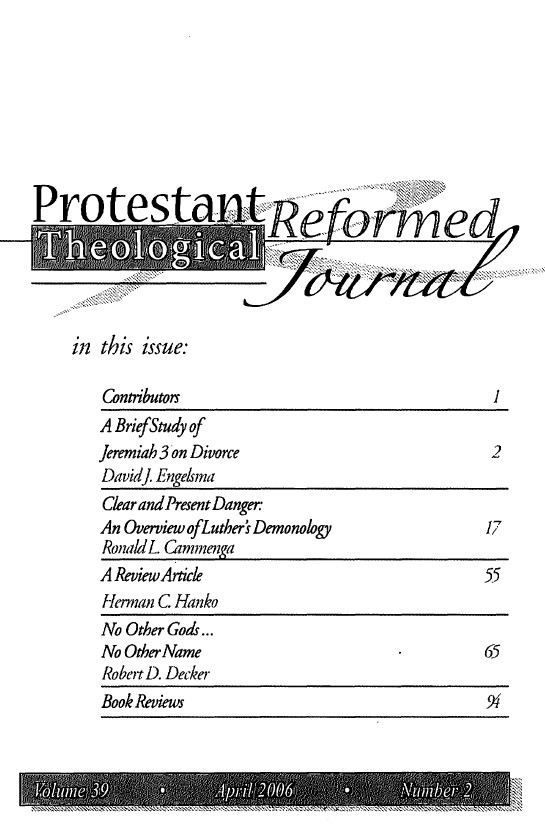
This is the last issue under my editorship. I plan to retire at the end of June 2006. My successor in the department of Practical Theology is the Rev. Barrett L. Gritters. Appointed to this position by the Synod of the Protestant Reformed Churches in 2003, Prof. Gritters expects to receive the Master of Theology Degree from Calvin Theological Seminary in May of this year. This degree, along with nearly twenty years pastoral experience in two large congregations in West Michigan, will serve Prof. Gritters, the Protestant Reformed Theological Seminary, and the Protestant Reformed Churches well. A great deal of...
Introduction In their zealous defense of remarriage after divorce, especially on the ground of adultery, some appeal to Jeremiah 3. Their argument is that the prophet teaches that Jehovah Himself divorced the nation of Israel for her adultery, thus dissolving His marriage to her. Jehovah was then at liberty to take another wife, the New Testament church. The basis of the argument is verse eight of Jeremiah 3: “And I saw when for all the causes whereby backsliding Israel committed adultery I had put her away, and given her a bill of divorce ….” The argument has its apparent force....
Introduction Some may argue that Martin Luther had a lifelong obsession with the devil. Such would be an extreme view. But to insist that Luther was profoundly conscious of the devil, his workings and his power, is to do justice to the facts. Behind Luther’s reformatory work was the deep-seated conviction that the devil was in no small way responsible for the declension of the church. Luther did not conceive of his battles as a reformer primarily in terms of physical opponents, like the pope, heretics, fanatics, or wicked rulers. He was, instead, convinced that his battle was “not against...
by Paul M. Elliott. Unicoi, Tennessee: The Trinity Foundation, 2005. Pp.479. $19.95 (paper). The author, himself a ruling elder in an Orthodox Presbyterian congregation (OPC), writes with passion and conviction concerning the doctrinal decline in his own denomination. Coming through all he writes is his sorrow that his church, with its rich heritage, is now, unless it repents, a Neo-Liberal congregation. That is indeed a serious charge. The 400+ pages of the book are intended to prove the charge. The spiritual father of the OPC was J. Gresham Machen, a professor in Princeton Seminary in Princeton, New Jersey, who left...
Introduction In this essay we offer a brief critique of the Religions of the World. We are interested in the biblical/Reformed answer to the question: How must these religions be viewed in relationship with Christianity? This fundamental question implies several more questions. Answers are needed to the following if we are to succeed in giving the correct answer to the fundamental question: Are there elements of good in these religions? Are there remnants of truth in them? Do these religions contain elements of the truth that are not to be found in the Christian religion, but are unique to Islam,...
by George Weigel. New York: HarperCollins, 2005. 307 pages. $26.95 (cloth). [Reviewed by David J. Engelsma.] From George Weigel, bestselling Roman Catholic author and confidant of popes, comes an insider’s account of the recent election of Joseph Ratzinger to the papacy as Benedict XVI and a forecast of the new pope’s agenda. Ratzinger is the “choice” of God of the title. It is obvious that God’s way of choosing a pope for the Roman Catholic Church bears no resemblance to the way in which He chooses pastors for true churches of Jesus Christ. What an intrigue! What a maneuvering! What...
by Guy Prentiss Waters. Phillipsburg, New Jersey: P&R, 2004. Pp. xii + 273. $16.99 (paper). [Reviewed by David J. Engelsma.] The Reformed community in North America has needed a clear, incisive critique of the “New Perspective(s) on Paul” (hereafter, NPP). The reason is the influence of the NPP on the spreading movement in the Reformed churches that calls itself the “federal vision.” This book supplies the need. Guy Waters, professor at Belhaven College in Jackson, Mississippi, examines the theology of Krister Stendahl, E. P. Sanders, James D. G. Dunn, Heikki Raisanen, and N. T. Wright. Although these theologians have their...
by Jakob VanBruggen. Tr. Ed M. van der Maas. Phillipsburg, NJ: Presbyterian and Reformed Publishing Co., 2005. Pp. xix +411. $19.99 (paper). [Reviewed by Ronald L. Cammenga.] This volume is the English translation of VanBruggen’s Paulus: Pionier voor de Messias van Israel, which was published in the Netherlands in 2001. Jakob VanBruggen is a Reformed theologian and scholar of considerable repute. He is the author of numerous books, many of which have been translated into English. He is longtime Professor of New Testament at the Theological University of the Reformed Church (Liberated) in Kampen, the Netherlands. The book is divided...
Download in pdf, mobi or epub formats

