


Steam blasts from his flared nostrils in the early morning cool. Hooves scrape dirt as he paws the ground impatiently. Thunder rolls as heavily muscled bodies rush across the field, fletched arrows rattling at their sides, riders holding fast to spear and shield. Trumpets blast amid the clash of battle noises, yet the horse “mocketh at fear, and is not affrighted; neither turneth he back from the sword…. He saith among the trumpets, Ha, ha; and he smelleth the battle afar off, the thunder of the captains, and the shouting” (Job 39:19-25).
The heaviness and sheer power of the horse make it a force to be reckoned with in war, and thus a terrible instrument of divine judgment. It was a grizzly scene when Jezebel was thrown from the window and trampled, “some of her blood…sprinkled on the wall, and on the horses” (2 Kings 9:33). It will be an even grizzlier scene when the blood of the winepress of God’s wrath flows like a river so deep it reaches to the bridle of any horse that happens to walk through it (Rev. 14:20).
As an instrument of divine judgment, the horse serves also as a symbol of the driving forces of history. A “pale horse” followed by death and hell, a “black horse” carrying a merchant with a scale in his hand, a “red horse” with a man of war holding an un-sheathed sword, all led by a “white horse: and he that sat on him had a bow; and a crown was given unto him: and he went forth conquering, and to conquer” (Rev. 6:1-8). The running of these four horses and their riders reaches its apex when at last heaven is “opened, and behold a white horse; and he that sat upon him was called Faithful and True…. And the armies which were in heaven followed him upon white horses, clothed in fine linen, white and clean” (Rev. 19:11-14). 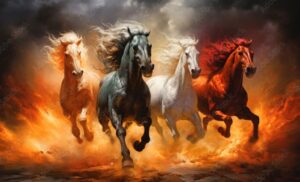
Horses, however, due to their immense strength and beauty, can also become a significant source of temptation. The threat is so serious that, long before Israel had a king on the throne, the law made clear no king shall “multiply horses to himself,” nor return to Egypt “to the end that he should multiply horses” (Deut. 17:16). Not that this law was obeyed. One of the first indicators that all was not well in the kingdom of Solomon is that, in addition to his many wives, he had “forty thousand stalls of horses for his chariots, and twelve thousand horsemen” (1 Kings 4:26).
The danger was that faith would be transferred from God to the horse. Thus, the many warnings: “An horse is a vain thing for safety: neither shall he deliver any by his great strength” (Ps. 33:17); “The horse is prepared against the day of battle: but safety is of the Lord” (Prov. 21:31); “Woe to them that…stay on horses, and trust in chariots…but they look not unto the Holy One of Israel!” (Is. 31:1).
The horse could also become a source of pride, and thus, the object of worship. This was not only true metaphorically, as people looked up with starry eyes to the horsemen who fought their battles. This was true literally, which is why King Josiah, in his ruthless elimination of idolatry out of Judah, also “took away the horses that the kings of Judah had given to the sun, at the entering in of the house of the Lord…and burned the chariots of the sun with fire” (2 Kings 23:11). This godly king wanted the people to know the true God “delighteth not in the strength of a horse,” but only “in them that fear him, in those that hope in his mercy” (Ps. 147:10, 11).
A temptation on the other side is to fear the horse. Imagine hearing the rumble of thousands of hooves striking the ground, and the clatter of chariot wheels making their way ever closer to you. Imagine the buzzing of millions of wings of locusts, whose appearance “is as the appearance of horses,” who leap “like the noise of chariots on the tops of mountains,” as they come to devour the crops that are your primary source of bread (Joel 2:4). Imagine the dread of hundreds of thousands of demon horses, whose heads “were as the heads of lions; and out of their mouths issued fire and smoke and brimstone,” storming across the river to kill off a third of humanity (Rev. 9:17). Would you tremble? Would you break and run for your life?
God says, “When thou goest out to battle against thine enemies, and seest horses, and chariots, and a people more than thou, be not afraid of them: for the Lord thy God is with thee” (Deut. 20:1). He says again, to the fearful servant of Elisha whose eyes were staring widely at the many horses and chariots posted outside the window, “Fear not: for they that be with us are more than they that be with them.” Whatever could he mean? Elisha prays, and in answer to his prayer, “the Lord opened the eyes of the young man; and he saw: and, behold the mountain was full of horses and chariots of fire round about Elisha” (2 Kings 6:15-17). Indeed, “some trust in chariots, and some in horses: but we will remember the name of the Lord our God” (Ps. 20:7).
To give yourself over to unbelieving fear of, or overconfidence in the horse (or anything other than God), is not to honor the horse. It is to become like the horse. It is to turn stubbornly to your wicked course of life just as “the horse rusheth into battle” (Jer. 8:6). It is to make your back as worthy an object for the rod as the behind of the horse is for the whip (Prov. 26:3). You may be even worse than the horse, when it comes down to it. “Behold, we put bits in the horses’ mouths, that they may obey us; and we turn about their whole body…. But the tongue can no man tame; it is an unruly evil, full of deadly poison” (Jam. 3:3, 8). Thus the plea of the psalmist, who has known the blessedness of yielding stubbornness to faith and finding in God a blessed Redeemer who forgives iniquity: “Be ye not as the horse, or as the mule, which have no understanding: whose mouth must be held in with bit and bridle, lest they come near thee” (Ps. 32:9).
In the end, God is the God of the horse, and He uses it as He will. Whether that is throwing the “horse and his rider” into the sea (Ex. 15:1), protecting Paul the Apostle with an army that includes seventy horsemen (Acts 23:23), or comparing the beauty of His bride “to a company of horses in Pharaoh’s chariots” (Song of Solomon 1:9), we all know the answer to this rhetorical question of God to Job: “Hast thou given the horse strength? Hast thou clothed his neck with thunder?” (Job 39:19).
