

Science teacher in Covenant Christian High School and member and elder of Hope PRC in Walker, Michigan
There are certain occurrences in the creation that capture our attention with dramatic intensity. One such event is about to unfold in numerous locations throughout the eastern half of the United States, if it has not already begun in some areas. This remarkable spectacle involves the emergence of countless cicadas from underground, a phenomenon that captivates observers because of its incredible magnitude. This particular emergence involves two neighboring groups of periodical cicadas that have not emerged together since 1803, the same year that the United States made the Louisiana purchase. Following this year’s emergence, these two groups will not surface together for another 221 years.
For some, the mass emergence of cicadas evokes fear. When early colonists first encountered this phenomenon, they mistook it for a biblical plague. This initial impression has stuck with these insects — groups of cicadas are still referred to as a plague or a cloud. Even now, these insects remain a source of anxiety for some. Soon after emerging from the ground, they begin their characteristic mating song. While the songs of many cicada species are pleasant, those of periodical cicadas are more like the roar of a jet engine or the buzz of a saw. Their cacophony can exceed 100 decibels, rivaling the noise of a chainsaw at close range. They fall from the sky, covering cars, trees, and houses. They spend only a few weeks above ground, but during that time they litter earth’s surface with their exoskeletons and dead bodies.
However, a better understanding of these remarkable insects should inspire awe and fascination rather than fear. Their distinctive appearance, with bulky bodies, bulging eyes, and membranous wings is familiar to most since they can be found throughout the world on every continent except Antarctica. Designed by God, cicadas possess remarkable attributes. Specialized structures, called tymbals, enable them to efficiently produce their loud, unmistakable songs. Additionally, their wings feature tiny structures that capture light and minimize detection by predators. The extraordinary life cycle of periodical cicadas culminates in a mass emergence that plays a vital role in their preservation from one generation to the next. Overall, cicadas are extraordinary creatures, whose life cycles and physical traits demonstrate the majesty of God, especially by revealing His order and wisdom.
CICADA LIFE CYCLES
Though cicadas emerge every summer, there is special excitement surrounding this year’s emergence. To understand why, it is helpful to know that cicadas come in two main varieties: annual and periodical. Populations of annual cicadas are located throughout the world and can be found in every state in the United States. Annual cicadas have life cycles of two to five years, but because their life cycle is unsynchronized, some individuals emerge every year. In contrast, periodical cicadas are controlled by genetic factors and environmental conditions that lead them to emerge in unison every 13 or 17 years, giving them the longest known life cycles of any insect in the world. Though there are more than 3,000 species of cicadas on earth, only nine of them are periodical. Seven of the nine periodical species can be found in the United States.
Groups of periodical cicadas with the same life cycle that emerge in the same year are called broods. Among periodical cicadas, there are three 13-year broods and twelve 17-year broods. This year’s emergence includes brood XIII, on a 17-year cycle, and brood XIX, on a 13- year cycle. Brood XIII is known as the Northern Illinois Brood and has a limited range that is restricted mostly to northern Illinois, eastern Iowa, southern Wisconsin and a few counties in northwestern Indiana. Brood XIX, known as the Great Southern Brood, is widely distributed through 15 states, many of them located in the south. Dense populations of this brood can also be found in Illinois, Missouri, and the northern portion of Arkansas. There is a small area in central Illinois, near Springfield, where these two broods may slightly overlap. Cicadas from these two broods are expected to emerge around the end of May or beginning of June in densities that range from 50,000 to 1.5 million cicadas per acre depending on the specific location. A total of more than one trillion cicadas is expected to emerge between these two broods.
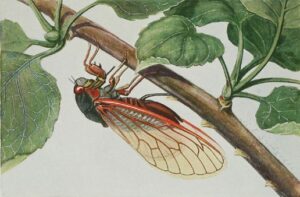 Soon after they emerge, cicadas take on their adult-winged form. This is the form we are most familiar with. However, cicadas spend most of their lives underground as nymphs. Like other insects, cicadas undergo metamorphosis. This orderly process includes three stages (egg, nymph, and adult). In years when they emerge, female cicadas deposit millions of eggs inside small tree branches, from which nymphs emerge six to eight weeks later. Once hatched, they fall to the ground and burrow underground near the roots of plants. Nymphs are created with specially designed mouthparts that enable them to penetrate the tough exterior of plant roots and access the sugary sap of the plant. Obtaining energy in this way, they serve as a key food source for animals such as shrews and moles which are unable to directly obtain energy from plants. They move through five nymph stages as they grow. In their final nymph stage, cicadas contain a light brown exoskeleton and large front limbs, designed specifically to anchor themselves to trees or other plants in preparation for their final transformation into their adult form. At the appointed time, they push their way to earth’s surface, aerating the soil as they do so. Once secured to a plant, they break out of the nymph exoskeleton, leaving it behind. Over the next few hours their wings expand and their adult exoskeleton hardens. They spend around five weeks above ground before dying, leaving their bodies scattered on the ground. Important nutrients are returned to the soil as their bodies decay.
PROVIDENTIALLY PRESERVED
Populations of periodical cicadas have been preserved through many generations. The timing of their emergence is one key to the survival of this species. They emerge once the soil at eight inches in depth warms to about 64o F, indicating that conditions are favorable for survival and reproduction. They emerge near sunset to minimize their exposure to predators, since daytime predators such as birds and mammals rely on eyesight to find prey and the activity of many nocturnal predators tends to be less intense during this part of the night. Emergence at such a specific temperature also ensures that massive amounts of cicadas will surface at the same time. Above ground predators voraciously feed on cicadas when they first emerge, but they are soon filled which allows many individual cicadas to survive long enough to find a mate and reproduce.
The intricate structure of cicada wings also plays a crucial role in the survival of these insects. Cicada wings appear to be perfectly flat, but a complex array of tiny pillars, known as nanopillars, can be seen on the surface of their wings when they are viewed under powerful microscopes. These nanopillars are smaller than the wavelengths of visible light and, therefore, trap light in the spaces between them. This prevents light from being reflected from the surface of the wing and helps them avoid detection by some predators. The wings are also coated with various waxy substances that are “naturally” water repellent and help the wing shed water. This prevents water from being absorbed into their wings, which would weigh them down and prevent them from escaping predators. Additionally, the size and spacing of these nanopillars causes bacterial cells that land on their wings to stretch and rupture, which aids in the prevention of bacterial infections that could affect their survival above ground.
The characteristic that cicadas are best known for, their songs, also plays an important role in the preservation of these unique insects. For a new generation of cicadas to form, adults must locate a mate once they have emerged from the soil. To that end, God has created male cicadas with specialized organs, called tymbals. While the exact mechanism behind the function of these organs is not completely understood, it is known that they operate through a process called buckling. In this process, special muscles in the abdomen of the cicadas rapidly pull the tymbals in and out of shape resulting in a series of clicks or vibrations that create their distinctive buzzing or chirping sounds. Cicadas also have air sacs located in their abdomens that resonate (vibrate at the same frequency) with the sounds produced by their tymbals. This serves to amplify the sounds they produce, raising them to impressive levels. Other insects, like crickets and katydids, produce songs by rubbing their legs together and, therefore, are not able to produce songs as loud as the cicada’s. It is suggested that the loudness of their songs is important for establishing territories necessary for breeding and acts as a deterrent to predators. Overall, the timing of cicada emergence and their unique anatomy play a crucial role in maximizing their chances of survival and successful reproduction in the above ground world.
GOD’S MAJESTY REVEALED
When reflecting on the life cycle and physical attributes of cicadas, several valuable lessons come to light. Firstly, it is evident that God has an important purpose for each stage of cicadas’ lives and equips them perfectly for each phase. Similarly, as children of God, we are led by God’s gracious hand through a variety of circumstances here on earth. Yet, none of these things fall outside of His control or eternal plan. God tenderly guides us by His sovereign hand, carefully ordering every step of our path and ensuring our preservation throughout this earthly life. Whether we encounter trials or moments of ease, every circumstance serves a purpose in preparing us for our final transformation from earthly life to heavenly glory.
Additionally, we can be thankful that the God who orchestrates every aspect of our lives possesses boundless wisdom, as evidenced by the intricate design of cicada wings and tymbals. Even wicked men are amazed by the efficiency and detail of these structures. Currently, researchers are attempting to replicate the nanopillar pattern found on cicada wings to enhance the efficiency of solar panels and develop bacteria resistant surfaces for medical facilities and implants. The remarkable ability of the tymbal to generate exceptionally loud songs while expending minimal energy has captured the interest of the U.S. Navy, which aims to use an understanding of these structures to enhance sonar technology for underwater exploration and communication. Just as God has so wonderfully equipped cicadas with what is good for them, so He graciously provides what is best for us, guided by His infinite wisdom.
Finally, God has ordained the life cycle of periodical cicadas to bring about their emergence from the earth in immense numbers. Their great abundance and powerful songs make them impossible to ignore. God’s revelation through this unique insect is loud, clear, and unmistakable. Despite the denial of many, the life of the cicada serves as yet another reminder that every aspect of God’s creation provides sufficient evidence of His existence and authority, leaving all men without excuse. By the grace of God, as trillions of these insects emerge this spring, we will stand in awe and proclaim with the psalmist, “O Lord, how manifold are thy works! In wisdom hast thou made them all: the earth is full of thy riches” (Ps. 104:24). What a majestic God we serve!



