

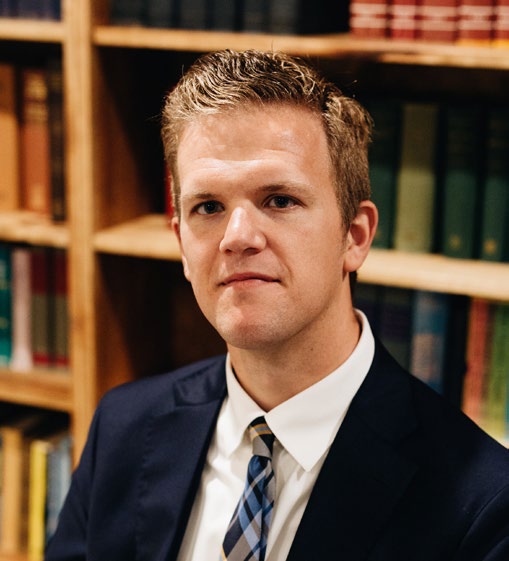
 On September 10, 2025, Charlie Kirk, Christian, husband, father of two, at thirty-one years of age, was assassinated by a gunman on a college campus in Utah where he was publicly debating with college students. It was a day we, especially the younger generation, will never forget: shocking, appalling, a day of great heaviness.1
The suspected shooter, twenty-two-year-old Tyler Robinson, grew up in a conservative home, but allowed himself to be radicalized by a dark, twisted ideology. He felt that Charlie Kirk was spreading hate, and so in an act of hatred he murdered him. He now faces the death penalty.
But who was Charlie Kirk? If all we saw was the title of an article in Christianity Today, we might think he was just an “Activist Who Championed ‘MAGA Doctrine.’”2 Involved in politics, yes he was, and with prowess. When he was eighteen, he co-founded Turning Point USA, an organization whose mission is to promote conservatism, especially among the youth. Charlie Kirk was known for his open, public debate on college campuses (a political lions’ den for conservatives) around the country, where he invited those who disagreed with him to ask questions and prove him wrong in his tireless effort to persuade students away from the ideology in which universities are often steeped and to win them over to the conservative cause. He played a pivotal role in the outcome of the 2024 election, evident in the swing that took place in the youth vote (a points difference in the double digits compared with 2020). His influence extended to the vice president’s name being on the ticket, and to the composition of the current cabinet.
But there is far more to the story than the title of the CT story suggests. Charlie Kirk was a Christian. He confessed with his mouth that Jesus is Lord and believed in his heart that God raised Him from the dead (Rom. 10:9). He frequently confessed his faith before men; even, it was a habit of his to bear witness of his Lord and Savior Jesus Christ. When asked earlier in the year, “If everything completely goes away…how would you want to be remembered?” he answered, “I want to be remembered for courage for my faith. That would be the most important thing.”3 He said about one of his favorite verses, Romans 8:28, “It is a very freeing and liberating verse for those of us that are Christians, because we believe that when things can be really bad God is working it for His good, His perfect and pleasing will…I do not have to be in charge of everything. There is a God and I am not Him and I surrender to His will.”4 He said this in an interview less than one hour before he was killed.
Charlie Kirk was a husband and a father of two, and his faith worked by love. Let us pray for his wife, Erika, who is now a widow, and her children, who must now grow up without their father. What goes through the heart of a wife and mother when she learns her husband has been killed? What goes through the hearts of a three-year old and one-year old when they realize they are not going to see their father again in this life? Their Father in heaven knows, and may He, a Father of the fatherless and a Judge of the widows in distress, comfort this family in the hope of the resurrection of the body and the life everlasting, when we shall be together again with the Lord. Thank God for the resurrection of Jesus Christ. No hope without it.
The apostle Paul tells us in his letter to the Romans, “Abhor that which is evil; cleave to that which is good” (Rom. 12:9). It is the Christian of all people who believes in God and has His Word, who can call a thing for what it is and must. This was evil. Not only the murder of a human being in cold blood, and the works of darkness that led up to it, but what took place after it, when many filled with hate celebrated and rejoiced over it.5 Human language fails to put the evilness of it into words. The good is called evil, and the evil is called good; darkness is put for light, and light for darkness (Is. 5:20). As it was in the days of Noah, the earth is filled with violence in rebellion against God (Gen. 6:13).
One word that has been used recently to describe this lawlessness is nihilism (“nothing”-ism): “the rejection of all religious and moral principles, in the belief that life is meaningless” (New Oxford American Dictionary). The word is often associated with the nineteenth-century German philosopher Friedrich Nietzsche who said in reference to modern, post-enlightenment man, “God is dead, and man has killed him.” If that is true, then religion and morality is dead, and man has killed that too; the meaning of life is whatever one wants it to be; might makes right; the fundamental urge of man is the will to power; and there is nothing in any meaningful sense of the word wrong with what used to be called evil.
A more biblical word to describe this state of affairs is godlessness, which gives birth to the evil (“the ungodliness and unrighteousness of men” [Rom. 1:18], in that order). As one author observes, when God is denied, the foundation of truth and morality is denied, together with the sanctity of human life.6 For apart from God, who is truth, there is no truth, and human life, which has been created by God, is nothing special. The consequence is that truth becomes irrelevant and human life becomes disposable. Do we not see this all around us? What was Charlie Kirk’s life, and the lives of his wife and children, to the one who killed him? Unborn children are killed and the world promotes it as though it were a light thing. Children are mutilated in the name of, and sacrificed on the altar of, transgenderism. Assisted suicide is advertised in Canada and there is discussion about extending eligibility to people who suffer from mental illness and even to “mature minors,” because what is the value of life anyway? Our age is anti-God, and because of that, it is anti-human. God help us. Come, Lord Jesus. Come to judge the world in righteousness; come to deliver the poor and the oppressed; come to destroy the works of darkness and to put things to right.
Evil is not the end of the story. About two-thousand years ago God, for His love for mankind in the elect, came into this fallen world in the person of His Son to redeem us and make all things new. God became human, and in human nature He suffered the evil to be done against Him, and died on a cross for the remission of our sins in order to defeat the evil. The third day, early Sunday morning, Jesus Christ rose from the dead in triumph over sin and death, evil and the evil one. Because of Jesus, the end of the story for all who are in Him is resurrection and life. “And I saw a new heaven and a new earth…. And God shall wipe away all tears from their eyes; and there shall be no more death…. Behold, I make all things new” (Rev. 21:1, 4, 5). May the light of Christ shine in the darkness of this world for the translating of many out of darkness into God’s marvelous light. May the church proclaim the gospel of Christ, which is the power of God unto salvation to everyone who believes. It will draw opposition, as our Lord told His disciples: “If the world hate you, ye know that it hated me before it hated you” (John 15:18). “In the world ye shall have tribulation.” “But,” Jesus said, “Be of good cheer; I have overcome the world” (John 16:33).
On Sunday, September 21, there was a memorial for Charlie Kirk, attended by tens of thousands and watched by millions. The most remarkable thing about it was the witness that was given of Jesus Christ.
Now I want you to know that Charlie right now is in heaven, not because he was a great husband and father, not because he saved millions of kids out of darkness on college campuses, not because he changed minds and chased votes to save the country, not because he sacrificed himself for his Savior—Charlie Kirk is in heaven because his Savior sacrificed Himself for Charlie Kirk.7
We should, of course, be discerning in all that we see or hear, including the memorial. Nonetheless, we should be thankful to God for the positive witness of Jesus Christ: the need for Him, His incarnation, His death and resurrection, substitutionary atonement, and the promise of the gospel for all who believe in Him. As the same speaker quoted above said, “Ladies and gentlemen, this is the greatest story ever told, and it happens to be true.”8
POSTSCRIPT:
There is a difference between politicizing the pulpit (which must not be) and addressing things from the pulpit that are also current in the political arena. It does not seem at the moment that the PRCA is “bringing politics into the pulpit,” pressing the pulpit into the service of this or that party, for example (which must be guarded against). But it is also possible to overreact by being silent about something that should be said, for fear of being perceived as political, and avoiding a certain subject that ought to be addressed because it is so politically charged. As Paul said to Timothy, “Preach the word” (2 Tim. 4:2), in season and out of season, right into the midst of present society and culture in which we live, and let the chips fall where they may when it comes to politics. People need it. We need it.
In the same vein, there is a difference between entangling the Christian faith and politics and the Christian faith having an influence upon the believer when it comes to politics. What aspect of the conversation of the Christian upon this earth does not come under the lordship of Christ? So, from casting our vote at the ballot box to the labors of a Christian congressman on the hill, there will be an influence, and we should want that influence to be felt by others.
_____________
“Do all things without murmurings and disputings: that ye may be blameless and harmless, the sons of God, without rebuke, in the midst of a crooked and perverse nation, among whom ye shine as lights in the world; holding forth the word of life; that I may rejoice in the day of Christ, that I have not run in vain, neither laboured in vain” (Phil. 2:14-16).
1 For further reporting and analysis from a Christian perspective I commend Albert Mohler’s “The Briefing with Albert Mohler,” which profited me and was of influence in the writing of this article.
2 Daniel Silliman, www.christianitytoday.com/2025/09/diedcharlie-kirk-maga-doctrine-tpusa-political-activist/
3 “An Unfiltered Conversation with Charlie Kirk,” www.youtube.com/watch?v=S7QLJSSry8Y
4 “Charlie Kirk: The Last Interview,” www.youtube.com/ shorts/R0ukW4AzcSs
5 Hear the outrage in the vice president’s voice when he decries this in his closing statement on “The Charlie Kirk Show”: www.youtube.com/watch?v=ngofqx9EfcM
6 Robert Barron, “He Died with a Microphone in His Hand,” www.firstthings.com/he-died-with-a-microphone-in-his-hand/
7 “Charlie Kirk’s mentor Frank Turek speaks at his memorial service,” www.youtube.com/watch?v=m9mSA1xHi6k
8 F. Turek.

