
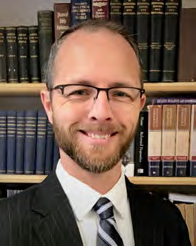
Pastor of Wingham PRC in Wingham, Ontario
BRUTAL PERSECUTION
Last February, Open Doors reported that “seventy Christians were discovered beheaded inside a Protestant church” in a northeastern province of the Democratic Republic of Congo (DRC). That part of the country has been torn by war between the DRC and rebel forces backed by neighboring Rwanda for some thirty years. An Islamist militant group with ties to ISIS, called Allied Democratic Forces (ADF), has added to the fear and chaos in that same region. They were the ones who carried out the brutal murder of those seventy men and women last February, after holding them hostage. According to a persecution watchdog, this was “not an isolated incident but part of a grim tapestry of violence that has claimed over 6 million lives in the DRC over two decades of on-and-off war.”1
In a Christian farming community in Nigeria, another central African country, armed nomadic herders who practice Islam “wielded guns and machetes, set residential houses and food stores ablaze, and ambushed and slaughtered defenseless victims when they tried to escape” last June. They reportedly “locked families inside their homes and burned them to the ground…. An estimated 100 to 200 people, mostly farmers, have been reported dead.” Reportedly, these Islamic herders literally got away with murder. According to one young Christian man in Nigeria (where more Christians are killed for their faith than in all other countries combined), “Since the government has failed to enforce laws, the people must now take care of themselves…. We continue to lean on God’s protection.”2
Many more stories could be told, since the violent persecution of Christians continues throughout the world today, especially in Africa and Asia. We need to hear these stories regularly, lest we fail to “remember them that are in bonds, as bound with them; and them which suffer adversity, as being yourselves also in the body” (Heb. 13:3). To learn more about persecuted Christians throughout the world, go to https://www. opendoors.org.
CANADIAN REFORMED SYNOD
The Canadian Reformed general synod, which meets once every three years, met this past May in Aldergrove, British Columbia, just north of the border from Lynden, Washington. A fraternal delegate who is the pastor of the Free Reformed Church of Launceston, Tasmania rather effusively characterized it as “the most momentous synod in the history of the Canadian Reformed Churches.” He informs us that “there were numerous decisions made affecting especially the worship and ecumenical relations of the CanRC.”3 In the blog post referenced below, he lists ten noteworthy decisions.
Some decisions had to do with relationships with other denominations. For example, they entered into what we would call a full sister-church relationship with the Reformed Churches (the Netherlands), “a new federation formed by the merger of two church groups that had previously separated from the Gereformeerde Kerken vrijgemaakt (GKv) [the Reformed Churches (liberated)—DJH].” According to their synodical press release, “In 2019, our churches were compelled to sever ties with the GKv, and it was therefore a joy to recognize and enter into fellowship with a faithful Reformed federation in the Netherlands.” The synod also introduced a new category of ecclesiastical relationship in which they hope to pursue denominations of “known Reformed character with whom full ecclesiastical fellowship is not yet feasible.”4
Regarding worship, the synod declared that the previous cap of 100 hymns for their Book of Praise is null and void. They added thirty-one new hymns and nineteen alternate psalm settings to their songbook and revised the article of their Church Order that regulates what each church may sing in worship services. Previously it said, “The metrical Psalms adopted by general synod as well as the hymns approved by general synod shall be sung in the worship services.”5 Now it says,
The 150 Psalms of the Bible are foundational to the church’s worship and are to be sung frequently in the worship services. General synod shall adopt metrical versions of the Psalms and shall approve hymns for inclusion in a song book which shall, as a rule, have the principal place in the worship of the church. The consistory may also approve the singing of alternate settings of the psalms and additional hymns, provided they are in harmony with the Word of God as confessed in the Three Forms of Unity.6
What is most striking to me is not so much that they are adding more hymns to their songbook, but that they have added to their Church Order the statement that local consistories are free to choose other psalms and hymns that are not in their denominational songbook. It is a matter of denominational unity and local autonomy, and they have decided to lean more in the direction of local autonomy in this regard. In the Protestant Reformed Churches, I think we take it for granted that all our churches use The Psalter, either the 1912 or the 2024 version. We should be thankful for the denominational unity we have in regard to the songs we sing to God in worship. Local consistories are free to choose songs not found in our Psalter for use in singspirations and programs. But in our worship services, we freely bind ourselves to Article 69 of our Church Order and sing only the 150 psalms and a few other songs. I would encourage my fellow members of the PRC to be thankful for that and to rejoice in the rich treasure that is our Psalter, both the one many of us grew up using and the beautiful revision that has recently been approved.
CHRISTIAN REFORMED SYNOD
The annual Christian Reformed synod met at Redeemer University in Ontario, Canada in June of this year. Among the many topics on their agenda, I point out three that grabbed my attention.
First, the synod unanimously approved the recommendations of an “Assisted Suicide Task Force” and declared “that synod deplore the legalization and practice of medically assisted suicide as well as the efforts to expand it to include minors, and those suffering solely from psychological disabilities.” Stephen Vander Klippe, a medical doctor who lives just down the road from us here in Wingham, is the chair of the task force. He said to the synod, “I don’t believe our response to suffering should be to authorize the health care system to facilitate death: unfortunately that’s how our society is responding to suffering. I think we need to be involved in compassionate care.” He added, “I do feel like there’s a strong line between intent to relieve suffering and intent to kill.”7 We can be glad to hear about this pushback on the evil of euthanasia.
Secondly, by a vote of 171-3, the synod turned down an overture from a Canadian congregation to separate the American and Canadian branches of the CRC. The lengthy discussion of the motion at synod was “almost entirely in support of remaining one denomination.” Caleb Bosveld, a “young adult representative,” pointed out that “there are differences in our cultural contexts, but these are not defined by the border.” He went on to say, “We have shown, as a synod, that we are able to make decisions on issues that disproportionately affect a country, in a unified and discerning manner. For example, our unanimous decision on medically assisted suicide yesterday, which disproportionately affects Canadians.”8 “Toward CRC Canada” said this about the decision on their website, “Synod 2025 has voted not to create a distinct Canadian CRC. Disappointed, we recognize that the time has come to turn the page…. Toward CRC Canada will be hosting a summit… in Kitchener, Ontario from November 5-9. With the goal to lay the foundation for a new community of Reformed congregations, we are inviting councils from across Canada to send delegates.”9 It seems they are determined to have a Canadian CRC one way or another.
Thirdly, the synod decided that from now on the content of The Banner must “speak from a distinctly Reformed perspective in line with our confessions and synodical decisions, representing the CRCNA as its official publication.” The editor of the magazine said this “was not a minor tweaking but a fundamental shift in the role and purpose of The Banner.” Jonathan Spronk from Classis Central Plains argued in favor of the change. He said, “I would prefer a magazine (that says) this is what we believe, this is who we are.” Ben Wimmers of Classis B.C. South-East argued against the change, saying it would be “a black mark on this synod.” He added, “If we move in this direction that restricts and constricts, we’re moving into an intellectual cul-de-sac.” But he was in the minority. The recommendation passed by a vote of 129-35.10
1 Anugrah Kumar, “70 Christians beheaded in DRC church attack: ‘Grim tapestry of violence,’” The Christian Post (February 20, 2025), https://www.christianpost.com/ news/70-christians-beheaded-in-drc-church-attack.html.
2 Emmanuel Nwachukwu, “A Brutal Attack Shocks a Village, and a Country,” Christianity Today (June 20, 2025), https:// www.christianitytoday.com/2025/06/nigerians-reel-from-attack-on-christian-village/.
3 Wes Bredenhof, “A Most Momentous Canadian Reformed Synod,” in “Wes Bredenhof: A Reformed Christian Blog and Resource Page” (May 22, 2025), https://bredenhof. ca/2025/05/22/a-most-momentous-canadian-reformed-synod/.
4 “Press Release of General Synod Aldergrove 2025,” https:// canrc.org/documents/10735.
5 https://canrc.org/documents/9191.
6 https://canrc.org/documents/10834.
7 Kristen Parker, “Synod 2025 ‘Deplores’ Assisted Suicide, Affirms God’s Gift of Life,” The Banner (June 17, 2025), https://www.thebanner.org/news/2025/06/synod-2025- deplores-assisted-suicide-affirms-gods-gift-of-life.
8 Kristen Parker, “CRCNA to Stay United as a Binational Denomination,” The Banner (June 18, 2025), https://www. thebanner.org/news/2025/06/crcna-to-stay-united-as-a-binational-denomination.
9 https://towardcrccanada.net/event/summit-2025/.
10 Gayla R. Postma, “The Banner’s Mandate Curtailed,” The Banner (June 19, 2025), https://www.thebanner.org/ news/2025/06/the-banners-mandate-curtailed.



