
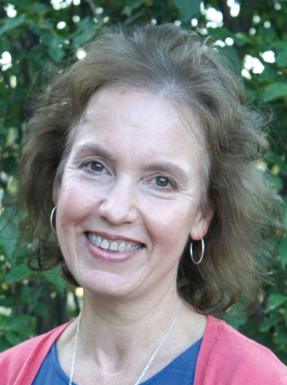
Mrs. Margaret Laning, wife, mother, and grandmother in the Protestant Reformed Churches
Do you speak aloud to yourself? Perhaps those closest to you can answer that. I remember times when my grandmother single-handedly carried on a solo conversation. She swept her patio as I played nearby; her quiet instruction, admonitions, and chuckles were intriguing. I was somewhat accustomed to this with my mother because the apple does not fall far from the tree. Sure enough, my sisters and I chattered while alone, too, often in front of the bathroom mirror. Not until marriage did I realize that not everyone does this on a regular basis. Nevertheless, some of our children and grandchildren have inherited this rather amusing trait.
If we ask others what they say aloud to themselves, we will likely receive countless answers. Some might say they try to memorize something useful or to reinforce a memory worth remembering. Some might focus on negative experiences, rehearsing previous conversations, even creating future ones that counter or help solve the previous ones. Some might tell themselves they cannot do anything right, while others give themselves a pep talk. Though talking to ourselves is not wrong in itself, we must admit that it can sometimes arise from our sinful nature. We are prone to taking our eyes off Christ and focusing on self. When we go the route of self-seeking our sins of pride, self-pity, discontent rise up against us, sometimes succumbing to such a negative, accusatory state that we are not in the right spiritual frame of mind when caring for our family.
On any given morning, for instance, a young Christian mother might wake up remembering an unkind remark from a previous conversation with someone. As the morning proceeds she begins a vengeful dialogue in her mind. All the while her twins are tugging at her, fighting and crying over a toy. The oldest does not have kindergarten this particular day and is lying on his back kicking at the couch moaning, “I’m so bored!” The toddler has a messy diaper and is walking from room to room depositing memorabilia which will require a full-out deep clean. Then a new thought comes to this mother’s mind: What if Mrs. VanSnoopsma stops by for a visit without calling again? She glances at the clock and it is 11:00 a.m. She is still in her bathrobe; there are toys everywhere and dishes unwashed. She looks at her crying, moaning children and mutters under her breath, “You know, I think I would be a really good mother if it weren’t for all of you!” Up pops her son straight as an arrow, eyes fixed on her. The mother is startled, then takes a few slow, deep breaths. Her face begins to soften as she says, “I’m so sorry, I think I need to give myself a good talking to.”
Why talk to ourselves?
Let’s face it, we do not need to ponder things that are not worth hanging onto. Rather, we need to prepare our hearts and minds by talking to our soul about the things of God! Think of it as a prelude to prayer, praise, devotions, worship and having the right frame of mind in leading our children to Jesus. Exhorting our soul is a biblical practice and Psalm 103 is an uplifting example. By the inspiration of the Holy Spirit, King David wrote, “Bless the Lord, O my soul: and all that is within me, bless his holy name” (Ps. 103:1). In this psalm David is talking to himself. There is nothing strange about it. John Calvin in his commentary on Psalm 103:22 says that the purpose is “to animate the soul all the more to the exercise of praise.”
Psalm 103 is a psalm to read over and over, even memorize with your children. It contains life principles that will be dipped into again and again. The focus is on our praise-worthy God, His perfections, and on His gracious benefits to all His people. Keeping this focus is important. The more we know God and His works, the more thankful we will be to stir up our soul to praise our Savior. In other words, our reaction to knowing all this elicits praise. Spend some time reading this Psalm thinking about that.
Meditating on Psalm 103 gives opportunity for self-examination, too. For all those times we look into the mirror as we get ready for the day, it might be good to ask, “What would it take for me to bless the Lord from ‘all that is within me’ all the time?” Could it be we are waiting for something better to happen first? Are we waiting for a larger paycheck, better health, more friends, to conceive a child, to see a wayward child repent, have less trials…what is missing? We cannot place our hope in our circumstances but in the God of our circumstances. Trust Him and He will turn them into blessed opportunities to grow in Christ.
History repeats itself
Psalm 103 brings up some church history to ponder which helps us put our praises into perspective. “He made known his ways unto Moses, his acts unto the children of Israel” (Ps. 103:7). According to the book of Exodus, God wrought a great deliverance for His people, Israel. He brought them out of bondage in Egypt, parted the Red Sea as they fled on dry ground, and chose Moses to lead them to the promised land. He directed Moses to Mt. Sinai to receive the Ten Commandments. While Moses was away, Israel fell into idolatry by making a golden calf for worship. God was very displeased with Israel. Moses interceded for them, praying for God’s mercy. Israel was not wiped out. Had they forgotten God’s word? Had they forgotten their identity as the church?
We can sing praises all day with our children, but if we are not stirred within our soul with the wonder of Christ, how He delivered us out of sin’s bondage, and how we belong to Him personally, then our praises fall flat with destructive consequences. For example, Satan is involved in identity theft on a grand scale, confusing children also in confessing Christian homes about who they are. A legion of churches are bowing to the LGBTQ+ golden calf. Though they may yawn at the thought of studying doctrine and prattle that truth is relative, they are busy covering up God’s glory by changing who He is and what He says to suit their sinful desires. Scripture exposes their idolatry and ever-changing ways.
God never changes. The truths of Genesis chapters one and two, highlighted in Ephesians 5:30-32, are timeless and clear on how God created male and female and instituted marriage between one man and one woman. Heidelberg Catechism Lord’s Day 1 demonstrates that it is not merely who we are, but whose we are. This is an important point. “That I with body and soul, both in life and death, am not my own, but belong unto my faithful Savior Jesus Christ….” Losing the knowledge of one’s God-given identity brings unfathomable distress. Our children need to be reminded whose they are often.
Reasons to praise and rejoice in Him
Psalm 103:6-19 focus on God’s holy character. Remember when Moses asked the Lord, “Show me thy glory” (Exodus 33:18)? Moses was interested in growing to know God in greater depth. So the holy God proclaimed who He really is, not how sinful man views Him, in a way as if to say, “These are my attributes and this is what I do.” God said, “The Lord God, merciful and gracious, long-suffering, and abundant in goodness and truth, keeping mercy for thousands, forgiving iniquity and transgression and sin, and that will by no means clear the guilty” (Ex. 34:6, 7). Psalm 103:6-19 is very similar. The more we and our believing children see who He is, the more we humbly realize that life is not all about me. Praise God for that. “Not unto us, O Lord, not unto us, but unto thy name give glory” (Ps. 115:1).
In our children’s beginners catechism (book one, revised edition) it teaches, “Were Adam and Eve happy in paradise? Yes, they saw the glory of God in everything round about them.” Seeing God’s perfections fills our soul with joy, does it not? When our children join in singing His praises with us, those times are precious. Sometime while working in the kitchen have your little ones pour some vinegar onto baking soda and watch it bubble over. Does our soul always bubble over? To our shame we do not consistently feel like giving our all, but a half-hearted effort at best. The apostle Paul was in prison when he wrote Philippians. Undoubtedly, he had to fight sinful thoughts, too. Yet Philippians is one of the most joyful books of the Bible. Paul wrote, “…if there be any praise, think on these things” (Phil. 4:8). Surely, we all need to do that more. Despite Paul’s hardship in bonds he rejoiced in praising the Lord Jesus. “Rejoice in the Lord alway: and again I say, Rejoice” (Phil. 4:4).
Does it not border on insanity how we sinners saved by grace have a tendency to remember things not worth remembering, yet forget the precious benefits and treasures we have in Christ? Such is the depravity of our sinful nature! Psalm 103:2 says, “Bless the Lord, O my soul, and forget not all His benefits….” Thinking on His benefits produces a long list that can only keep growing. We can help each other out in this. For instance some families have marker boards to help remember important things. Why not start a list titled, “Forget Not All His Benefits” or “Thankful Blessings”? The children can suggest what they are thankful for, such as their family, church, Christian school, friends, and so on. In Psalm 103:3-5 the psalmist lists these benefits: He forgives, He heals, He redeems, He crowns, and He satisfies. There is a lot there to talk about. Without a doubt God’s forgiveness is our great benefit from our Savior’s work on the cross. “As far as the east is from the west, so far hath he removed our transgressions from us” (v. 12). If your children wake up early enough, watch the sun rise in the east together and then watch it set in the west come evening. Ask if they can guess how far away the east is from the west. What an impossible question! Of course, the distance is immeasurable—just like the vast, completeness of God’s forgiveness of all His people’s sins.
My husband and I were in Fort Worth, Texas and Budapest, Hungary recently where we met with a number of believers, some of them new Christians. One of them came to faith just two years ago when her Christian friend gave her the Gospel of John to read. She, as well as the others, rejoice that their names are written in heaven (Luke 10:20).
God will keep gathering His church until He returns. Praising God in our conversations is infectious. May we encourage others to praise Him by our own praising.
“…for consider how great things he hath done for you” (I Sam. 12:24). By His grace, may we shake away spiritual dullness and stir up our soul to lively, passionate praise. This is glorifying to God. Bless the Lord, O my soul!



