
professor of Practical Theology in the Protestant Reformed Theological Seminary, and member of First PRC in Grand Rapids, Michigan
As a pastor and a professor who teaches Reformed worship in the Protestant Reformed Seminary, I am always trying to think of ways to help God’s people embrace and carry out Reformed worship with mind and heart. As you know, we are to offer every aspect of our worship to God “in spirit” as well as “in truth.” Yet, at times God’s people struggle to maintain the proper spiritual mindset as the service progresses through the elements of worship. It seems to me this is especially true when the law of God and the summary of that law are read on Sunday mornings. How important it is that we hear both declared to us week after week! Even so, it can be difficult to keep our attention focused on examining our own rebellions and shortcomings from the week past, our need for the Savior, and the life of grateful obedience the law lays before us.
In this article, I attempt to provide aid with this, all the while informing you about a trip some of the youth made to Mexico this past summer.
SUMMER VISIT TO MEXICO
In July, Ethan Mingerink, who teaches Spanish at Covenant Christian High School (Grand Rapids, Michigan), a few chaperones, two PR Seminary students, and I, took a group of youth who had taken the Spanish 3 course at Covenant to Mexico City for a conference on the preservation of the saints. The conference was held at the Juan Calvino Seminary, which is the seminary of the Independent Presbyterian Church of Mexico. In addition to a local seminary professor who gave a speech on the correct (Reformed) understanding of John 3:16, the speakers were Arend Haveman (now Rev.), Seminarian Bruce Feenstra, and myself.
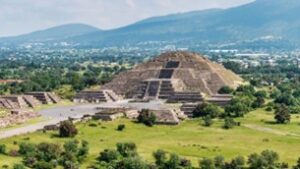 One of the purposes of this trip was for the Spanish 3 students to perfect their Spanish abilities even as they became acquainted with some of God’s people in Mexico. One particularly memorable day of interaction was a day trip to Teotihuacan (tay-oh-tee-wa’-kan). Teotihuacan is the site of two massive ancient pyramids that centered a city likely built by the Olmec civilization around AD 500. The city was taken over by the Aztecs in the 1400s, and at its zenith became the largest city in the Americas and the sixth largest in the world.
Although visitors are no longer allowed to climb the pyramid of the sun and the pyramid of the moon, they are an impressive and chilling sight to behold.
These pyramids were altars of a violent pagan civilization, and the child of God beholding them comes into contact with a blood-curdling paganism he otherwise knows only from the pages of Scripture. Both the Olmecs and the Aztecs repeatedly made human sacrifices. After archaeologists unearthed the road leading to the pyramids, they appropriately named it “the avenue of the dead;” lining both sides of the boulevard were thousands of human skulls.
The local church members in Mexico City hired a tour guide for our visit to the pyramids, a man who energetically and captivatingly told the story of what happened—sometimes daily—at the summit of these ghastly peaks. As he told it, a priest would lead a sacrificial victim—male, female, adult, or child—to the apex, where there was nothing between them and the clouds. The priest would then command the poor victim to stretch his arms out leaning slightly back, as if to offer himself to the sun. With a sharp obsidian knife, the priest would stab the victim in the chest below the ribs. While the offering was still very much alive, the priest would dive his hand into the slit, push his arm in to the elbow up under the rib cage, and pull out the beating heart, leaving the victim to drop dead. The priest would then hold the now vainly pumping muscle up to the sky, offering it as appeasement to the god del sol.
THE SEED OF RELIGION
John Calvin spoke of the sensus divinitatis (perception of God) that lies in the heart of every human being and of a “seed of religion” that is found in every culture on earth. Calvin said that if one searched the world over for total ignorance of God, “surely one was most likely to find an example of it among the more backward folk and those more remote from civilization. Yet, there is… no nation so barbarous…that they have not a deep- seated conviction that there is a god.” Furthermore, Calvin continued, if the atheists are put forward as evidence to the contrary, let it be known that they too “from time to time feel an inkling of what they desire not to believe.”1
But how vacant of grace is this understanding of God! Nowhere is the cross to be found! Apart from special revelation, men only know God’s eternal power and Godhead (Rom 1:20) and nothing of His redeeming work in Jesus Christ. How man corrupts even the limited knowledge of God he has! This sense of the divine degenerates in man as he suppresses and twists the truth (Rom 1:18, 23). Unregenerated, the pagan mind (whether Olmec or modern secular) is dark, leading him to worship the creature (whether the sun, or man himself) as though it is the creator. Professing wisdom, man apart from grace shows himself a fool (Rom. 1:22).
Yet not an entirely ignorant fool. In addition to a basic knowledge of the Lawgiver, man understands that there is divine law. The “work of the law” remains ever written on man’s heart (Rom. 2:15). This law is the law that was both written into God’s creation and was pressed upon Adam in the garden. It is the law that says, “Do this and live. Do not and die.” That law and its central message still presses itself upon every man born of fallen Adam so that he lives with a conscience preaching to him, “You have not done it, and you will die.” No matter how he tries to silence that conscience, and no matter how seared his conscience becomes, he cannot silence it utterly. For the law of God is not silenced, and the conscience is testimony within to the law and judgment of God without. Thus, on some level, every man faces the quandry, “How do I turn away His wrath?”
This all lies behind the Olmec priests offering their thousands, if not millions, of human sacrifices on the altar of the pyramid of the sun and the pyramid of the moon.
THE TRUTH OF THE GOSPEL
The wonder of the gospel is found in Scripture alone. The truth is that we cannot propitiate the wrath of God for our sins by ripping out our heart and giving it to Him or by working from the heart outward in our life to achieve the standard of righteousness. Only He can do either of these things. And the good news is that He has done both! God has fulfilled His own righteousness, has appeased His own wrath by offering His own sacrifice for the benefit of His people. “He that spared not his own Son, but delivered him up for us all, how shall he not with him also freely give us all things” (Rom. 8:32). He spared not His Son. He delivered Him up for us all! Desiring to reveal His glory by a wholly unmerited grace, God has in Christ become the priest and the sacrifice, even as He is the one propitiated. The Lord Jesus Christ gave His heart to God in His life by living a life of obedience. And the Lord Jesus Christ took the wrath of God into His heart to satisfy God’s justice against our sin. This is the uniqueness of Christianity. Every religion demands men find their own sacrifice to offer to God to propitiate His wrath. Christian truth makes known the God who offered His own sacrifice to propitiate His own wrath for man’s benefit.
A HOLY OFFERING
When our group came back to the Juan Calvino Seminary after the visit to the pyramids, we sat on benches in the atrium and talked about the experience. It did not take long for everyone to notice that what was etched into the benches at the seminary was a picture of a hand holding a heart up “to the sky,” offering it to God. This was no 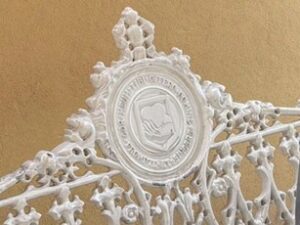 grotesque pagan symbol, however,some remnant of Olmec works-righteousness. It was in fact John Calvin’s own seal, surrounded by his motto, “My heart I offer to Thee, O Lord, promptly and sincerely.”
We discussed how different this offering of the heart is. An offering of gratitude for a finished work. An offering of love and devotion, not of terror. An offering out of life, not to achieve life.
HEARING THE LAW AND ITS SUMMARY
As believers, when we come to church and hear the law and the summary of the law bidding us to “love the Lord our God with all our heart, mind, soul, and strength,” what are we to make of what we are hearing? Lord willing, the pagan practice of the Olmecs contrasted with the seal of Calvin will help us pay close attention and understand what we are to be hearing and doing. We ought to hear the law and its summary in its first and third uses when we are gathered for corporate worship. The first use of the law is to expose our sin and drive us to the cross for hope. The third use of the law is as a guide for grateful holiness.
When we hear the law and listen for its first use, we ought to think of our sins and failures. We are as guilty by nature as the Olmec pagans, perhaps even more guilty, for we know better and we still sin. We ought then to think of the bondage and blindness of the Olmecs, ripping the physical heart out to offer it to god as a vain sacrifice to atone for sin. And we ought to flee to the cross where Christ gave Himself from the heart outward, in His life and death, both to make a full atonement and to impute to us His own righteousness. And we ought to rejoice in that gospel! Then, believing and relying on Christ in our hearts, we can hear the law also in its third use. With Calvin, we willingly offer our hearts right there in the service, promptly and sincerely in grateful love to the God of the gospel. Hearts that we offer as a living sacrifice, “rendering grateful returns of ardent love to him, who first manifested so great love towards [us]” (Canons of Dordt I.13).
1. Institutes of the Christian Religion, 1.3.1,2.



