

professor emeritus of Dogmatics and Old Testament in the Protestant Reformed Theological Seminary, and member of Southwest PRC in Wyoming, Michigan
INTRODUCTION
Suppose that you walked into a Jewish eatery in the Old Testament, let us say a Jewish Russ’ Restaurant in Nazareth. The noon specials might not strike you so much for what they were as much as for what they were not. There would be no BBQ pork or Reuben sandwich on the menu. There would be no shrimp salad. You would not be able to order a ham and cheese sandwich. And no ham and pea soup or clam chowder. None of these would be kosher dishes. None of them would be acceptable fare for an orthodox Jew.
In my last article on the Second Helvetic Confession, I covered the first several paragraphs of chapter 12, “Of the Law of God.” In that connection, I explained the distinction that the SHC makes between the ceremonial and the judicial, or civil laws of the Old Testament. In response to that article, I received an email from an interested reader inquiring where the dietary laws of the Old Testament fit. Should they be classified as ceremonial laws or as judicial (civil) laws? This is an interesting question, worth a response in the Standard Bearer.
Usually, the dietary laws are classified with the judicial laws, the laws governing Israel’s life as a nation. Admittedly, there is some overlap with the ceremonial laws, the laws that have to do with Israel’s worship of God. Many of the sacrifices, for example, involved eating portions of the sacrificial victims by the Israelites who brought the sacrifices and by the priests who offered the sacrifices. Jesus and His disciples, for example, ate the last Passover in the upper room on the night of His betrayal. But for the most part, the dietary laws have to do with the day-to-day life of the people of God in the Old Testament and, therefore, are considered judicial laws.
There are at least three incidents in Scripture in which the dietary laws come into play. The first of these concerns Daniel and his three friends in Daniel 1:3-16. This is a story familiar even to our small children. In the account, Daniel and his three friends refused to eat the “daily provision of the king’s meat, and of the wine which he drank” (v. 5). Daniel and his friends would not “defile” themselves, verse 8 says, with the king’s meat and drink. Instead, they requested of the prince of the eunuchs that he might give them “pulse to eat, and water to drink” (v. 12). There were undoubtedly two main reasons behind the request of the young Israelite princes. First, much of the king’s meat would have been “unclean” according to the dietary laws of the Old Testament. And second, the king’s meat and drink would almost certainly have been meat and drink offered to (blessed by) the idol gods of the Babylonians.
The second incident concerns Jesus’ disciples and is recorded in Mark 7:1-13. In this passage, the scribes and Pharisees fault Jesus’ disciples because they “eat bread with defiled, that is to say, with unwashen hands” (v. 2). Verses 3 and 4 explain: “For the Pharisees, and all the Jews, except they wash their hands oft, eat not, holding the tradition of the elders. And when they come from the market, except they wash, they eat not. And many other things there be, which they have received to hold, as the washing of cups, and pots, brazen vessels, and of tables.” The rationale of the Jewish leaders was that it was quite likely that some uncircumcised Gentile or ceremonially unclean Jew touched the produce or meat that had been purchased in the market. By coming into contact with that unclean food item, a Jew would become ceremonially unclean. This uncleanness was prevented by washing one’s hands after returning from the market and before cooking any food items. The concern of the Pharisees was not for hygiene. Their concern was for “the tradition of the elders” (v. 5), a tradition that was connected to the dietary laws of the Old Testament.
And the third incident involving the dietary laws of the Old Testament was the vision of Peter, recorded in Acts 10. This is another familiar incident, in which a sheet was let down from heaven three times. Contained in the sheet were “all manner of fourfooted beasts of the earth, and wild beasts, and creeping things, and fowls of the air” (v. 12), which were unclean according to Old Testament law. Three times this occurred and each time there was a voice from heaven, “Rise, Peter; kill, and eat.” Invariably, Peter’s response was, “Not so, Lord; for I have never eaten anything that is common or unclean” (v. 14). The Lord’s reply each time was, “What God hath cleansed, that call not thou common” (v. 15).
OLD TESTAMENT DIETARY LAWS—“KOSHER”
In the Old Testament, God specified foods that the children of Israel might eat, as well as foods that were off limits to them. The word that describes approved foods is “kosher.” The word “kosher” comes from a Hebrew word that means “fit, proper, or correct.” Merriam-Webster’s Dictionary and Thesaurus defines “kosher” as “ritually fit for use according to Jewish [dietary] law.” Although the word “kosher” is a modern word, not strictly speaking a biblical term, it describes accurately the laws concerning food that applied to the Old Testament people of God. Those laws are contained primarily in Leviticus 11 and Deuteronomy 12 and 14.
The dietary laws concerned especially meat. To a far lesser extent, they concerned beverages and cereals (grain), fruits, and vegetables. In the case of the latter, it was primarily a matter of how they were produced and prepared that determined whether they were kosher.
Although the Old Testament laws had to do mainly with what might and might not be eaten—clean versus unclean—the dietary laws were more extensive than that. They also specified how an animal was to be slaughtered and the care that was to be taken of the carcass after the animal was slaughtered. Ordinarily, an animal’s throat was to be slit with a sharp knife and it was to be thoroughly bled before its meat was to be eaten. “Only be sure that thou eat not the blood: for the blood is the life; and thou mayest not eat the life with the flesh. Thou shalt not eat it; thou shalt pour it upon the earth as water” (Deut. 12:23-24). Further, the laws extended to the cooking and preparation of the meat of the butchered animal. Meat was to be prepared in the right way if it was to be classified as kosher and edible for the Jews. The Old Testament law was, “Thou shalt not seethe a kid in his mother’s milk” (Deut. 14:21). “Seethe” means “to boil.” The prohibition of boiling a kid in its mother’s milk was applied broadly by the Jews to forbid cooking of any meat and dairy together, so no cheese over your burger. All kosher dishes had to separate dairy products from meat products.
DISTINGUISHING CLEAN FROM UNCLEAN
The Old Testament law carefully distinguished the clean animals from the unclean.
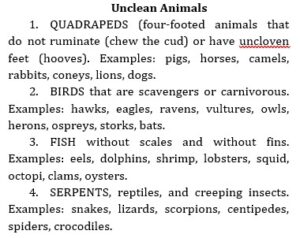
Why did God make a difference between the clean and unclean animals in the Old Testament? Why were some animals on the forbidden list and other animals placed on the list of animals permitted to be eaten?
One reason was God’s concern for the health of the children of Israel. That was especially the case in the heat of the land of Palestine and during a time when animals were not always raised in the best of conditions. Having created our bodies and the animals, God knows which animals are more likely to make us unwell and which animals are better for our health. Best of all are the cereals, fruits, vegetables, and nuts. Nevertheless, since the time of the flood, God has permitted man to eat certain animals. “Every moving thing that liveth shall be meat for you; even as the green herb have I given you all things. But flesh with the life thereof, which is the blood thereof, shall ye not eat” (Gen. 9:4-5).
God’s care for the health of His people contributed to the Old Testament distinction between the clean and unclean animals. Scavengers, for example, eat dead and rotten flesh, often infested with parasites. Pigs eat nearly anything. And pigs do not have sweat glands, which means that everything bad is stored in their fat. When you eat pork, you eat whatever they have eaten, which in a controlled environment and with modern feed mixtures is not a problem. But in the Old Testament it could have been. Shrimp, crabs, lobsters, crayfish, and other shellfish, besides being high in cholesterol, are bottom feeders. They eat decaying fish, dead matter, and garbage on the ocean floor. When you eat them, you are again eating everything that they have eaten. For the safety and health of His people, God set limits to the meats that they might eat.
But the second and main reason on account of which God made distinction between the clean and the unclean was for the spiritual health and wellbeing of His people. There is gospel significance to the dietary laws of the Old Testament. The distinction between clean and unclean highlights the antithesis. The dietary distinction was one way in which God impressed upon the children of Israel their calling to live antithetically. They were called to make the spiritual distinction in their lives between the clean and the unclean. Their calling was to reject and disassociate themselves from the unclean; their calling was to embrace and fellowship with the clean—the spiritually clean.
The apostle Paul makes this application of the dietary laws of the Old Testament in 2 Corinthians 6, where he warns God’s people, “Be ye not unequally yoked together with unbelievers: for what fellowship hath righteousness with unrighteousness? And what communion hath light with darkness? And what concord hath Christ with Belial? Or what part hath he that believeth with an infidel?” (vv. 14-15). From this he derives the calling, “Wherefore come out from among them, and be ye separate, saith the Lord, and touch not the unclean thing; and I will receive you.”
Notice that the apostle phrases the calling to live antithetically as not touching that which is unclean, which is a clear application of the Old Testament dietary laws. The people of God are to live spiritually separate from the wicked world, those who are unbelieving and ungodly, those who are living not for Christ but in service to Belial, that is, Satan. Based on the Word of God, Christians are to distinguish between clean and unclean. And the promise is: “And I will receive you, and will be a Father unto you, and ye shall be my sons and daughters, saith the Lord Almighty” (2 Cor. 6:17b-18).



