
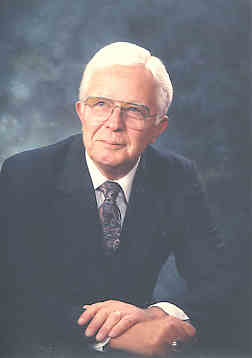
During the week of September 21 the undersigned sent his personal reply to the slanderous charges lodged against him personally and against the Committee for Protestant Reformed Action. With this reply went a letter, in which I requested that my defense be placed in Concordia, if necessary in two installments. In this letter I emphasized that the word limit on contributions could not rightfully be imposed against my article, seeing it was only just that Concordia should allow me full opportunity to defend myself against the evil charges lodged. I further requested that I receive an answer to this request on or before October 2, in order that I might know when my article would be placed.
To all this I received the following reply:
September 28, 1953
The Rev. H.C. Hoeksema,
Doon, Iowa.
Dear Rev. Hoeksema:
We received your note with the enclosure requesting that the enclosed material copy be published in our next Concordia. Having met and discussed the matter we have decided to express great reluctance to publish your material since we feel that it can hardly serve for the edification and true instruction of our readers. We feel strongly for what one brother wrote that “the last issue of the Standard Bearer evinced a spirit from Which we must completely escape or God cannot use us for the furtherance of the church-ingathering.” Since your proposed article is in the same spirit we prefer not to publish it and would strongly advise you to retract it.
If, however, you still feel that you must answer, above and beyond what has already appeared, we will have to remind you that your article far exceeds the 300 word limit for contributions; which limit was specifically noted just a few issues back. Hence your present article is much too long. Nor do we expect to prolong this matter and publish it over a series of numbers.
But again, to give you all the benefit of the doubt, we are willing to relax this rule for this time and offer you as much space as was taken by the Editor in his original writing on this matter. That was about 1200 words or the equivalent of 4 typewritten pages, double spaced. We feel that this is a very gracious concession on our part and affords you ample space for an answer. That means, of course, that your present article would have to be revised and cut down to about half its present length if we shall place it.
Finally, we must inform you that we could not place it before our issue of October 22, since our available space is taken until then. You should also understand that our Editor will have opportunity to add his comment and correction, if he so desires, and that will close discussion on this matter as far as Concordia is concerned.
Sincerely yours,
For Concordia,
(w.s.) W. Hofman,
I will not comment at length about this reply. Only the following remarks I want to make:
In the light of all the above, I wish to say the following:
1) There is only one course left open for me, namely, to place my reply in the Standard Bearer, in the hope that not all minds are closed to truth and justice (not the brand of Concordia and the Reformed Guardian).
2) Let our people be warned that Concordia is an anti-Protestant Reformed paper. By all means, read it, in order to keep posted on the views of the opposition. But do not support it. And do not believe it. It is not to be trusted.
3) I personally will have nothing to do with that paper any more, except to call upon its staff to repent of their evil way. They are plainly not devoted to the cause of the truth, either in doctrine or in ethics.
Here follows the original article in reply to Hofman. Concordia did not have the courtesy to return it, but I fortunately had the foresight to keep a carbon copy.
Rev. W. Hofman,
Editor of Concordia,
Orange City, Iowa
Dear Mr. Editor:
I had never intended to ask for space in Concordia after, through the unjust closing of its columns some time ago to the “condition debate”, it became principally a closed paper. But now, by your recent slanderous attack both against me personally and against the organization of which I am temporary chairman, you have made it necessary for me to seek space in your paper. And ethically you cannot now deny me as much space as is necessary to defend myself and the good name of the Committee for Protestant Reformed Action before Concordia’s readers. I have, therefore, every reason to expect that you will allow ample and prominent space in your columns for this answer, and to expect also that when I have made my defense you will retract your evil charges completely and humbly confess your heinous sin of lying and slander. For of such you are guilty.
By this time you are aware that your editorial has been attacked from other quarters, namely, by the Editor of the Standard Bearer, I have known for some time of the writing of that editorial, and for that reason I also refrained until this time from answering your vile charges, lest there should be unnecessary repetition. And because you should in all honesty take over said editorial of the Standard Bearer (Sept. 15) in full, I shall briefly cover those aspects of your article upon which the Editor of the Standard Bearer did not reflect at length.
And then I want to call attention, in the first place, to the ethical aspect of your article, and to some facts on this score of which your readers could not be aware. Your editorial constitutes a breach of ethics so horrible that even a worldly daily newspaper would scarcely become guilty of such a thing. You have publicly made charges and insinuations against a fellow minister (At that time he was your fellow minister, at least; by this time you have schismatically followed the Rev. H. De Wolf, and you are no more Protestant Reformed.) and against brethren in the church without ever approaching either that minister or those brethren personally. Never did you admonish me. Never did you say one word to me about anything connected with the organization of our committee. Never did you approach my consistory even, about this so-called “inkruiperij”. Never did you bother to ascertain whether you had the bare facts about our committee and its organization. All of a sudden, without warning, you break out into print with the most horrible charges and slander.
This I call absolutely unethical. It must be classed as belonging to “the proper works of the devil.”
Would it not have been proper on your part, if indeed I was actually guilty of interfering in another minister’s congregation unlawfully, to call my attention to this sin? Should you not have made plain to me my sin, and admonished me? And, in case I would not confess the sin with which you charge me, should you not have made the case pending with my consistory? My consistory, I am sure, would not have turned you away; they are honorable men, and upright officebearers, who will not tolerate any error in doctrine or in walk on the part of their minister. And if you had convinced them that their minister was walking in a sinful way, they would certainly have “taken their minister in hand.”
But all this you refused to do. Instead you gossiped with others, as is plain from your opening paragraph. It makes no difference to me who were in that “group” of you who were discussing these matters. You gossiped! And after you had gossiped, you published your old wives’ tales in a public paper, and that too in the name of harmony, concordia. Even if all your charges were true (and I shall show that they are false!),—but even if they were all true, you would still be guilty of backbiting, which is really as evil as slander. Did you never learn that if your brother has sinned against you, you must tell him his sin between thee and him alone?
What makes your doings all the more astounding is that you belong to those who have become known in our churches by their pleading for brotherly love and tolerance. Concordia’s very name speaks of such. And I recall distinctly that last spring at the home of the Rev. J.D. de Jong you personally spoke great boasting words about tolerating me and about the need of tolerance in Classis East. I contradicted you then. And now you have by your infamous editorial contradicted yourself. I have often been suspicious about this brand of brotherly love in recent years, for I have more than once experienced its activity. Now I am no more suspicious: I am convinced! To you, therefore, I say: Repent! To Concordia’s staff I say: It would have been better had Concordia never been born! And to all our people I sound the warning: Do not support such a slander sheet!
In the second place, your whole editorial is false. Many of the things which you state are down-right lies. And when occasionally you mention a fact,—and you have very few of them straight,—you twist and contort even the facts by all kinds of innuendo and insinuations, until even those few facts are slanderously turned against us. Let me prove this:
“As our name implies, we are and mean to be Protestant Reformed, first of all. We love our Protestant Reformed truth, and we want to maintain and preserve it, under God’s blessing.”
“Our name also implies that we mean to be active in this respect. And our activities will be directed toward:
“1. Bringing before our Protestant Reformed people the facts and the truth in the present church situation. We are doing this in the proposed mass meeting. We shall do this in the future by means of more meetings and by means of literature.
“2. Rallying all lovers of the Protestant Reformed truth behind our Standard Bearer. This cause seems to be languishing especially in this vicinity, and does not have the support it should have. Rut the Standard Bearer is still the bearer of our Protestant Reformed standard. And we would like to see more readers, more subscribers, and more financial support of it.
“We believe, however, that we do not stand alone, but that there are still many of our people who love the truth of God’s sovereign, unconditional grace, and who are willing to rally to its defense, and to the preservation of our Protestant Reformed cause. And we would like you to join us, and work along with us as a permanent organization.”
All this you ignored. If you saw fit to attack our committee as subversive, you should have proved that we did not live up to our name and our avowed purpose. You should have proved, for example, that we did not bring before our people the facts and the truth in the present church situation. There are some of your friends, the Rev. A. Cammenga and the Rev. H. De Wolf, who have a tape recording of that mass meeting in Hull. You can undoubtedly gain access to it from them; and if not from them, from me. I would like to have you prove black on white, with full opportunity for debate and cross-examination, that at that mass meeting the Rev. H. Hoeksema did not present the facts and the truth in the present church situation. Furthermore, I would like to have you show what is subversive about rallying our people to the support of the Standard Bearer, and that too, publicly. In the third place, I would like to have you prove what is subversive about inviting people to join us and to work along with us as a permanent organization and to rally to the defense of the truth of God’s sovereign, unconditional grace and the preservation of our Protestant Reformed cause. These things you cannot prove. Nor can you point to a single instance in which we did not act in accord with that purpose. But you have ignored all this wilfully.
Instead you have slandered us without a cause. Is it because we differ as to what is Protestant Reformed and who is Protestant Reformed? Is it because you did not want the facts and the truth to be published, lest the eyes of many here in the West should be opened? Is it because you hate and oppose the Standard Bearer without a cause? I fear you must be numbered among such, Rev. Hofman. And I say once again: Repent, before God and His church! Repent!
a) It is not true, as you would make men believe, that this committee was conceived of by me and organised through my efforts. The very first sentence of our letter states otherwise: “The idea of the mass meeting and the beginning of this committee arose in the minds of some of our men just recently….” I am very glad that I was one of those men. And I am happy to this day that I could aid them in the organization of this committee. But anyone who knows me and is acquainted with my labors will testify that I am not one who believes in one-man rule or in domination of the organic life of the church by the “dominie”. Furthermore, I did not even have a vote in the organization of the committee, for as chairman I refrained from voting, and allowed the majority to decide things freely, after full discussion.
b) You cannot even present my name correctly. I suppose you will claim that you wanted to distinguish me from “the old Rev. Hoeksema.” But the fact is that names themselves are for the purpose of distinguishing. And neither the names, nor the initials, nor the place of residence (I live in Doon, Iowa, not Grand Rapids, Michigan) are the same in this case. You might very well, of course, have used my first name, especially in the light of the fact that for years we were neighbors in Grand Rapids, and knew each other as “Homer” and “Wally”. But that’s all right, Reverend: I have never yet been ashamed that my name is Hoeksema; and in good conscience I can say that I strive to heed Paul’s admonition to Timothy, “Let no man despise thy youth; but be thou an example of the believers, in word, in conversation, in charity, in spirit, in faith, in purity.” I Tim. 4:12.
c) You speak of our insinuations and of out sowing seeds of distrust and suspicion. Again, you offer absolutely no proof. Indeed, we recognized the fact that there were some with whom we could not agree concerning affairs ecclesiastical. We realized too that we constituted a minority in the churches of this area. We realized long ago that we could not any more expect righteousness and truth from Classis West and from most of its constituent consistories. We expected, in the light of past history, that the people would not be given the bare facts of the church situation and be allowed to decide for themselves. And so, as was our perfect right, and because you and others had given occasion for distrust and suspicion long ago, we organized a free committee and are organizing a free society to further our purposes announced above. I would still say, after you apologize for all this slander: If you are Protestant Reformed; if you agree with our announced aims; join our society!
d) You speak of the delegates being gathered through “various and devious means.” Let me tell you something. They were gathered through one means. We asked men point blank if they were willing to come. And we asked men to bring one or two others along with them if possible. Anyone was free to decline. And some did decline to come. Nothing devious about it. I believe in going straight to the point.
e) You speak of the fact that no ministers were invited or even informed of this meeting, except myself. You add that no consistories were informed or notified. You know very well, of course, that ours is a free organization, not under the jurisdiction of the church institute. You know too why no other ministers were invited, and you yourself have recently proved this by your schismatic action at Classis West and in your own consistory. Did you think we were blind? Did you think we were going to allow the enemy to infiltrate our society just as he has infiltrated many of our churches?
f) But you are amiss once more when you say that we acted secretly or slyly. All our doings were published, by bulletin announcement and by letter, both concerning the mass meeting and concerning our organization. We had absolutely nothing to hide. In fact, we did not want to hide it, but rather to publish it far and wide. If you were in doubt about the bulletin announcement (your own elder, Mr. Hoekstra, was not), you could consult your consistory, as some did. If you are in doubt about our committee, you may still at this late date have a copy of all our minutes. But I will not ask you for any “minutes” of your meetings (plural) with other ministers from East and West, meetings to which I was not invited.
I expect, of course, that all your discussions were honorable. For even as editor of a public paper you try to be “fair and honest.”
g) Your fourth paragraph reveals the untrustworthy character of gossip. You refer, of course, to Edgerton in these lines. But let me set you straight. The Rev. H.C. Hoeksema did not make a few personal calls upon certain sheep in that flock, as you write. The story is this. The Reverend and Mrs. (my wife likes to go visiting with me) H.C. Hoeksema visited Mr. and Mrs. Henry Huisken, upon the latter’s invitation, not as sheep in Edgerton’s flock, but as respected personal friends. That is far from onderhruiperij, is it not? I performed no pastoral labors. In fact, I was not even present in any official capacity. And I was under no obligation to inform Edgerton’s minister of our visit, any more that you were when you visited members of my flock last May after you had preached in Doon. Let me warn you, Reverend Hofman: it is fatal to give heed to old wives’ tales!
Sometime, Rev. Hofman, I would like to have you meet a group of consecrated, faithful, and militant Protestant Reformed men! I would like to have you meet the members of our committee and our society for Protestant Reformed Action. Well might you wish you were among them.
But before you can join them, you must repent and confess! May God give you grace to do it, is my prayer.
Rev. H.C. Hoeksema

